
soldiers affixed to wall, MIT's Infinite Corridor, 12.14.2011
This morning I went to the free lessons provided to members of the MIT Figure Skating Club, which I joined this year. The teaching is professional and attentive, and groups are small. Weekly attendance varies, though, and there is sub-par continuity.
Today Esther, the club founder, announced the start of lessons at 9:30am, and she directed absolute beginners to one teacher, beginners to another, the “somewhere between beginners and intermediate” to two teachers working together, and the intermediate to the fifth teacher. I swizzled over to the group with a lot of room for in between, where I consider myself.
The two teachers for that group, Susan and Alex, suggest we divide into two sub-groups: “If you can do the backwards crossovers well, skate with Susan. If you’re still working on them, skate with Alex.” I skated over to Alex’s circle. We warmed up by practicing forward moves around our circle.
At Alex’s signal, we switched to backwards crossovers. I practiced haltingly, stopped to watch the others, practiced some more, and watched some more. I looked over occasionally to Susan’s circle, too, to watch their attempts. (Often I can learn as much from my slightly better peers as I do from the instructor.)
Here’s one thing I noticed: every single skater, but for two in Alex’s group, was struggling with the crossovers in some way. The self-selection into groups, therefore, was according to a criterion that could be too loosely interpreted (if you can do moves “well” versus “still working on them”). Except for the two skaters who had (wrongly) sorted themselves into Alex’s group and who could do the backwards crossovers very well, we were all still learning, practicing, working.
Nothing bad came of this. We all got excellent instruction, including 1:1 coaching, and plenty of practice time. Still, perhaps the self-sorting could have gone better if Susan had said, “Skate with me if you can do the backwards crossovers in a fluid motion and are now working on the second push; skate with Alex if you haven’t gotten to the second push yet.”
This is recreational skating, so there is little at stake. However, think about how this happens in other educational contexts or at work. People are asked to volunteer if they are (self) perceived as “good” at something. “If you can draw, sign up for the graphic design committee,” or “If you have leadership experience, we need some committee heads,” or “If you’ve finished the homework, come work with your classmates who haven’t.” In every case, it’s possible that some not-very-qualified people who overestimate their own ability will end up in a high stakes position in which they’ll flounder. It’s also true that some very-qualified-yet-humble people will not volunteer for a role in which they could make a huge contribution to the group.
Last semester, for example, in one of the classes I teach in with students organized into project teams, I said to a student whose work I had seen, “We need you for the presentation slides. You have a sharp eye and a real sense of visual design.”
“Me?” she balked. “Oh, I just learned this stuff in a class last year.”
“Yeah, but it’s good.”
“Oh, I don’t know,” she continued to protest.
Another student chimed in: “I’m good at graphic design. I’ll do it.”
The team elected the second student, who chimed in with great self-assurance, to design their presentation. It turned out fine; it was workmanlike. But did it pop? No.
This is an age-old problem: the egotistical will typically overestimate their abilities and the modest will underestimate (or under represent) them. As teachers or administrators, though, we must come up with more precise language and criteria to improve self-selection. We could also ask for examples and demonstrated skills.

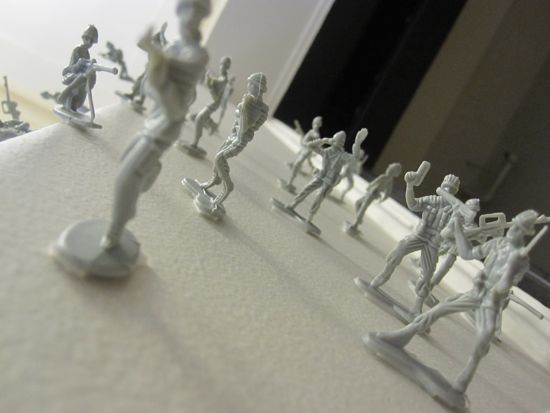
more toy soldiers on wall, MIT's Infinite Corridor, 12.14.2011
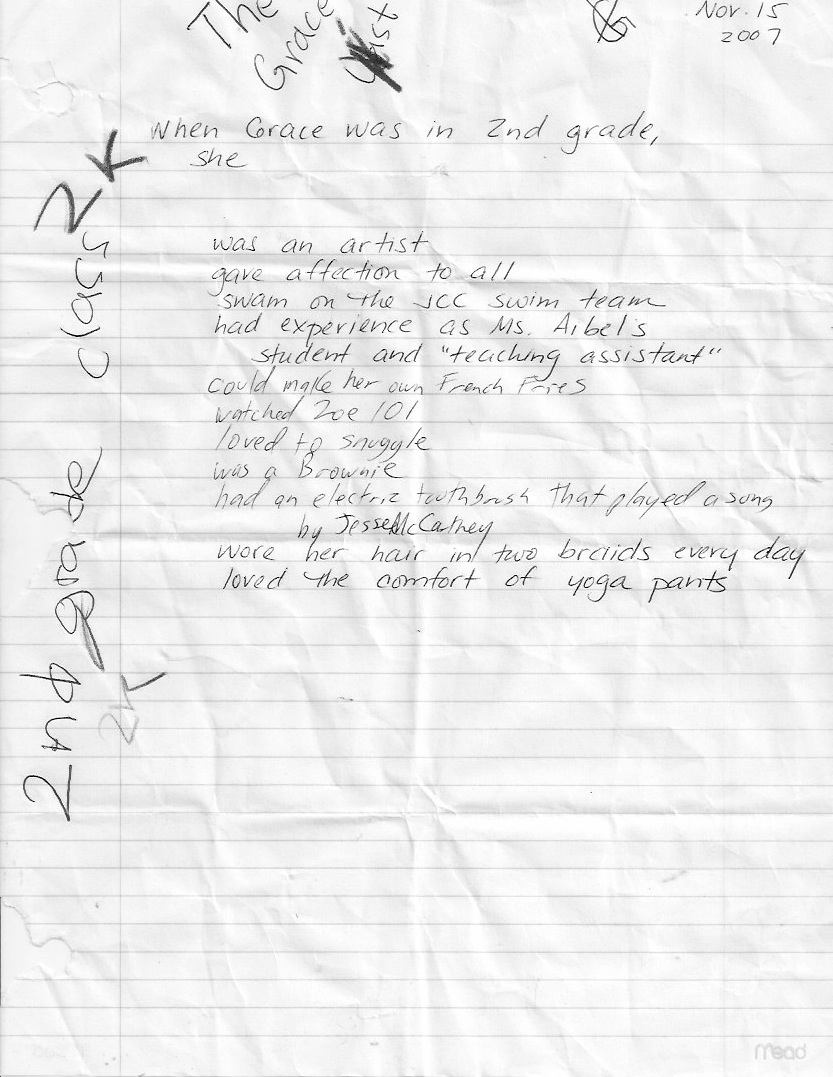 Grace and I have been bitten by the organizing bug, and we are culling our collections. I took four boxes marked “Jane’s Junk” and got them down to one, and Grace has stripped her closet down to the essentials and tackled her desk drawers. Last night she came across a list made five years ago when she was in the second grade. Knowing I like to save the textual artifacts of childhood, Grace handed it to me. You can click on the thumbnail to see the scanned version in full size or read the transcript below.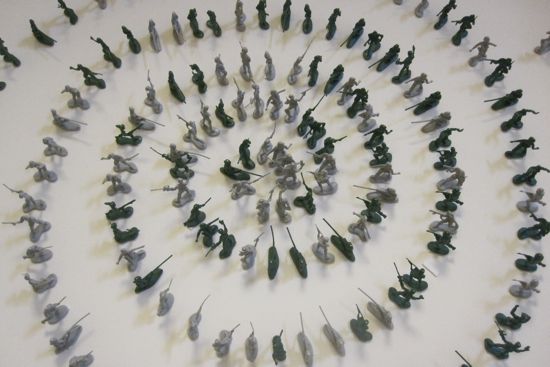





 leaf stitch word