More grading goes on at my kitchen table than eating. And more of my teaching goes on behind-the-scenes than in front of students. The yeoman’s work of draft commenting may take 10 hours for every 1 hour I am actually in the classroom. Yes, sometimes it is lonely. One comfort: my new favorite pen.
teach
Space carved out
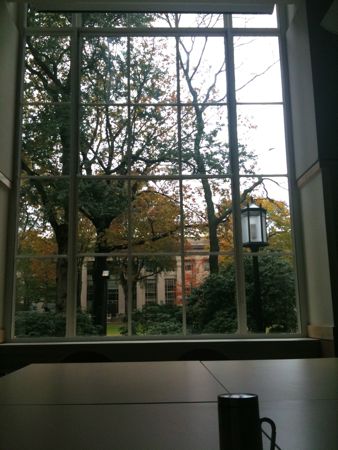
It was Wednesday, one hour squashed between other hours and another appointment in a week filled with appointments. In the room, I and my ESL student, whose name is Karma, worked side-by-side on our own copies of the reading. The door to the hallway was closed. Through the wall, we heard a muted piano and, etched on top of that sound, a soprano voice. I counted 12 chairs around the table in our tiny room, and a chalkboard filled one wall and a window another.
This was silence. This was luck. This was like the world saying, Be here now.
The hour was long enough.
How to work a cocktail party like a tutor
Last night Jimmy and I went to what’s called a drinks party and, to our relief, enjoyed ourselves. I realized later, after several good conversations, that what makes me an effective tutor can help me get through challenging social situations. Or vice versa.
Why are cocktail parties challenging? I mean, I may not be attention-hungry, but I’m not shy. Here’s the problem: so many people, no defined role for me, and no structure.
If those are the conditions — and they are for most parties, except for baby showers which are usually rather annoyingly structured around “games” (and those are intentional quotation marks) — then a person must have a strategy for dealing with the conditions. Otherwise, the impulse is to hide in a corner with the one person you know, clinging to that corner as though it were a berth and you a little boat afraid of being battered by the open sea.
And just as the secret to being a good tutor does not involve being drunk on the task, the seven secrets to party-going success that follow do not involve drinking half the bottle in the first 10 minutes. Continue reading
The continuum
Sunday night, I couldn’t sleep. I stayed up late to work, one in a long string of staying-up-late nights, and then I couldn’t let go. For two hours I lay in bed and ruminated over the papers I had stayed up to review. Not wanting to fret about insomnia (which only exacerbates insomnia), I occasionally said to myself, “It’s okay. At least I’m resting my body.”
At 3am, I moved to the couch. I noticed the many ways the lights from the street made their way into the room. I bunched a feather pillow under my head and replayed a couple of weeks of work in my head. And then I thought about the weeks ahead. In no way was I worried or panicking. It was simply as though my brain continued to develop and work on problems even as my body lay there immobile.
At 4:30am, with the same loop of images still playing in my head, I thought to myself: “I am mentally ill.” No, really. It occurred to me that this is what people mean by obsessive thoughts. Leave it to me to have them about drafts, and colleagues, and presentations, and this student and that one, and even that pile of folders on my desk that I keep meaning to put in the shredder bin.
“Ah, no. Not mentally ill,” I thought. “Just fucked up.” I did have enough awareness to step outside myself a bit, look at my thoughts, and recognize how unproductive they are. I wasn’t able to quiet them, but I could reality-test them.
Years ago, my friend Betsy told me and our small circle of friends about the mentally ill/fucked up continuum. This is not unlike the sexuality continuum, although M.I. and F.U. have nothing to do with a person’s sexual identity. Essentially, we are each of us M.I. or F.U., and there are gradations between. Continue reading
A is for awesome.
Lydia and I were talking about school, hers and mine. We considered motivation, and what fires people up to be and do the best they can. She told me about her high school history teacher and an upcoming presentation assignment that Lydia wants to nail. In part, she is motivated by the teacher’s rubric:
A equals awesome.
B is not bad.
C is meh.
D is “Um…”
Lydia is aiming for “awesome.” I would go pretty far, too, for an authentic awesome. And if on the first draft I got a meh, I might laugh at the teacher’s humor, figure out what to do, and keep trying.
—–
Photograph of the CN Tower, Toronto, August 2010.
Rethinking the red pen
Grace promised to loan me a fine point pen with which to mark a stack of summaries. I opened her pencil case and found only a red one.
“I need a black one. All you have is red?”
“Yeah.” Grace, who sat across a table piled high with her homework and mine, looked at me quizzically.
“I can’t write on my students’ work with red ink.”
“Sure you can,” said Grace. “And, why not?”
“Well, because the red pen is perceived as… harsh, um, kind of censoring. A pencil, or even a green pen, seems kinder.”
Grace got that Mom, You’re a Lunatic look on her face. “I wouldn’t mind the red pen.”
“You wouldn’t?”
She sighed. “If I used perfect penmanship to write something, and then the teacher wrote on it with red pen and messy handwriting, that would be bad and probably hurt my feelings. But if the teacher has nice handwriting like you, Mom, and wrote carefully with a red pen on top of a student’s nice work, I wouldn’t mind.” Continue reading
Unpretty potatoes and their lessons
There are beautiful ideas, and there is reality.
I learned this from a tutor I was training, several years ago, when I worked in the Simmons College writing program. Her name was Kristin, and she told our group about a time she absolutely could not write a paper, although she had “written it in her head,” and it was perfect. So she went to her professor, and she told him about this perfect, imagined paper and how she was unable to write it. He said to her, “All you have now is a beautiful idea. And beautiful ideas are not writing.” He handed her a lined, yellow pad of paper and looked at the clock. “I’ll be back in two hours. Write,” he said. Kristin sat at a desk in the hallway and wrote. And what she produced was less perfect than what she imagined producing, and yet it was real. The words existed in the world and did not merely float in her head. “There,” the professor said. And the paper turned out to be neither good nor bad, Kristin told us.
If a creative person has high hopes for her work, she must learn to tolerate the gap between the idea and its manifestation.
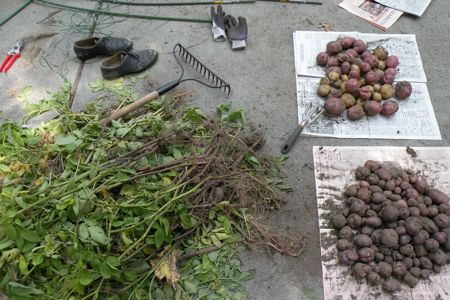
Yesterday I completely harvested my first crop of potatoes. I waited for the soil to dry from a previous rain, and then I clawed around each plant, exposing the stalks to the first potato. One at a time I grasped the plant down near the exposed soil line and pulled gently and with a little vibration, as though wiggling a tooth out. I piled up the stalks on the driveway. I piled up the potatoes — gold, red, and purple — on dry newspaper. My dark shirt absorbed the sun and my scapula were like hot wings. Continue reading
Road not taken
While a junior at Wellesley College, I developed a crush on my not-young history professor. These things happen all the time in education — students falling for professors, and sometimes the inverse too — and perhaps even more so in single-sex environments.
It turns out I was more comfortable with my fantasies of conducting a romance with him than I was with the reality. During a moment in his office, it seemed as though Professor Zimmer (a pseudonym) was offering me an invitation, and I, out of good sense or fear or both, turned away.
That was the end of our story, but not the end of the story for me. The crush and the offer and his later, early death have taken root in my imagination, and again and again in my life I have pulled them out to consider them. About the place of this memory in my life I wrote an essay, “Dead and Gone.” The moment when the flimsiness of the crush encounters the cold fist of reality is described here:
The room was still, my body pinned in the chair and in space. Without moving my eyes, I watched the dust sparkle again in the air between us, and I looked at him and I did not look away. This was a test, and I wanted to pass it.
The office was his, and the silence was his to disrupt. “You know, if you ever want to talk about your major, or the class, we could meet again. In the afternoon, or later. We could even go get a beer.” There was a pause. “Sometimes I’m free in the evening.” And he looked at me without looking away.
I felt as though I was being dared: dared to be the object of attention, dared to interpret his offer, dared to say, Yes, I’d love to. I sat there, pinned and thinking. And the big billboard of my romantic fantasy gave way and fell into pieces. I saw us meeting in the parking lot near the town grocery store after dark, and him pulling up in the kind of old Volvo that all the professors drove and pushing open the passenger side door and me getting in, and me ducking down below the dash so nobody could see me as we drove and drove and drove away from town to somewhere he would take us. And on the floor of this car I saw all the crap that’s always on the floor of these cars, because as a babysitter for other professors and their children I had driven these cars and ferried children not my own around town in them, and I recognized the bits of cereal and plastic lunch baggies and receipts and the discarded envelopes of mail opened in the car and the gloves and winter grit and the floor mats askew. And I had plenty of time to study this stuff on the floor because my head was tucked down, and there was no view out the window for me, because I was hiding — he was hiding me — and this, I suddenly saw, is how our time together outside of school would be.
“Thank you,” was all I could say out loud. I had no words for whether I would consider history or not, meeting or not, because suddenly I knew that all I wanted was to remove myself from what would only, it seemed then, become sordid. Old car, old motel room in some other town, old dirt.
A few of my readers have seen this essay in draft, and their feedback and encouragement helped shape it. Thank you again.
—-
Photograph, “Volvo Dashboard,” by Jean Pichot on flickr via creativecommons.org
– Audience problems
Not having an audience is a problem.
Having an indifferent audience can present another problem, especially if you are speaking in front of them. Try lecturing to sleepy students at 2 o’clock in the afternoon sometime. Watch those eyelids flutter.
Misunderstanding the audience can lead to their disappointment, or even your own. When I was in nonprofit development, I spoke at the First Annual Conference on Black Philanthropy, and watched half my audience walk out of the room one at a time because I had completely failed to understand the cultural values shared by most of the people in the room who were not me.
Yesterday, in working with a 13 year old writer, I was reminded of an audience problem that affects, especially, writers of creative nonfiction and memoir. And that problem is knowing an audience too well.
This writer, whom I’ll call Justin, is writing a personal narrative that will be developed into a 3-minute digital story, with voice over and music tracks, and photographs from his own collection. Justin is one of several teens in a local community center involved in making digital stories through my friend Lisa’s business, Storybuilders. His story mentions his mom, siblings, and, most notably, his teacher. The most striking detail in Justin’s notes for the story, in fact, involves the teacher and how she disciplines her students when they’re distracted: she spritzes them with a water bottle. Continue reading
– Bingeing on sticky notes
“Post-it® notes came out when I was in college.” I mentioned this to a group of students as I was passing out stacks of the colored sticky notes, along with a Ziploc® bag full of Sharpie® markers: tools for an article annotation and mapping exercise.
I continued, “In fact, I recall my friend Jeanne buying a pack — they only came in yellow at the time — and her marveling to me at their coolness. Secretly, I was thinking that the little pad with adhesive strips was about the stupidest invention ever: Don’t paper and a piece of tape do a sufficient job?”
How wrong I was, I concluded. “It’s hard to imagine school life today without sticky notes.”
Teachers, not just students, need sticky notes too. In the past few weeks I’ve been thinking through and organizing a presentation, for the WAC International Conference, on “The Professional Poster Session and Its Simulation in the Undergraduate Setting.” I interviewed four PhD students on their first experience as poster presenters at professional conferences in their disciplines, and I had about 80 pages of interview transcripts. That’s a lot of material to boil down into an interesting 15 min and 12 slide talk. So, I decided to walk my own talk, get out the sticky notes and markers, clear off the kitchen table, and sit down and sketch first… with words. Continue reading