– Feedback season

Wite OutWhen it’s midterms for students, it’s midterms for teachers. (There’s something rather binge-and-purge about school, isn’t there?) In the past two weeks, since Columbus Day, I’ve been reading, commenting on, and grading the drafts of technical reports and scientific analysis papers, about 35 altogether. They’re long (average: 20 pages), but after the first few in a batch, I get into a rhythm. And while I don’t copy and paste comments from one report into another, I do notice similar issues and may make similar comments among reports.

I don’t claim any of the following lines as poetry. Here are some of the kinds of things I write or type in the margins. Continue reading

– Presentation of self

Hide450

Once in a while, if someone knows or notices that I wear an insulin pump, that person says to me, “Don’t you love it?”, gushing on the word love.

This happened to me recently, during my annual check-up. I was sitting on the table with a paper gown wrapped around me and talking to my doctor, whom I like, and the medical student who was observing. It was my doctor who asked the question and gushed on “love.” Clearly, even though it was an endocrinologist and not she who had prescribed it for me, she considered the pump a marvel. As miniature devices go, this one is indeed remarkable in what it can do.

Because she is a doctor, and because I feel able to speak frankly to her, I replied honestly: “No.”

Dr. H.’s lips pressed together and then broadened into a smile, which I took as a signal: Go on.

I elaborated.  “Sure, I appreciate the technology, and it’s more convenient than multiple injections, but, no. Loving it would be like being an amputee and loving a cool prosthetic leg, when what I want is my real leg.” Continue reading

– The anonymous they

Crowd blurToday I heard students discussing feedback that their team had received from a few instructors on a presentation. The students’ sentences uniformly began with the pronoun “they.”

They liked [such and such].

They said [so and so].

They didn’t like [such and such].

After several of those sentences, the “they” became a blur, and, even though I had a sense of who those instructor/feedback-givers were, it all started to feel vague to me. The actors — the givers or performers of the feedback — were made anonymous by the use of the nonspecific, plural pronoun.

I don’t want to shake my finger at the students. Indeed, I’ve heard teachers use the same pronoun to the same effect, referring over and over to an anonymous conglomerate of students as “they.”

They don’t do [such and such].

They seem to like [this or that].

They want [more].

This usage cloaks the identity or characteristics of individuals in a particular group. “They” also indicates that a group is not “we.”

And so, by designating an anonymous and even homogeneous them, we somehow reinforce the unity and presence of our us. There’s an implicit binary.

I have noticed that this tendency to invoke an anonymous “they” is not restricted to the realm of education. For example, after the dot-com bubble crash, I would sometimes hear people, still in great pain from having lost money and hope, rail against the violations of an anonymous They. They did this. All they wanted was that. They never told us that [something bad] could happen.

“They” is a very useful pronoun. It effectively and succinctly signifies a large group of others (in fewer letters than “large group,” or “the regulators,” or “the instructors,” or “the students in my intro psych class”), a group somehow distinct from our group. I do not think we should or even can eliminate the word from our speech.

However, when I catch myself using the pronoun “they,” I do wonder what experience or characteristics I’m trying to distance myself, and my peers, from. That’s what this use of “they” does — creates distance.

What does that distance offer us?

—–

Image “Liverpool Street station crowd blur” by victoriapeckham on Flickr. License via Creative Commons.

– Explicit teaching

In the first few moments of her three-day workshop, Supporting Reading Comprehension, Writing, and Study Skills at the Landmark College Institute, Linda Hecker prompted participants (I was one of five) to introduce ourselves and say why we came.

When it was my turn, I answered that I wanted to learn and develop more explicit teaching methods, to help not only my students with learning disabilities, but all students I work with. We were invited to tell the story of a student, and I talked about A., who, when I very clearly proposed to him an alternative structure for his paper, said to me: “I understand what you mean, but I don’t know how to do what you’re saying.” I’d like to know, I said to Linda and the group, how to teach better those students who don’t intuitively know all the little steps involved in tackling a big writing task. What’s involved, for example, in summarizing a passage or chapter? I know how to summarize — but do I know how to teach the same skill?

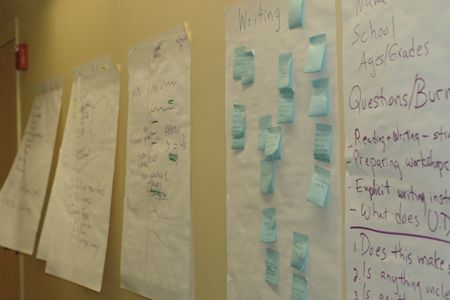
wall_postits

In the workshop, I did learn a strategy for teaching the summary, and picked up a few tools as well. Landmark emphasizes multimodal teaching, which engages a student aurally, visually, and kinesthetically in learning.  Even though their faculty have developed this kind of teaching to reach students with learning disabilities and AD/HD, this pedagogy is applicable to all learners.

Indeed, after three days at Landmark, I wanted to try out some of these exercises and tools not only on students, but on my own reading and writing practices. They’re more than effective — they seem motivating and, dare I say, fun.

What follows here is a select list of some of the ideas, remarks, readings, tools, and websites that seemed most immediately interesting to me. Certainly, there was more. It was a great experience, and, if you teach, I recommend that you go. Continue reading

– Uneasy nostalgia

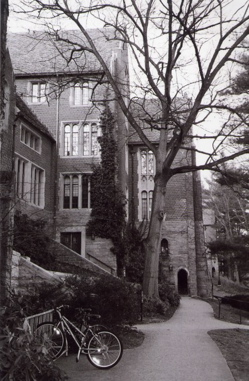
Outside Founders Hall

Outside Founders Hall

I finished writing and revising “Dead and Gone,” and I sent the essay off to editors of a journal who asked to see more of my work. One editor e-mailed me back today, confirming its receipt. All I can do now is wait.

A few readers and friends have asked about the incident central to the essay: a meeting between my Wellesley College professor and me.

That scene, which is the last bit from the essay I’ll post, is at the center of the story. It’s what I most recall about the professor and  our acquaintance, and it’s what I have turned over and over in my mind as I have considered my college years (1983 – 1987) and what the encounter has meant to me.

Curious? Continue reading

– Evidence

Last summer I started and made substantial progress on a draft of a memoir/essay about having a crush on one of my Wellesley College professors, *not* having an affair with him, and reading many years later of his death from prostate cancer. A first excerpt is here, and another one is here. (There’s also a reflection on writing the essay here.)

Then, I put the essay aside for the winter and did other things and wrote other pieces as well as lots of comments on student work.

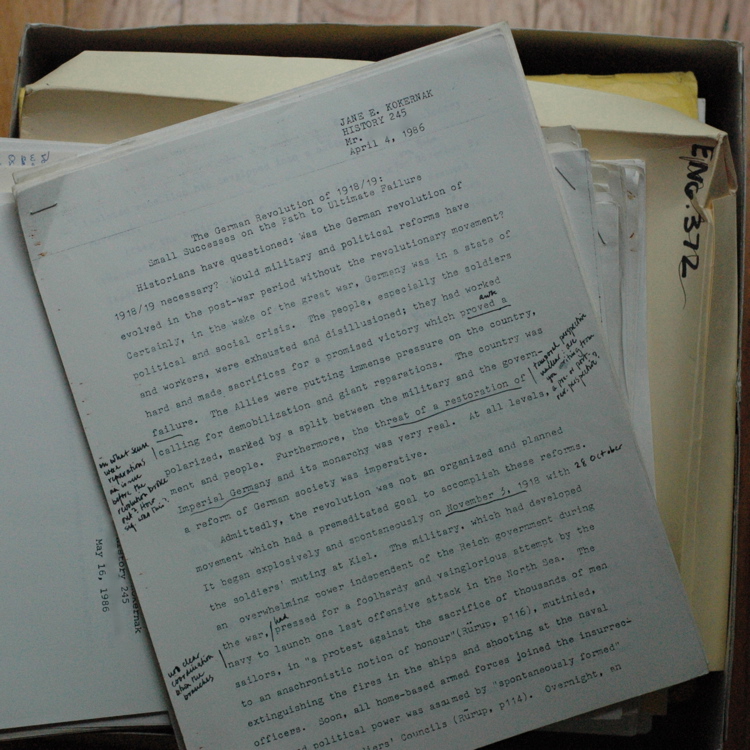
Archives750RetouchedResolved to finish the draft, I picked it up again a couple of weeks ago. I hit a snag when I felt I had exhausted my memory of that time in college. Searching for something concrete, I opened up my college archives (a green cardboard box) and found three papers I wrote for that professor.

Ah, evidence. It helps. In writing about those papers and his comments, I found my way back into the essay and finished the draft. It’s funny how artifacts function, however. While they are more lasting and stable than memory, our interpretation of them is often — usually — slippery.

Excerpt #3, “Dead and Gone (draft)”:

All that I have left from Mr. K’s class (History 245) are three papers I wrote, typed, handed in, and got back with his handwritten feedback and grade. These are my only concrete artifacts of my time in that course. Who knows, though? Maybe in the College Archives, or in his own papers, there are records of that course from that semester: a syllabus, a grade book, his own notes if he kept them. (All teachers must keep some sort of notes.) But this is all I have and all I’m willing to put my hands on. Continue reading

– Sunflower folly

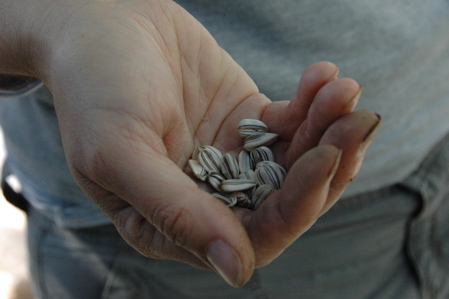
This is what hope looks like.

Seeds in hand
During a spring semester clouded by the recession and my own economic downturn, I forced myself to take on tasks that were both optimistic and doable. I tended to my students and their work; I cultivated ties to colleagues and friends; I hoed the already neat rows of my resume; and I scattered queries for teaching jobs.

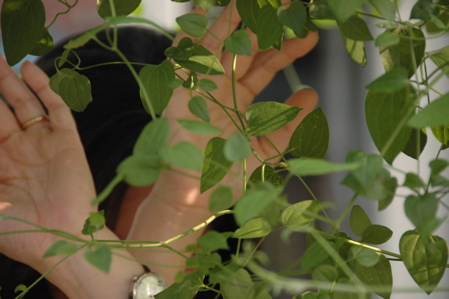
And I planted sunflowers, a huge patch of them. A “folly,” it’s called. In the midst of the sober and the sensible, I had to do something dramatic, quirky, and above all possible. I mean, sunflowers I can grow. (So can you.)

Along with my helpers Grace, Jimmy, and George, I stuck those seeds in the dirt only 10 days ago, on May 10th. It’s too soon to tell whether the folly will be a success. Amazingly, however, there has been an unexpected bounty on the teaching front: I’ve been rehired, as funding to the MIT writing program has been restored for the coming year.

And I am so… HAPPY! I feel the way I expect those sunflowers to make me feel when they bloom in August.

There’s still time for you to plant your own sunflower folly, according to the tutorial that starts below. The original concept can be found in Katherine Whiteside’s The Way We Garden Now (an excellent, unfussy, and imaginative garden project book, by the way). Variations are by me. Continue reading

– Accentuate the positive

This week at MIT could be called “Presentations Galore.” In many classrooms, lecture halls, and meeting spaces, day and night, students are making formal presentations to their peers, profs, and even parents, if they want to invite them. My colleagues and I who are communications lecturers have been overseeing a lot of the behind-the-scenes rehearsals and being first audiences for draft presentations. We reserve practice rooms, lug laptops and projectors, cue students, ask questions, offer feedback, articulate our puzzlement, troubleshoot PowerPoint, watch the clock, talk through nerves, and inspire confidence.

And on the big day, the best thing we can do, besides be attentive members of the audience, is root for them, like devoted sports fans. Students do better when they sense our belief in them. They can borrow our positive energy.

So, I sent my presenters an e-mail yesterday morning, just a few hours before showtime. I wanted the message to be practical, positive, and sincere:

Dear [student names]:

I really enjoyed working with you on your draft presentations. I have
learned soooo much from your teams this semester, and I look forward to today’s showcase of your work.

Here is some preparation advice that is most relevant on the day of:

–Drink water. (If your mouth and voice are comfortable, you will feel more comfortable *and* confident.) Bring some with you, so you can keep sipping up until your showtime.

–Breathe. (Some deliberate breathing, in the five minutes before you go on, really helps with gaining your poise.)

–Pick a personally relevant, positive message. (Like, “I will reach my
audience,” or “I will enjoy this,” or, like an athlete, “I’m winning this
thing.” Once, before a good presentation, I said this to myself: “I own this stage.” This seems corny, but, honestly, it WORKS.)

And remember… your audience is interested in your project, and your friends and peers are rooting for you!

All good thoughts,

Jane

Thanks to my friend, Jan, who sometimes signs her notes, “All good thoughts,” which makes me, the recipient, feel as though she’s sending some good vibes my way. And if you want to hear Bing Crosby and the Andrews Sisters sing “Accentuate the Positive” (1944), you could watch this scene from The Singing Detective on YouTube.

– What they teach us

On Wednesday afternoon, I went to capstone presentations by students graduating from Mount Ida College, where I used to teach and run the writing center. Events like these seem more a measure of educational outcomes than any standardized test or GPA could ever be. The students were poised, engaged, knowledgeable, professional, and comfortable discussing both theory and its application to experience. Wow.

I really, really went to see Sarah Elliott, who worked with me in the writing center. In her capstone poster and remarks, Sarah described her year-long practicum at the Italian Home for Children in Jamaica Plain, working 1:1 with traumatized children, one in particular.

At some point, someone in the audience asked Sarah and her peers, “What did you learn about yourself through your work with your clients?”

I loved Sarah’s answer, and I wrote it down on the spot:

What they teach you is so much more important than what you already know.

In the auditorium, I was sitting in the dark next to Alan Whitcomb, a math professor and first year program director there who’s on my A-list of good teachers. I leaned over and said to him, “That’s what I think makes a good teacher.” He agreed, and added, “And it’s harder to teach that way.”

Interesting, that. To be a learning kind of teacher may be harder than being an expert kind of teacher.

Yet, it’s such a useful and optimistic stance as a teacher and tutor, or social worker, doctor, advocate, therapist. Open to students, open to keeping one’s own work alive.

(Go, Sarah!)