– If you teach

… you may be interested in this short article, written by me and friend & colleague Lowry Pei and published this week in Tomorrow’s Professor.  It’s on ways to use informal writing and peer response in any class you teach, in any discipline.

Excerpt, Ways to Teach Peer Writing and Response:

Writing’s role in critical thinking and learning has been well documented, and it has important social and pedagogical functions as well. Collaborative writing and peer responding helps to create the network of relationships that makes a class succeed. Informal writing and small group work varies the classroom experience and transfers more responsibility to students. Even in large lecture courses, in-class writing and response time fosters ideas, problem-solving, and playfulness and makes a space for everyone to say something to someone. From our own practices and from colleagues’ across the disciplines, we’ve assembled a kit of basic principles and tested exercises that could help teachers consolidate and improve the ways they teach peer writing and response in any course, with any size class, at any level of student mastery.

This one — like another piece on teaching writing we published in October 2007 — also goes to eleven.


– What are you letting go?

balloonOn Saturday night in Berkeley, after trying (without reservations) to eat at Chez Panisse (the upstairs, less expensive café part), Betsy and I walked along the block for a while before deciding on Café Gratitude, a raw food vegan restaurant that practices sacred commerce.

Our young server, Natalie, with her bangs and long black braid, bright eyes blackly lined, and pink glossed lips, gave us a tour of the menu and recited a bit of Gratitude’s history. Before she left us to ponder food choices, she asked us the question of the day: “What are you letting go?” Natalie opened her hands, palms up.

Betsy replied with her own question: “Do you want us to answer you… ?”

I interjected, “—or just think about it?”

Natalie seemed to take a step away. “Whatever you want,” she said and continued to smile. “I’ll be back.” As she walked off, I noticed she wore cool black boots with her black clothes. Continue reading

– Dehumanized

spiderYesterday I graded papers at my dining room table all day, and then last night too. I had to push myself: it’s a special challenge to stay motivated and energized lately about teaching tasks that are difficult even in normal times. (And these are not. As one of my MIT colleagues wrote to me recently in an e-mail about layoffs, “Stupid economy.”)

Same thing this morning — pushed self up and out of bed at 6am to make a worksheet for a peer review exercise. Left house at 7:30am to give Eli a ride to his early class and then head to campus myself.

On the way, I listened to the radio station already on: WBUR, the local NPR affiliate. News, news, news. As I pulled into the parking lot, this story by Carey Goldberg came on. In her own voice, she describes getting laid off from the Boston Globe, where she was a part-time science writer, and she reflects on how paradoxically painful it was to hear her boss and colleagues say, “It wasn’t you.” We like you. Continue reading

– Reading comprehension: the joy and the pain

It’s MCAS season, and all three of our children — a 3rd grader, a 7th grader, and a high school sophomore — are taking them. They seem unbothered by a few days of testing: Lydia announced, “They don’t matter,” and Grace said, “No homework this week!” Eli is his usual cool and collected self and has altered his behavior only a little, to get the recommended good night’s sleep.

This morning Grace emptied out her school bag from Friday, and after they all left the house — I’m grading papers at home today — I looked at the worksheets from last week. There must have been 25 of them. (I would say that the idea of a Paperless Classroom has been about as successful as the idea of the Paperless Office.) I was completely riveted — and I am not kidding — by one of the reading comprehension worksheets from the MCAS review curriculum.

It’s a social history piece, written by children’s book author Lucille Recht Penner and called “Don’t Throw Your Bones on the Floor,” on the Pilgrims and their manners. Here are some good (wonderfully disgusting) facts, verbatim: Continue reading

– A huge disconnect

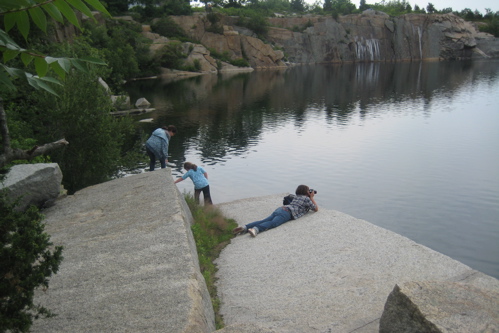
"At the Edge of the Quarry," July 2008

"At the Edge of the Quarry," July 2008

There is much beauty in the world and its people.

(Dear Reader, I beg your patience. In this post I’m going to attempt to start at beauty and end up at crisis. At this moment of beginning, I’m not sure I’ll find the path.)

There is much beauty in the world and its people. That is what I feel and what I believe. I would say, too, that beauty is what I see around me; it is my nearest and often most vivid experience. Children, what grows from the ground, surfaces, words on pages, good hearts. Beauty is real to me.

Last week I was in San Francisco, the first time since 1987, and I stayed with my friends Marcia and Steve, who live near the Presidio. On my first evening there, Steve and dog Henry walked me up there to look out over the city and across to Alcatraz and Angel Island, the Bay Bridge, a cemetery, the Golden Gate. We walked through cypress and eucalyptus trees that composed a woods both magical and spooky, and everywhere in the air was their scent.

Good words fail at these overwhelming moments. Continue reading

– Pink slipped, again

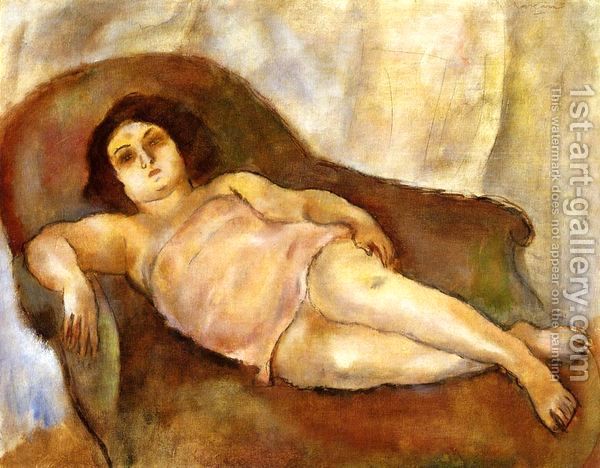
"Model in a Pink Slip," Jules Pascin

"Model in a Pink Slip," Jules Pascin

Last week I had a meeting with my boss, and I learned that my job in the writing program at MIT is ending with this semester. Others in the program, too, have lost their jobs or had their hours reduced.

Three years ago, a little later in the spring, I heard similar news from my boss at Simmons College, where I then worked and taught.

Here’s a reflection on how I felt then and how I feel now. And let me preview the conclusion: Yes, one gets wiser — and more determined — with experience. Continue reading

– Page length

pages500A recent post in Tomorrow’s Professor treats the forces converging on that often irritating but essentially benign student question: “How many pages?”  Here’s the lead:

He said, “How many pages does that paper have to be?”

She said, “As many as it takes to make your case.”

This exchange is pretty common, and annoying. The student is trying to set the boundaries of the assignment and is probably annoyed with the vague response he got from the instructor. The instructor wants the student to learn how to make a good argument, and is probably annoyed that the student seems to be focusing on quantity rather than quality. But there’s a motivational theory that might help each party understand the other.

Teachers, read the full post for insight into students’ impulses for this question, and your own motives for deflecting this question, if you do indeed deflect it. Continue reading

– Eye of the family storm

In the fall of 2004, I participated in a faculty development workshop at Simmons College, where I then worked and taught, on the teaching of writing. There were about 15 of us, and it was led by Lowry Pei and it was great. We got together weekly, we talked about students (in general, not gossipy), we puzzled over how to teach academic writing, and we did some writing, too. Some of it was formal and academic; some of it was free.

I’ve been digging in my archives from that workshop, looking for material. Here’s an excerpt from a 30-minute freewrite I did at 7:30am on a Sunday in November, 2004.  Eli was 12; Lydia 8; and Grace 4.  As I wrote, I tried to let family interruptions become part of the writing, and so I documented them along with my train of thought. Eventually, the interruptions became the train.

Freewrite #6:

I often wait for the perfect conditions within which to write (quiet, long stretch of time, well rested) and those perfect conditions present themselves to me, or I’m able to make them happen not –

–interruption.  Lydia is doing some algebra problems, for fun, that I created for her.  She doesn’t get “2x = 24” – that “x” is unknown and that multiplication is implied.  She thought that “x” meant “double the number” and she came up with 4.  I explain.  She says, “so two times twelve?”  That’s right, because value for x in this instance is 12.

And I only get perfect conditions about two hours per week.  That’s not a lot of time in which to do much.  So, doing things on the fly has to work for me.  I’m attracted to the short form for this reason, or that’s what I want to believe.  Continue reading

– Dear Ms. Morin

Jan Morin
Leicester High School (1979-1983)
Winslow Ave.
Leicester, MA 01524

Dear Ms. Morin,

My friend Rosemary, writing about her relationship to exercise over her lifetime, looks back on high school gym classes, where “being active meant being an athlete.” It made me think of high school gym class, and that made me think of you.

Ms. Morin, I was never a hardcore athlete and I liked gym class, and I liked it whistle1because you were a great gym teacher. I don’t know if I was aware of your greatness when I was in high school, or if this is only a realization I’ve had since becoming a writing teacher five years ago, but I always had fun in class and enjoyed talking to you. Teachers bring energy to their students, whether positive or negative, and yours was buoyant, humorous, and tough. I can still see your off-kilter smile; I remember your laugh, a whooping cackle.

Gym was one of those classes, as it is today, that was a requirement. We couldn’t get out of high school until we had taken so many P.E. hours.  That means that, unlike on sports teams, where everyone has volunteered to participate, all the students in gym were there to some degree against their own choosing.  Continue reading

– Two hours and five minutes

That’s how long it took me to make an MLA style list of works cited for an essay I am submitting to journals.

There are only nine sources on this list.

Why did it take so long? After all, I kept detailed research notes.  And, I tried EasyBib, which automates citation creation.

It took so long because, like the dashboard design that is unique to every car model, how each publication, whether print or electronic, catalogs its content is idiosyncratic.  Sometimes the author’s name and date are right there, at the top of the page.  Sometimes the name of the newspaper is the same as the owner (New York Times, for example). Sometimes URLs remain stable over time. And sometimes — most of the time — not.

Teachers, don’t we wonder why our students fail, almost every time, to adequately document their research in their papers? What’s wrong with those damn students? (Yes, I am shouting in my stage voice. You know I love them, and I suspect that you do, too.) Let me tell you something:

Continue reading