– Twisted world

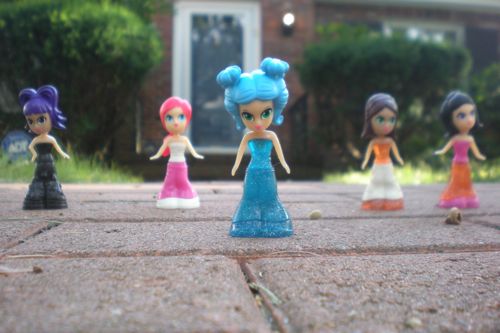
Dolls1

Usually, we keep the cars unlocked when they’re sitting in our driveway. What would anyone want to steal, but a handful of change in the cup holder, empty water bottles on the floor, or a soccer ball in the back? An opportunistic thief, it seems, might also be attracted to a red bag full of first aid supplies for Grace’s scouting troop, of which I am the volunteer first aider. Bandaids, gauze pads, Benadryl, instant cold packs, surgical scissors, a CPR face mask: stolen. Today we replenished the kit. It costs $104 for supplies that fit this description, plus $20 for a discount backpack to hold it all.

On the MBTA Green Line, a man in nice pants, black scuffed vinyl shoes, and a puffy down Patriots jacket sat across from me, with his head bent over a notebook. Left-handed, he wrote a numbered list of principles in big block letters on the lined paper. The list, which was easy to read upside-down and across the aisle, had to do with campaigning, I gathered. “1. Door-to-door. Get the message out. 2. Phone bank. Waste of time. 3. Direct mail. Expensive, uncertain.” And so on. I feared, for some inchoate reason, he was launching the beginning of a political career.

Above ground at the Park Street Station, the street was blocked off with that yellow police tape. The whole intersection, blocked. People standing around. No cars. I looked and looked at my fellow bystanders, trying to make eye contact before asking someone to explain. No eye contact. I walked over to the hotdog stand guy. “Yes, miss?” he said to me as his glance landed on mine. I asked him what had happened. He answered, “A quite older woman was hit by a truck in the intersection. She passed away.” Oh, no. Still, I found it so strange that the gentle phrase “passed away” could be used for a victim who had been rammed by a truck.

In the rundown jewelry store on the corner of Tremont and Winter Streets, I finally got the battery in my watch replaced. Only $8.49 — what was I waiting for? For at least two months, I had been covertly using the digital display on my insulin pump as a time keeper. The jeweler’s assistant told me she sees everything out her store window, everything. The old woman who was hit by the truck had her “head cracked open. Open.” The assistant, who had heat-straightened brown hair and a very kind smile, cupped her two hands around her forehead as she described what she saw. I pictured her head like an egg, the shell opening. Continue reading
– I would read a book about pencils.

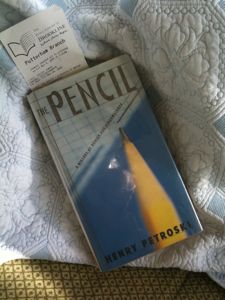
Pencils_Pillow300For some reason, Grace, Jimmy, and I were talking about single-noun-subject books. What concrete thing interests you enough that you would read or write an entire book about it? Salt, for example.

Grace raised potatoes as a possibility.

“Pencils,” I said. “I love pencils. I would read an entire book about pencils.”

Yesterday, my library helpers found and brought this home for me. I saw the title, and my heart started to beat a little faster in anticipation. I opened to chapter one. First words: “Henry David Thoreau seemed to think of everything…” Ah, book heaven.

– Feedback season

Wite OutWhen it’s midterms for students, it’s midterms for teachers. (There’s something rather binge-and-purge about school, isn’t there?) In the past two weeks, since Columbus Day, I’ve been reading, commenting on, and grading the drafts of technical reports and scientific analysis papers, about 35 altogether. They’re long (average: 20 pages), but after the first few in a batch, I get into a rhythm. And while I don’t copy and paste comments from one report into another, I do notice similar issues and may make similar comments among reports.

I don’t claim any of the following lines as poetry. Here are some of the kinds of things I write or type in the margins. Continue reading

– Learning to write: a meme

Over at digital digs, Alex Reid (someone I don’t know but whose thoughts I enjoy reading), writes about how he learned to write. While his post raises illuminating questions about a well-accepted pedagogy — that teachers’ experiences of learning to write and developing a writing practice are central to their teaching of first year composition — his post also gives me an idea for a meme.

He captures his development of a writer by describing three contradictory practices. I’m going to do the same, and then I’m going to tag four friends.

My practices?

1. The first grade I got in college was an F. The class was English 150: Critical Interpretation. The professor was Robert Polito. The assignment was to do a close reading of a Shakespeare sonnet. Continue reading

– The anonymous they

Crowd blurToday I heard students discussing feedback that their team had received from a few instructors on a presentation. The students’ sentences uniformly began with the pronoun “they.”
They liked [such and such].

They said [so and so].

They didn’t like [such and such].

After several of those sentences, the “they” became a blur, and, even though I had a sense of who those instructor/feedback-givers were, it all started to feel vague to me. The actors — the givers or performers of the feedback — were made anonymous by the use of the nonspecific, plural pronoun.

I don’t want to shake my finger at the students. Indeed, I’ve heard teachers use the same pronoun to the same effect, referring over and over to an anonymous conglomerate of students as “they.”

They don’t do [such and such].

They seem to like [this or that].

They want [more].

This usage cloaks the identity or characteristics of individuals in a particular group. “They” also indicates that a group is not “we.”

And so, by designating an anonymous and even homogeneous them, we somehow reinforce the unity and presence of our us. There’s an implicit binary.

I have noticed that this tendency to invoke an anonymous “they” is not restricted to the realm of education. For example, after the dot-com bubble crash, I would sometimes hear people, still in great pain from having lost money and hope, rail against the violations of an anonymous They. They did this. All they wanted was that. They never told us that [something bad] could happen.

“They” is a very useful pronoun. It effectively and succinctly signifies a large group of others (in fewer letters than “large group,” or “the regulators,” or “the instructors,” or “the students in my intro psych class”), a group somehow distinct from our group. I do not think we should or even can eliminate the word from our speech.

However, when I catch myself using the pronoun “they,” I do wonder what experience or characteristics I’m trying to distance myself, and my peers, from. That’s what this use of “they” does — creates distance.

What does that distance offer us?

—–

Image “Liverpool Street station crowd blur” by victoriapeckham on Flickr. License via Creative Commons.

– Ancestral division of labor

In doing some reading and note-taking on the history of agriculture for my blueberry project, I came across this.

The need to care for children helped create division of labor among hunters and gatherers. Men hunted, women gathered. Of the two pursuits, gathering was clearly more important. While the capture of a single large animal might have provided a clan of forty people with meat for two weeks, it was gathering that gave our ancestors a dependable diet — probably about seventy percent of their caloric requirements in the arid tropics. Though it has been generally assumed that hunting provided more food than gathering in the high northern latitudes (above 40 degrees), an American anthropologist studying tribes along the western Canada/U.S. border (45 – 48 degrees N.) found that even this far north, with plentiful game and declining plant resources, women provided seventy percent of the diet from gathering. (7)

Shattering: Food, Politics, and the Loss of Genetic Diversity, by Cary Fowler and Pat Mooney (U of Az Press: 1990).

While I know that many men cook and feed their housemates and families (as, for example, Bryan T., my childhood neighbor does his), the feminist in me did a little cheer when ancient women got that affirmation. Seventy percent of a population’s caloric requirements — that’s a lot of roots, seeds, nuts, and fruits.

– Store bought manure

In the first episode of season six of The Office (watch it here, on Hulu), Michael spread false rumors about several employees in order to cloak his having leaked the secret about Stanley’s affair. He figured if he spread a LOT of gossip, no one would know what was true and what was not. Classic Michael logic.

About Dwight — weird, weird, weird paper salesman from a family of farmers — Michael insinuated he used store bought manure. Dwight was livid.

Manure

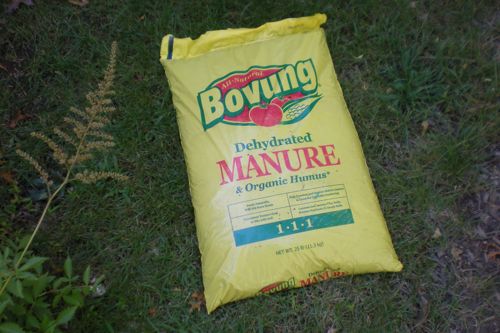
We’re not as proud here on Puddingstone Road, and we don’t have access to a herd. Over the weekend, we bought eight bags of dried cow shit and raked it into our future potato patch.

—-

P.S. Word lovers, what do you think of the product name? 🙂

– Reverse commuter

Do you know the work of the contemporary poet Deborah Garrison?

This one, in particular, is something I read out loud to myself every year, in the fall around this time.

I Saw You Walking

I saw you walking through Newark Penn Station
in your shoes of white ash. At the corner
of my nervous glance your dazed passage
first forced me away, tracing the crescent
berth you’d give a drunk, a lurcher, nuzzling
all comers with ill will and his stench, but
not this one, not today: one shirt arm’s sheared
clean from the shoulder, the whole bare limb
wet with muscle and shining dimly pink,
the other full-sheathed in cotton, Brooks Bros.
type, the cuff yet buttoned at the wrist, a
parody of careful dress, preparedness—
so you had not rolled up your sleeves yet this
morning when your suit jacket (here are
the pants, dark gray, with subtle stripe, as worn
by men like you on ordinary days)
and briefcase (you’ve none, reverse commuter
come from the pit with nothing to carry
but your life) were torn from you, as your life
was not. Your face itself seemed to be walking,
leading your body north, though the age
of the face, blank and ashen, passing forth
and away from me, was unclear, the sandy
crown of hair powdered white like your feet, but
underneath not yet gray—forty-seven?
forty-eight? the age of someone’s father—
and I trembled for your luck, for your broad,
dusted back, half shirted, walking away;
I should have dropped to my knees to thank God
you were alive, o my God, in whom I don’t believe.

—Deborah Garrison

From the New Yorker issue of October 22, 2001.

– In the pines, in the pines

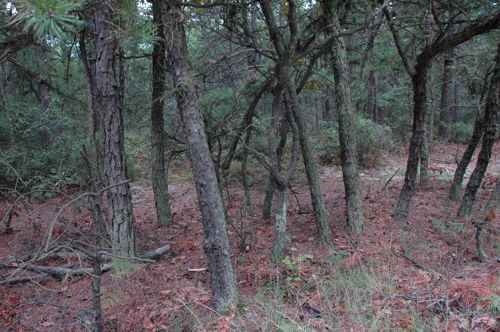
Pines2“What did you find out?” That was the question I was asked when Jimmy and I returned from our one-day field trip to the Pine Barrens of New Jersey, to find Elizabeth White’s house, Suningive, and explore Historic Whitesbog Village, a state trust which preserves a turn-of-the-century company town built around cranberry and blueberry farming.

The question, innocent enough, made me bristle. It seemed to beg for information, and the purpose of the trip had really been about sense. Having spent a good part of the summer reading about agriculture, fruits, the Pine Barrens, and Elizabeth White and her family, I wanted to test my sincerity. Am I really interested in this subject? Is my curiosity powerful enough to bring me back here, to keep taking the next steps?

There’s something about the beginning of an idea that’s so fragile: just a few cells, stuck together, with a heart barely beating. One must hold onto it, without exposing it. That’s how I feel. The beginning should be conducted in the darkened room of privacy.

So the question — wow! That felt like an intrusion. Inside, I felt my will kind of clamp down around what I could say or reveal, wanting to keep it for myself.

Still, the question-asker is a kind of audience, and I had said enough about my impulse to write a biography of Elizabeth White that the audience deserved a response, an early communication. Continue reading