Consider the hummingbird: a reading and writing exercise

Today I met with Karma, an MIT employee and adult student whom I tutor in English once a week through a pilot program. We have a grammar workbook that we are going through rather doggedly, and we like to break up the formal exercise with reading, writing, and speaking activities.
2483989061_536ffa3d77_z

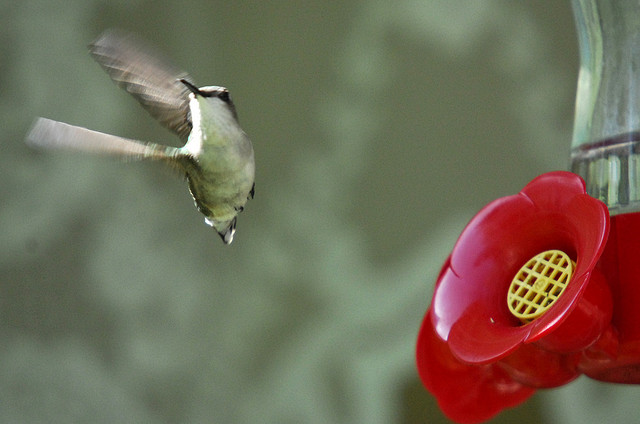
Last week we read out loud together one of my favorite short essays, “Joyas Volardores,” by Brian Doyle (The American Scholar, Autumn 2004). Read the full text here: link. It is about the hummingbird, and more. The essay is full of beautiful facts and therefore new vocabulary, so it is suitable for an ESL student. There is also a curious passage about the blue whale and a meditation on the human heart. There is much to puzzle over.

Today, we did some free writing based on the nature of the essay (i.e., facts lead you to ideas and even strong emotion) and its first sentence:

Consider the hummingbird for a long moment.

I proposed to Karma that we generate more concrete nouns, in place of “hummingbird,” for things we had knowledge about that could be described.

Consider the __________ for a long moment.

landscape
automobile
microwave oven
maple tree
Bobcat (small truck)
iPhone
computer
motorbike
kitchen
… and so on

I suggested that we each take the first sentence, put in a concrete noun of our own choosing, and free write from there, trying to emulate some of Doyle’s declarative style and building paragraphs on sentences with the simple subject/verb structure, which is used lavishly in the essay.

We wrote for 15 minutes. We read aloud to each other the first and last sentences of what we had written, to see how far our ideas had come. The noun Karma had chosen was “computer,” and the one I had chosen was “kitchen.”

I wrote a lot in 15 minutes, yet felt unhurried the entire time. (See below the jump for the full text of my free write.) I really was following my thoughts. Karma wrote less than me yet seemed contented also. This is a good way to get writers to excavate what they know from experience and observation; this exercise could be followed up with a research assignment to start to develop material from the free write into an essay.

I noticed, when Karma read it aloud, that his last sentence has the word “unimaginable” in it. A word in my last sentence is “unconscious.” We seemed both to have traveled from concreteness to the cerebral. To get to an idea is the goal.

What will we do with what we wrote? As we parted, I told Karma there is no real homework, but that I hoped he would think about his last sentence, and I will think about mine. We will start there next week.

Keep reading for my free writing…
Continue reading

Leaves of insight, before they disappear

6130889443_74c365a02b_b Here are three quotations from my reading over the past few weeks. Each has something to do with writing, even when it is not about writing.

1.
In this profile of Dr. Steven Zeitels (“Giving Voice,” John Calopinto, New Yorker, March 4), who is the surgeon who saved Adele’s voice, another patient, Scott Flaherty, “an operatic tenor… working as a teacher,” describes his motivation for undergoing risky surgery to restore his singing voice:

He explained [to Colapinto] why teaching was no longer satisfying. “I’ve grown tired of just talking about it,” he said. “I mean, when you sing you’re giving voice to your soul.”

Teaching singing to singing parallels the relationship of teaching writing to writing. It’s not enough to talk about or comment on. And yet that seems to be mostly what there is time for. This was my mournful state of mind in the weeks leading up to Spring Break.

2.
The playwright Annie Baker (“Just Saying,” Nathan Heller, New Yorker, February 25) also teaches in the graduate playwriting program at NYU. In his profile of her, Heller follows Baker and her playwriting students into the basement of a Washington Square bar, where they discuss the pressure to outline screenplays. Baker is wearied by them and negotiates her contracts to avoid outlining. She says

“I feel like it’s the most dangerous — I actually feel like Hollywood hurts itself when everybody outlines screenplays. And then it trickles down to grad writing programs. Like, I’m willing to sit around for hours to talk about what the screenplay’s going to be, and talk about ideas, and doodle diagrams on dry-erase boards, but I just won’t…. Because by the time I finish the outline, it’s dead.”

Talking and drawing can be explorative and generative when it comes to creative writing. But outlining: a killer. Too much left brain.

3.
Piano player Jason Moran (“Jazz Hands,” Alec Wilkinson, New Yorker, March 11) lives in New York but teaches once a month at the New Conservatory of Music in Boston. In tutoring Jiri Nedoma, who played his own composition once hesitantly and again with more sureness, Moran directed him to play it again, changing “the whole idea of the song”:

“Make it entirely different. Could you play it in stride piano?” […] Put different factors into the equation. Play it backward. Upside down. Your left hand might use something 1940 and your right hand is 2000, and what you find becomes part of your vocabulary.”

Nedoma played it again: “more delicate,” with richer chords. “He ended with a series of rising notes.”

Moran responded

“What you played at the every end, that’s where you should start… It’s almost like you played all that prelude just to find that little bit.”

Play, play, play. Mess it up. Experiment in unlikely ways. Often, you discover what you’re writing about at the very end — that’s what we tell students. It seems like this is true in other kinds of composition. What is found, at the end, becomes the new start. Not everyone, though, will have the perseverance to revisit one’s own work with the eyes of new discovery.

—–
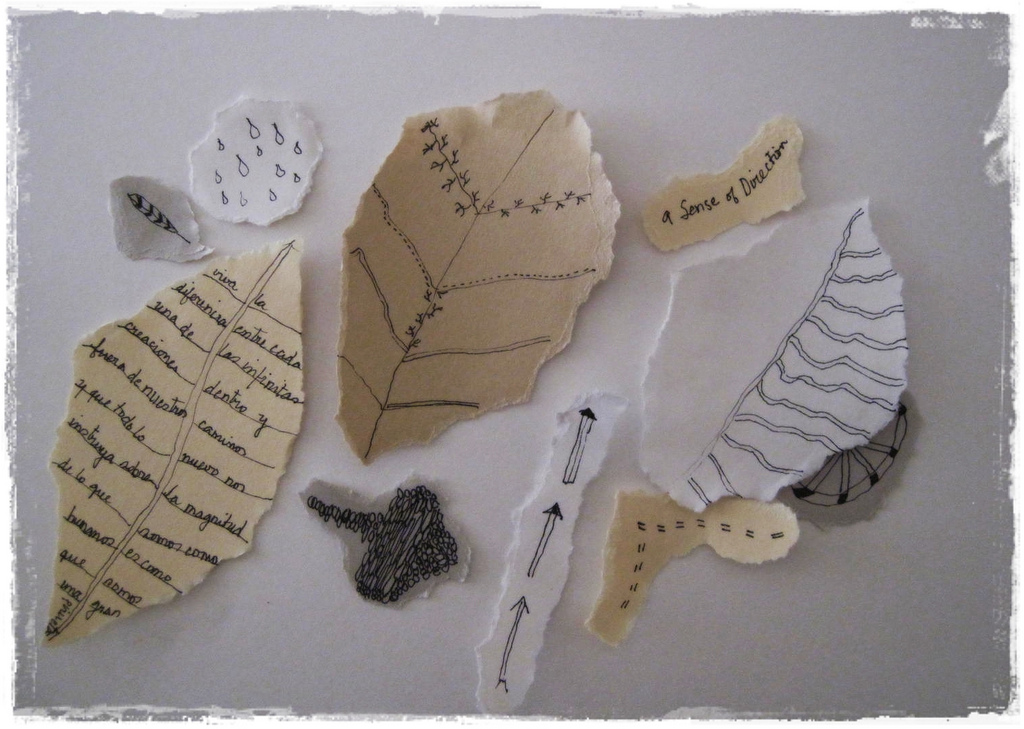
Image, “A Sense of Direction,” by Constanza on Flickr via a Creative Commons license

Almost one month later, the never-ending holiday ends

We returned the unwanted gifts to the stores in time for the 30-day return limit.

I packed up the ornaments, took down the artificial tree, vacuumed, undecorated the mantle, and got Jimmy to help me put the Christmas things in the attic. Then I went outdoors and stripped the yard of ornaments.

mail

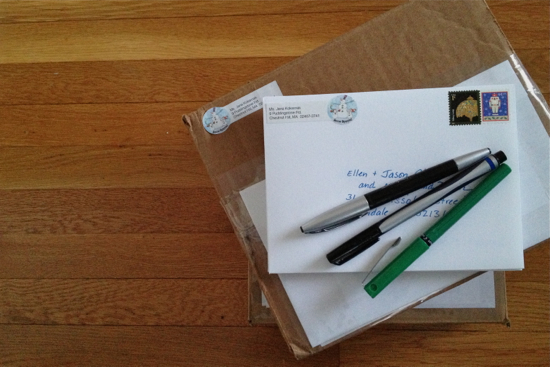
I signed and stamped my second batch of holiday cards. I had ordered some with the New Year’s theme, knowing I’d never make a Christmas deadline. I bought some Taza chocolates and Effie’s oatcakes, local products to send to friends in Germany and son Eli in Burlington, VT.

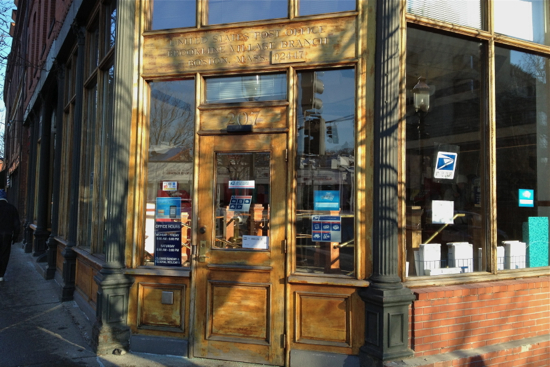
This morning, I mailed the cards and packages. New postal clerk in Brookline Village: very friendly and efficient.

post office

I declare Christmas officially done. It’s been a long month.

What will I do differently next year? It was fun having dinner at our house; I would cook again, and perhaps the same meal. But the whole presents scheme must change. Next year, it will be quality over quantity. I ended up returning a lot of the gifts bought for the teenaged Gutermans and giving them cash to buy what they want. In the future, I will (a) not shop at TJ Maxx and Marshall’s, which I love and they seem to hate, and (b) buy one special gift, fill the stockings, and give the rest in cash.

I will send holiday cards again. I haven’t done that in years, and I enjoyed the opportunity to reminisce about my cousins and childhood family friends and simply write by (private) hand and not via social (and public) media. At my sister Sally’s suggestion, I made a file with all the addresses in it, so that will be streamlined next year. I even added a few names of people I intend to send cards to next year; this year I ran out.

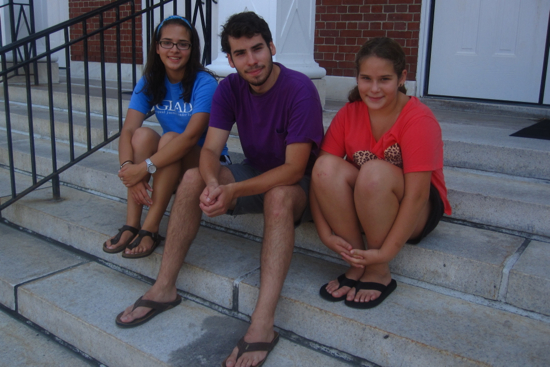
Here’s the New Year’s card photo, taken August 2012:

Mighty Gutermans

Also, now that the big push of Christmas is behind me and the choke points of the semester still to come, I am going to attempt to blog much more frequently, even if most of the offerings are slight. The accumulation of a lot of small gestures may add up.

It’s a new year and time for new experiments.

Look beyond the self on New Year’s Day

My resolutions are usually about aiming for personal goals or eliminating personal deficits.

What if our resolutions were more focused on our interactions with others, not as a way to get but to give?

The writer David Rakoff (b. 1964) died in 2012 from cancer. In its year-end feature on notable deaths of the year, “The Lives They Lived,” the New York Times Sunday Magazine published a letter that Rakoff’s friend Ariel Kaminer had written, thanking him for important lessons. They are ones to live by:

  1. Don’t trade up.
  2. It’s better in the long run to be kind.
  3. Be grateful and humble and mean it.

Read the full version of the letter, and a fuller description of each axiom, here: link.

P.S. Of course I still have a personal resolution or two and will publish them later.

Over time, we may come to understand what these gifts mean

Angel_smallThere is this great desire to be known. To be recognized for who one is. We need signals from the intimate world, from the people closest to us, that we have been observed and found out. And around Christmas time, we start to hope that the gifts will be those signals — that someone will unearth or make the item that will tell us we are known, and we are prized for who we are.

We know we are loved. But are we known? That we worry about in our heart of hearts.

—–

As I child, I always loved Christmas and looked forward to it each year. My sister Sally and I shared a room for a long time, and every Christmas Eve we would lie in our beds wriggling with delight over what Santa and the morning would bring. It was hard to sleep, and we would kick and bicycle our legs deliberately to get rid of the energy. In later years, after the dream of Santa was behind us, I still endowed Christmas with much hope — a great, great deal of it — even though my rational mind knew that, with knowledge, the magic had dissolved.

When I was about 14 or maybe older, I received from my parents the gift of an antique wicker chair and table that had come from my mother’s Aunt Gert’s house. The set had been dusted off, and my mother had sewn a new cushion set. Intellectually, I could tell this was a special gift. I said thank you, and even now I hope I outwardly seemed grateful and happy. I wasn’t happy, though. I don’t recall if there was something in particular I wanted, but it wasn’t a family hand-me-down. I was a teenager, so perhaps boots or clothes or a record player or hot rollers would have been more worth getting.

I don’t actually remember the nuances of what I felt beyond the shock of seeing the table and chair, around the corner from the living room, too big to be put under the tree. I have a mental snapshot of the moment, and in trying to stand there in the same place again, looking at the table and chair, all I feel is the force of my own self-control: try to be thankful, try to keep your cool, try to appreciate the meaning and effort that mum has put into this.

The effort to accept a gift that one doesn’t want is so great.

—–

I still have that chair and table. Many years ago, I updated the table, marbling the top, when I took a furniture-painting class. The chair has been professionally restored by a wicker man, who told me the chair is a classic, and he may have even named its style, but I don’t remember it. There is a little piece of wicker on the arm rest that has broken off, and I have put it aside, intending to glue it back.

Continue reading

See Jane get ready for Christmas Day

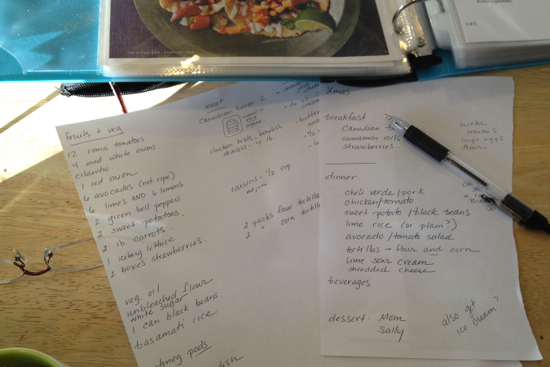
I could write a post every day that featured some hand-written note or scrap I had produced. While I wish I could say that I’m one of those writers who carry around a lined pad and work on their latest thing in longhand, I’m not. But I love lists, notes to self, and notes to others.

A few days ago, I felt a bit panicky about Christmas. There were still gifts to buy and a menu to plan. All the details were in my head, as packed as the city swimming pool on a blistering day and I the lone lifeguard.

I wrote my gift list: items purchased and shopping to be done. This morning: the menu for Christmas Day (15 of us) and a grocery list for the go-getter, Jimmy Guterman. My breathing slowed as I wrote and categorized. All the swimmers started doing laps in lanes.

ListChristmas550I drew a little picture for the Canadian bacon; there’s a certain kind + brand I want, and I can see it in the store and package, but I can’t remember the name beyond the word “organic.” I hope the picture will help Jimmy see it.

Specificity in item, quantity, and place helps with order and therefore the feeling of calm and preparedness.

This is my way to organize the part of the world that has me in it. The impulse comes from and satisfies me, I know, but my drive for order might benefit others.

Well, actually in fact it does. Ho ho ho!

Time of the season

An MIT friend/colleague posted this on her Facebook page:

This week: 22 student meetings (30 minutes each), 12 student presentations to watch and grade, rehearsal for panel talk, planning meeting for IAP workshop, go to conference, give talk, come home… By next Monday I expect to be a shambling, drooling zombie.

Her capsule summary of her week prompted me to print out my Google calendar and annotate it with things I needed to get done the evenings ahead of actual student meetings, deadlines, a rehearsal, a lecture. Last night I left it laid out on the dining room table. This morning it greeted me. I added the coffee.

All those cross-outs on my To Do list on the left, obviously a good thing, explains my absence from blogging. There are especially a lot of drafts to review, and in the bits of free time left over I find myself wanting to read (The Heart Broke In, by James Meek — so good), not write, or go outside instead.

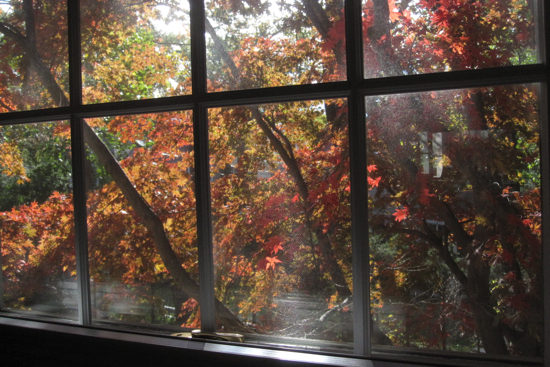
Outside the windows and along the route to work, the trees are changing and getting ready to drop their garments. Watching the big Japanese maple in the backyard, which we can see outside the south-facing windows on the second floor of our house, involves the holding of one’s mental breath. The leaf color turns and turns and turns, the leaf stems continue to cling to the branches as though hanging from their fingertips, a few let go and fall, and one day soon — poof! — the rest will fall, blanketing the grass in a big crimson carpet.

This is autumn: school burdens and tensions and the lead up to the holidays, while nature relaxes. I find myself wishing for the bottom of the To Do list to be reached, quickly, and simultaneously studying the unfolding of the season.

This is autumn too: leaves to rake, fallen branches to pick up, annuals to compost, and small and noticeable steps of progress and pleasure in one’s students (and children!).

We can, at once, be getting things done and in the moment. I do not think life can be lived entirely one way or the other.

—–
The title is of course an homage to the Zombies 1968 song, “Time of the Season.” I associate this with my brother Michael, who was one of the influential disc jockeys of my childhood. This 45 got a lot of play on my parents’ record player.

If a tree falls in an empty conference room, does anybody hear?

Last weekend I went to Orlando, Florida for an academic conference. Two colleagues and I were on the program to present a panel (that is, three integrated short talks) on the teaching and learning opportunities in original research projects for undergraduate mechanical engineers. We had been working on our project since last January: drafting the proposal and later the paper, revising them, drafting the slides, rehearsing, revising the slides, and going over them again. I estimate that about 250 woman-hours went into our talks.

Two people came to our panel. That’s right, two. Oh, and one came 15 minutes late.

This is the thing about academic conferences that everybody knows about but no one does anything about: there are too many panels on the program for the number of attendees, which disperses the audience among too many rooms. Yes, some panels I attended had 30 people in the audience, the size maybe of a class of students. Usually, you hope for at least 8 to 10. But two? Well, that’s just disillusioning, as one of my colleagues said. Our work had almost no effect.

I wonder, selfishly, what else could I have written with the same 100 hours I contributed to the panel? One could say I learned a lot from the research I did (my talk was based on a qualitative study I conducted among students on their experience of a set of assignments), and my colleagues and I consolidated our understanding of our own work through this experience, but, really, to have an audience is better.

In the talks I went to, the best was by keynote speaker Manuel Lima, who presented from his book Visual Complexity: Mapping Patterns of Information (Princeton Architectural Press, 2011). He argues that, as the dominant paradigm for visualizing knowledge has gone from the tree to the network, ideas of beauty must change from an emphasis on symmetry and order to complexity and disorder. Lima’s presentation ranged over history, art, science, Gestalt psychology, and our digital world. He used beautiful, disparate images from handmade manuscripts and other artifacts in surprising ways. Illustrations of trees, like this one from 1202 by Joachim of Fiore (in Lima’s book), gave way to abstract art and in particular a network-like painting, Autumn Rhythm, done in 1950 by Jackson Pollock.

The Tree of the Two Advents (1202)

I sat at a table with Manuel Lima at lunch and heard more about his ideas; I bought his book and got his signature. One always gets something of value out of these academic conferences. I am intrigued by the shift from trees to networks as the paradigm of knowledge in our era and by our ideas of classical beauty giving way to complex beauty.

Networks are not just at the center of a scientific revolution; they are also contributing to a considerable shift in our conception of society, culture, and art, expressing a new sense of beauty. As we continuously strive to decipher many of their inner workings, we are constantly bewildered by their displays of convolution, multiplicity, and interconnectedness. And the most elaborate of schemes are the ones that apparently seduce us at the deepest level. — Manual Lima, Visual Complexity (2011)

This is a big idea, the only one at the conference. My colleagues and I were ready with a well-done yet admittedly modest idea. Is this the thing to do, which Lima has done: dedicate one’s self to bigger ideas and bigger projects?

—–
Image credit: The Tree of the Two Advents, Joachim of Fiore (1202), via Brainpickings.org

Bounty of writers’ insights

Sweet autumn clematis (link) reaches its full beauty in early September and then lasts. I have a few spots of it in the yard — over an arbor in the front, along both sides of the chimney, and climbing up the neighbor’s fence — and this summer it exceeded its usual proliferation while I wasn’t looking. Suddenly, it seemed to explode into my attention. One day I said to a member of my editorial staff, Grace Guterman, “Please, when you have a moment, go out in the yard and take some photos for me!” I wanted to preserve the lushness. She did.

Also this month I have noticed in the news a proliferation of commentary from writers on writing that surprised me in some way. So that I don’t lose these good finds, I’m going to catalog and excerpt below the three that made the greatest impression on me.

1. Brian Martin recommends that writers train like athletes. Excerpts from his article in Tomorrow’s Professor:

Write for 15 to 30 minutes every day. Yes, that’s it: the core requirement is daily writing, at least five days a week, preferably seven.

Coaches expect their athletes – swimmers, runners and so forth – to train daily. Junior athletes are expected to show up for training every day, at the same time. Swimmers put in the laps and runners put in the miles. This sort of training enables dedicated high school athletes to achieve times better than world champions a century ago.

So what were top athletes doing back then? Those were the days of amateurs, usually from the upper class with spare time and access to facilities, who trained when they felt like it, typically on weekends. Very gentlemanly. But their performances weren’t outstanding by today’s standards.

What about writing? Most academics seem to be operating like the gentleman athletes of the past. They wait until they feel like writing. That usually means when they have a big block of time, or are forced to meet a deadline.

Most academics learn binge-writing from doing assignments in high school or undergraduate years. Binging becomes increasingly dysfunctional as tasks become larger. Writing an essay overnight is possible, but completing a 300-page thesis requires planning and sustained work. Continue reading

Writer’s Dozen: Peter Selgin and Limits

This is the fourth in a series of posts, called “A Writer’s Dozen,” on texts that have been important to me as a writer.

When he was in his early 20s and struggling to get started as a songwriter, Peter Selgin was attacked by a black Labrador retriever owned by the woman for whom he was apartment sitting in New York. The dog chomped into Selgin’s left wrist. He underwent microsurgery to address significant scarring around the ulnar nerve that affected feeling in and mobility of the hand. Results were minimal.

This event is described in his essay, “Confessions of a Left-Handed Man,” which is the centerpiece of a new book of essays by the same name. I first read this essay in Best American Essays 2006.

Always a left-handed artist and writer, Peter Selgin knew at age 25 that the full manual dexterity of his dominant hand would not return after the attack and surgery. In the essay he recounts his attempt to train his right hand, which felt like “trying to sing with [his] fingers holding his tongue,” to do what his left hand had always done for him. Around this time he also broke his leg. One night he walked on crutches to the East River with thoughts of killing himself. He had always been the left-handed boy — had identified himself as that — and the mirror opposite of his twin brother George, a right-handed boy who became an economist. At the river that night he had a “good bawl” and “hobbled back” to his room.

Twenty years later, he wrote the essay from a point in time he no longer felt that his left-handedness had any special meaning. It simply was. Furthermore, he continued to write and make art with his compromised left hand. The work he made before and after the injury, though, have “nothing in common” with each other. He calls his style “naive, even primitive,” and he asserts that his “lack of dexterity has freed [him] from glibness, which in turn has delivered [him] from the temptation” to show off.

Even though Selgin’s theme for his essay is humility — he says that, for an artist, “to master humility” is as important as mastering the techniques of his medium — for me, the lesson is about limits that we cannot overcome, that we must work within. There is nobility in this, and necessity, once the sorrow passes. Continue reading