– Ancestral division of labor

In doing some reading and note-taking on the history of agriculture for my blueberry project, I came across this.

The need to care for children helped create division of labor among hunters and gatherers. Men hunted, women gathered. Of the two pursuits, gathering was clearly more important. While the capture of a single large animal might have provided a clan of forty people with meat for two weeks, it was gathering that gave our ancestors a dependable diet — probably about seventy percent of their caloric requirements in the arid tropics. Though it has been generally assumed that hunting provided more food than gathering in the high northern latitudes (above 40 degrees), an American anthropologist studying tribes along the western Canada/U.S. border (45 – 48 degrees N.) found that even this far north, with plentiful game and declining plant resources, women provided seventy percent of the diet from gathering. (7)

Shattering: Food, Politics, and the Loss of Genetic Diversity, by Cary Fowler and Pat Mooney (U of Az Press: 1990).

While I know that many men cook and feed their housemates and families (as, for example, Bryan T., my childhood neighbor does his), the feminist in me did a little cheer when ancient women got that affirmation. Seventy percent of a population’s caloric requirements — that’s a lot of roots, seeds, nuts, and fruits.

– Not too comfortable

Notebook page This week I audited a lecture given by the lead professor of a big mechanical engineering course that I’m involved in. I was there to signal my interest and get some information on an upcoming assignment.

At some point, the students were prompted to draw a human-powered hovercraft. I was sitting next to another communications lecturer, Mary, and we looked at each other, as if to say, Are we gonna do this, too? After all, we don’t draw — we write, we speak, we teach.

And yet, we were there. So, we gave it a whirl, too.

Anyway, mine is powered by a jolly human who steps up and down on resistance pedals, like on a stair master. The action of the pedals somehow fills a series of air bladders, which collect compressed air, and then force the air, incrementally, down into an air reservoir. The air forcefully puffs out of an array of pores, which creates a cushion of air between the craft and the ground.

I certainly felt humbled by doing the exercise — what I can’t draw, what I don’t know — but I also, by drawing, thought much more deeply about the challenge than I would have if I had just watched the students in the class draw.

Hover craft

It was a good chance, actually, to be a student myself for an hour.

And rudimentary as my drawing is? Once I submitted to the spirit of the task, making it was fun, like being 12 years old and building a fort with the neighborhood gang.

– Store bought manure

In the first episode of season six of The Office (watch it here, on Hulu), Michael spread false rumors about several employees in order to cloak his having leaked the secret about Stanley’s affair. He figured if he spread a LOT of gossip, no one would know what was true and what was not. Classic Michael logic.

About Dwight — weird, weird, weird paper salesman from a family of farmers — Michael insinuated he used store bought manure. Dwight was livid.

Manure

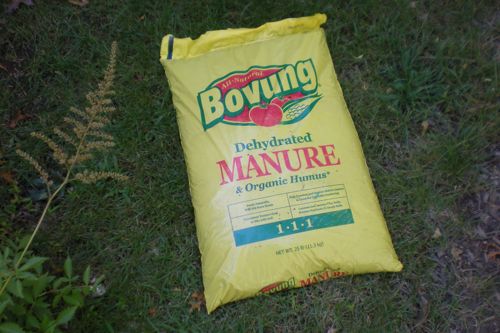
We’re not as proud here on Puddingstone Road, and we don’t have access to a herd. Over the weekend, we bought eight bags of dried cow shit and raked it into our future potato patch.

—-

P.S. Word lovers, what do you think of the product name? 🙂

– Harvest

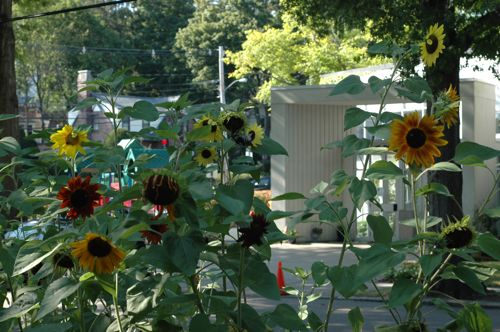
Rich, my neighbor — husband of Julie, father of Georgie, and looker-alike of this guy — walked by and asked me if the sunflowers were ready to be harvested for seed.

Yes.

Harvest_profusion2

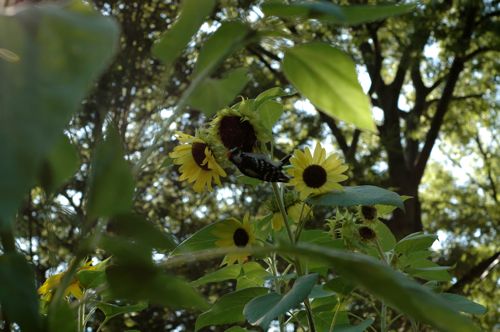
However… “I decided not to harvest them,” I replied to Rich, “and that I’d leave them for the wildlife.” I told him about a Downy Woodpecker and other birds that were feeding obsessively on the seed heads.

Harvest_ sunflower gymnast

It also seemed that there was other local wildlife interested in harvesting those seeds: Grace and Georgie. Later, as I poked around in the yard, they asked me if they could cut some down and get the seeds. I said, “yeah, but you can’t eat them.” Their countenances suggested I had offended their intelligence: “We know.”

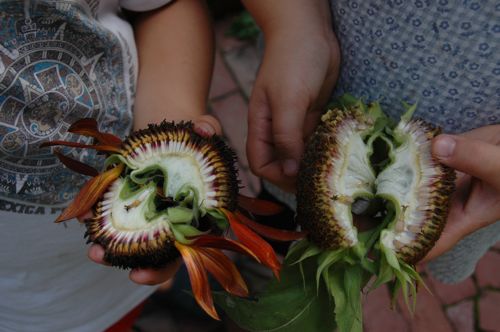
The two of them went to work, cutting down mostly spent sunflowers and cracking open the seed heads.

Harvest_heads in hand

Then they strafed them. Continue reading

He’s not here

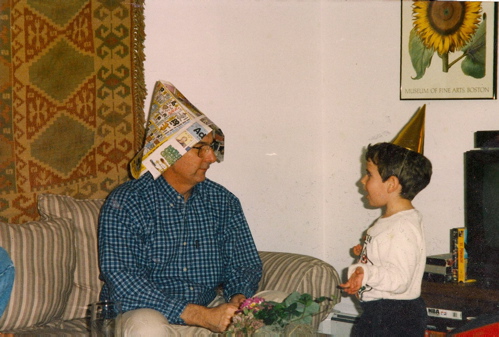
grandfather and grandson, March 2007

grandfather and grandson, March 1997

That’s a photograph, taken with a film camera, of my father, Stephen Kokernak, and my son, Eli Guterman, at the Harvard Square apartment of my sister Emily and her then boyfriend/fiancĂ©. My father made the comics hat on his head to entertain Eli; he made hats like that for us when we were children. Eli seems to be having one of his frank talks with his grandfather. I look at the picture and can hear his little voice: “Grandpa…”

There were other people in the room: my mother, my brother Michael, Lydia, Emily, and Emily’s boyfriend, Stephen Ward, a “Steve,” too, like my father. Perhaps members of Steve’s family, from Gorham, Maine, were there, too; I met them there once — they were clannish, like the Kokernaks — but I don’t remember if this was that time. All those times at Emily and Steve’s place roll into one large, peopled, and good memory.

It would almost be possible to get everyone together again (in a new room, though, because the apartment has been passed along). All of us — I and my family, my parents, Emily, my three other siblings, Steve’s mother and siblings, his nephew — would be 12 years older. There would be new additions to both our families.

I’m not certain, though. Steve is gone, we’re not in touch with his family, and I don’t know who makes up the Ward clan now.

Emily and Steve broke up some time after this; I don’t recall when. Why they disbanded is Emily’s story to tell — I can say only that it seemed to be for an accumulation of the kinds of slights and hurts that break people up, and not a drama.

Had I thought about Steve after the break-up, and before September 11, 2001? Not much. Continue reading

– Reverse commuter

Do you know the work of the contemporary poet Deborah Garrison?

This one, in particular, is something I read out loud to myself every year, in the fall around this time.

I Saw You Walking

I saw you walking through Newark Penn Station
in your shoes of white ash. At the corner
of my nervous glance your dazed passage
first forced me away, tracing the crescent
berth you’d give a drunk, a lurcher, nuzzling
all comers with ill will and his stench, but
not this one, not today: one shirt arm’s sheared
clean from the shoulder, the whole bare limb
wet with muscle and shining dimly pink,
the other full-sheathed in cotton, Brooks Bros.
type, the cuff yet buttoned at the wrist, a
parody of careful dress, preparedness—
so you had not rolled up your sleeves yet this
morning when your suit jacket (here are
the pants, dark gray, with subtle stripe, as worn
by men like you on ordinary days)
and briefcase (you’ve none, reverse commuter
come from the pit with nothing to carry
but your life) were torn from you, as your life
was not. Your face itself seemed to be walking,
leading your body north, though the age
of the face, blank and ashen, passing forth
and away from me, was unclear, the sandy
crown of hair powdered white like your feet, but
underneath not yet gray—forty-seven?
forty-eight? the age of someone’s father—
and I trembled for your luck, for your broad,
dusted back, half shirted, walking away;
I should have dropped to my knees to thank God
you were alive, o my God, in whom I don’t believe.

—Deborah Garrison

From the New Yorker issue of October 22, 2001.

– In the pines, in the pines

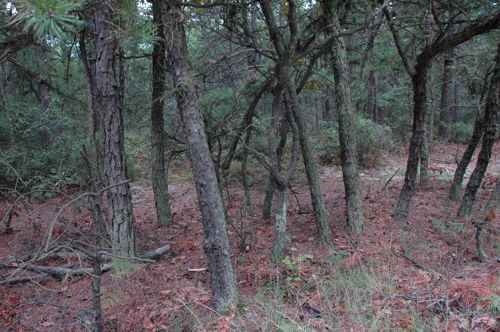
Pines2“What did you find out?” That was the question I was asked when Jimmy and I returned from our one-day field trip to the Pine Barrens of New Jersey, to find Elizabeth White’s house, Suningive, and explore Historic Whitesbog Village, a state trust which preserves a turn-of-the-century company town built around cranberry and blueberry farming.

The question, innocent enough, made me bristle. It seemed to beg for information, and the purpose of the trip had really been about sense. Having spent a good part of the summer reading about agriculture, fruits, the Pine Barrens, and Elizabeth White and her family, I wanted to test my sincerity. Am I really interested in this subject? Is my curiosity powerful enough to bring me back here, to keep taking the next steps?

There’s something about the beginning of an idea that’s so fragile: just a few cells, stuck together, with a heart barely beating. One must hold onto it, without exposing it. That’s how I feel. The beginning should be conducted in the darkened room of privacy.

So the question — wow! That felt like an intrusion. Inside, I felt my will kind of clamp down around what I could say or reveal, wanting to keep it for myself.

Still, the question-asker is a kind of audience, and I had said enough about my impulse to write a biography of Elizabeth White that the audience deserved a response, an early communication. Continue reading