– Convalescence

Dark sunLydia came into the bedroom at 7pm last night and said, “Mom, I can tell you kept yourself busy this morning.”

“You can?” It was so sweet of her to know how I operate.

“Yeah,” she replied. “You never fold my clothes.”

She was right. Yesterday morning I busily and methodically went through the house, making beds, folding dropped clean clothes and putting them away, hanging up jackets and shirts, sponging the kitchen table, and straightening books and papers on the coffee table. That’s my modus operandi: to deal with percolating fear, I keep busy.

By the time Jimmy and I left, yesterday morning, for the hospital at 11am, the house was as neat as if we were expecting company. My hair looked great and perfectly straight, because I had blown it bone dry, which I rarely do in the summer. My finger and toe nails were trim and clean — don’t anesthesiologists examine the nail beds for oxygen flow? I think I learned that on Quincy, M.E., years ago, when the clue that pointed to murder was the dead woman’s painted fingernails. She had died during surgery, and her nails were still beautifully manicured. Quincy had overlooked that detail at first: Don’t women often have painted nails? Ah ha!, though, not if they’re having surgery; the surgical team needs those nails bare. Quincy removed the polish and found the cause of death: a lethal injection to the nail bed.

Not only do my hands tend to unnecessary tasks when nervous, my mind does, too. Continue reading
– Reading comprehension: the joy and the pain

It’s MCAS season, and all three of our children — a 3rd grader, a 7th grader, and a high school sophomore — are taking them. They seem unbothered by a few days of testing: Lydia announced, “They don’t matter,” and Grace said, “No homework this week!” Eli is his usual cool and collected self and has altered his behavior only a little, to get the recommended good night’s sleep.

This morning Grace emptied out her school bag from Friday, and after they all left the house — I’m grading papers at home today — I looked at the worksheets from last week. There must have been 25 of them. (I would say that the idea of a Paperless Classroom has been about as successful as the idea of the Paperless Office.) I was completely riveted — and I am not kidding — by one of the reading comprehension worksheets from the MCAS review curriculum.

It’s a social history piece, written by children’s book author Lucille Recht Penner and called “Don’t Throw Your Bones on the Floor,” on the Pilgrims and their manners. Here are some good (wonderfully disgusting) facts, verbatim: Continue reading

– A huge disconnect

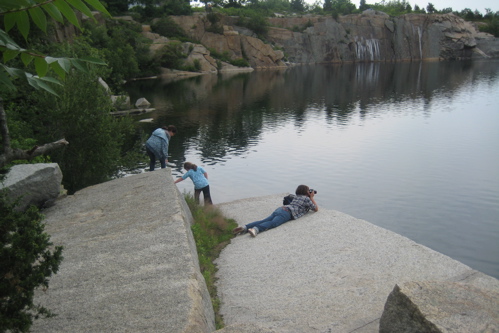
"At the Edge of the Quarry," July 2008

"At the Edge of the Quarry," July 2008

There is much beauty in the world and its people.

(Dear Reader, I beg your patience. In this post I’m going to attempt to start at beauty and end up at crisis. At this moment of beginning, I’m not sure I’ll find the path.)

There is much beauty in the world and its people. That is what I feel and what I believe. I would say, too, that beauty is what I see around me; it is my nearest and often most vivid experience. Children, what grows from the ground, surfaces, words on pages, good hearts. Beauty is real to me.

Last week I was in San Francisco, the first time since 1987, and I stayed with my friends Marcia and Steve, who live near the Presidio. On my first evening there, Steve and dog Henry walked me up there to look out over the city and across to Alcatraz and Angel Island, the Bay Bridge, a cemetery, the Golden Gate. We walked through cypress and eucalyptus trees that composed a woods both magical and spooky, and everywhere in the air was their scent.

Good words fail at these overwhelming moments. Continue reading

– Lice removal machine

Jimmy found some archival videos from an earlier time in our children’s lives when lice seemed to be visiting in regular waves. I hosted them on my head, too, more than once. I itched, and the girls diagnosed me. Here’s one of those lost moments:

Incidentally, the video captures a scene in “Little Creatures,” an essay I wrote about head lice, which is really about love. Last week I got word from PMS poemmemoirstory that they will publish it in the upcoming issue. Hooray.

Dear reader, did you land here looking for lice advice? Top searches that get visitors to this blog have something to do with lice, lice treatments, and lice removal, because I’ve written about this subject before. To answer the questions implied in these searches, Continue reading

– Only the rain has such small hands.

Althea Crome Merback knitted Coraline’s sweater. She knitted these gloves, too.

gloves

In this short video on her work, Merback calls herself, as far as she knows, the “only person in the world who knits conceptual sweaters and garments on such a small scale.”

Seeing these gloves for no hands reminds me of a conversation I had last week with one of Grace’s teachers, who said, “Art doesn’t have to have a use. It’s just… because.”

—-

Photo from haha.nu, which shows images of even more of Merback’s miniatures. And thanks to Rosemary, who gave me the idea to alter a line from a poem and use it as a post title. And to the late e.e. cummings, who wrote the poem, which I loved as a teenager. I see why.

– I surrender.

whiteflag2An ultrasound technician called me “laid-back” yesterday. This seemed, at the moment, not unlike other things people have called me, like “calm” or “safe.”

I could turn this into a boast, I suppose, but I’m not here to write about compliments. It does seem interesting to write about what it feels like, to me, to be calm while under stress.

It feels like surrender.

And that is the short, true answer.

But that makes surrender sound easy. And it’s not. The kind of surrender I want to describe (my kind) — to stress, chaos, noise, demands, surprise, discomfort — takes energy. It’s not like falling onto a couch and flicking on the tv. Continue reading

– All facts

I am a slow eater. Or, perhaps I live with fast ones.

At dinner, I said to the kids, “Slow down, slow down.”

I added, “I just read that people who eat fast are two times more likely to be overweight than people who don’t.”

Lydia: “You read that? Where?”

Jane: “Yes. In my Diabetes Forecast.”

Lydia: “So, it’s a fact.”

Jane: “Yes, and don’t you like facts?”

Lydia: “I love facts. There should be a magazine called All Facts. People would love it.”

Jane: [thinking…] “I agree.”

Lydia: “Like almanacs. Have you ever read the Almanac? That’s all facts.”

She said this with a kind of relish, my fact-lover.

And I’m with her.

– Dear Ms. Morin

Jan Morin
Leicester High School (1979-1983)
Winslow Ave.
Leicester, MA 01524

Dear Ms. Morin,

My friend Rosemary, writing about her relationship to exercise over her lifetime, looks back on high school gym classes, where “being active meant being an athlete.” It made me think of high school gym class, and that made me think of you.

Ms. Morin, I was never a hardcore athlete and I liked gym class, and I liked it whistle1because you were a great gym teacher. I don’t know if I was aware of your greatness when I was in high school, or if this is only a realization I’ve had since becoming a writing teacher five years ago, but I always had fun in class and enjoyed talking to you. Teachers bring energy to their students, whether positive or negative, and yours was buoyant, humorous, and tough. I can still see your off-kilter smile; I remember your laugh, a whooping cackle.

Gym was one of those classes, as it is today, that was a requirement. We couldn’t get out of high school until we had taken so many P.E. hours.  That means that, unlike on sports teams, where everyone has volunteered to participate, all the students in gym were there to some degree against their own choosing.  Continue reading

– Body’s report card

It’s on the kitchen counter, having arrived in the mail a day or two ago: a letter from the Joslin Diabetes Center with a full, quantitative report on what’s going on in my blood cells and, by extension, me.  I’m not ready to open it.

report2

Last week I saw my diabetes specialist. At one time, when I was new to diabetes and full of zeal, my performance — at monitoring, eating, record-keeping, sweets-avoiding, exercising, and controlling — was excellent. Sometimes, when Dr. A. introduced me to a med student on rotation, he would say, “This is my best patient.” Or even, “Here’s my A student.” In my late 20s at the time, that always struck me as paternalistic, if not affectionate, but still flattering. In the last couple of years, however, my body’s quarterly report card shows a more erratic performance. Occasionally, those numbers look great. More often than not, they look… merely adequate. Last week, as we looked over the records that I keep daily on my blood sugar, Dr. A. raised his eyes over the top of the paper and  asked me, in so many words, why I couldn’t do better. When I shrugged and smiled weakly, he caught my glance and then tapped the side of his head (home of the brain) as if to say, “You can do it. And because you’re not doing it, it must be your attitude.” Continue reading

– Writing in bed

I am reclining with the heating pad under my shoulder. It’s only 7 o’clock in the evening. With me is also Everyman, which I am finishing, and my iBook.

Jimmy walks in and says to me, “You know, a lot of writers wrote in bed.”

“Really?” I ask, which does not express doubt, but is just the way I say: “Tell me more.”

He says that Proust did. Capote did.

“Why?” I wonder.

He tells me that Proust was sick. Capote just preferred it.

Not for me, I say, or something like that.  And, yet, here I am, writing in bed, and doubting that I will do it again.