– All facts

I am a slow eater. Or, perhaps I live with fast ones.

At dinner, I said to the kids, “Slow down, slow down.”

I added, “I just read that people who eat fast are two times more likely to be overweight than people who don’t.”

Lydia: “You read that? Where?”

Jane: “Yes. In my Diabetes Forecast.”

Lydia: “So, it’s a fact.”

Jane: “Yes, and don’t you like facts?”

Lydia: “I love facts. There should be a magazine called All Facts. People would love it.”

Jane: [thinking…] “I agree.”

Lydia: “Like almanacs. Have you ever read the Almanac? That’s all facts.”

She said this with a kind of relish, my fact-lover.

And I’m with her.

– Hidden badness

Yesterday I made a turkey tortilla soup for lunch. It was to be the vehicle for a delicious, surprising chili accessory that I ate recently at my friend Brandi’s home: a dollop of sour cream, into which was mixed lime zest and juice. It was just the thing that turned her good chili into one of those meals that makes you feel loved and delighted.

The limed sour cream was just as delicious at my house.  I did wonder out loud to my fellow diners, however, if the combination constituted what my brother Brian recently called a hidden badness: a food that contains ingredients that you can’t see or identify. (An example of hidden badness, apparently, is fruited yogurt. And American chop suey.)

Lydia, at the lunch table, said, “Yeah, that’s a hidden badness.” She avoided the sour cream with lime.

Eli, the food adventurer, disagreed.  “I would call this, and other things like this, the hidden goodness.” He dropped more sour cream into his soup and ate the whole bowl.

And so did Jimmy.  And so did I.

Grace, at a friend’s house, escaped the moment.

– Christmas ghosts

A couple of weeks ago I hurt my neck or my shoulder — “the C6 region,” according to the chiropractor whom I started seeing out of desperation yet now am quite attached to — and it’s been hard to get into the anticipatory rituals that make a holiday interesting and attractive. When I was a child, my mother would bake cookies for gifts, and this would start weeks in advance. The house always smelled like almonds and butter and oven heat. It was fun to try to guess where she hid the cookies, and a treat to be allotted a few.

I have done no baking, no Christmas cooking.

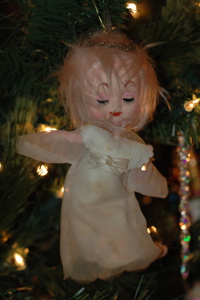
Ornament, c. 1965

Ornament, c. 1965

Tonight for our Christmas Eve dinner we had pizza rolls, noodle soup, and squash soup, plus glasses of milk. Deck the halls. I had said to Jimmy, when we went out earlier at 5pm for a last-minute errand, “I wonder what the Hales are doing tonight?” Those are my cousins, with whom I grew up, and, for perhaps the first 36 or 37 years of my life, we spent every Christmas Eve together. Whether we gathered at our cousins’ house across the street or at ours, the basic meal was always the same: deviled eggs with a bit of paprika, Swedish meatballs, scalloped potatoes, pickled herring for the old aunts, ham, Uncle Bob’s baked beans, green salad, and in the early days a gelatin salad. Some years a daring cook would experiment and bring a new vegetable dish; sometimes there was lasagna. There was always plenty; my mother and her cousin Joyce believed there had to be a lot, “because men like to eat.” While they were right, I noticed that the women liked to eat, too. Continue reading

– Onions are vegetables.

This post is dedicated to my brother, Brian, who said recently that he’s trying to eat “more cooked vegetables.” His resolution I find charming; it’s so much more idiosyncratic than one of the standard <yawn> resolutions, like trying to lose weight or save money.  A couple of years ago, on New Year’s Day, I resolved to stop using parentheticals in my writing. (I’m addicted to them.) I succeeded perfectly for one month, as most people do. Still, I keep trying.

Last night for dinner I made American chop suey, a staple of childhood and, really, just about one of the best New England comfort dishes we’ve got going. I realized, as threw it together (because it is one of those kinds of dishes), that it’s a painless way to get your cooked vegetables, because, except for the tomatoes, they are all verily disguised.  Aside from the canned tomatoes, there are two others: bell pepper and onion. Yes, onions are vegetables, too.

It’s cheap; it’s good; and it’s easy to remember the recipe, because everything is in quantities of one: 1 pound of this, 1 can of that, and so on.  However, American chop suey (also called ghoulash in the Midwest and chili-mac on public school cafeteria menus) is not photogenic.  Here’s the recipe, without photographic illustration, passed down to me by my mother and revised by me: Continue reading

– Lunch love notes

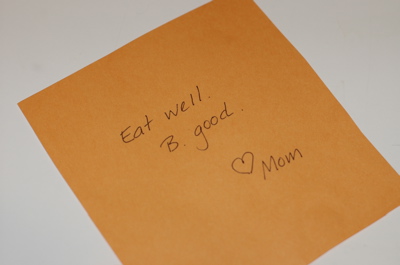
I made the school lunches today.  The food was so-so (sandwich, Cheez-Its®, apple), but I also added a treat: little notes.

lunch-note

My mother occasionally packed one of these in my sack lunch when I was in elementary school. Finding the note, which I kept to myself, made the afternoon at school glow.

– Circumstantial soup

I wasn’t intending to buy baby bok choy.  In fact, I had never bought the leafy green before.

But it caught my eye as I strolled the produce display, looking for a red pepper, in my recently re-arranged supermarket. I saw it and my brain leaped to the idea of “Soup!”

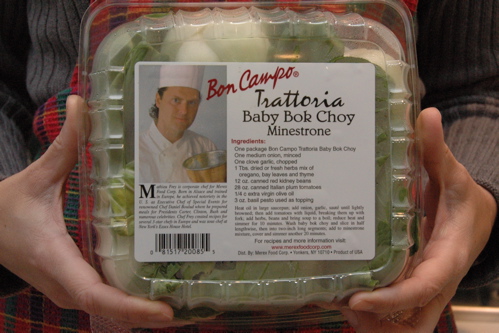
Attention-getting label on baby bok choy

Attention-getting label on baby bok choy

When I got home and unloaded the bags, I realized that some other shopper, or maybe even a produce clerk, had put back the bok choy and mistakenly turned the recipe-labeled side of the package so that it was facing the shoppers. On the other side, there is a small label on the big product window, as is normal for packaged greens.  I wouldn’t have bought it (or all the other soup ingredients, which I did), probably, if all I had seen was the usual view.

Perhaps words or information about the leaf persuaded me more than the leaf itself.

In any event, keep reading for my version of the recipe for the soup, which was easy and good. My variations are in purple. Continue reading

– Jane’s addiction

This afternoon, 4 o’clock.  Our kitchen.  Outside, raining.  Inside, Lydia and I, the afterschool chat.

Lydia: Mrs. M. is giving up coffee. (Mrs. M. is a teacher.)

Jane: Really??? (voice rising, incredulous) Why?

Lydia: Yeah.  Because it’s bad for you.

Jane: No, it’s not.

Lydia: IT’S ADDICTING.

Jane: Right.  But it’s not bad for you.

Lydia: Mom, it’s addicting.

Jane: Lydia, I couldn’t get through my life if I couldn’t drink coffee.

Lydia giggles.  It opens up into laughter.  I’ve surprised her!  This is a wonderful thing, when serious Lydia laughs. Her voice is a bell, a pretty one.

Lydia: Do you hear what you’re saying?

Jane: Yes.

Lydia: I’m not going to drink coffee until I’ve reached my full height and stopped growing.

Jane: Really? Okay, let’s have this conversation again when you’re sixteen.

Which is when I started depending on, er, I mean, drinking it.

(But I didn’t have any this afternoon.  I didn’t.)

– Considering toast

Toast, from toastalicious.com

Toast, from toastalicious.com

I was thinking of a croissant with my coffee, but then I smelled toast. “Ah, toast.” This was as I got within 20 feet of the snack bar in my building at 9am this morning. I gave in to the toast impulse — I smelled it, I pictured it, I heard the sound of the word in my head — and it seemed foolish to get what I suddenly no longer wanted.

At my desk, I ate the toast. I drank water and sipped coffee but did not look at papers or compute while eating. I stared at the wall; I thought about toast.

Henry James said that “summer afternoon” are two of the most beautiful words in the English language. I cannot disagree. Yet, I’d like to add “toast” to a short list of beautiful, evocative words. Dr. Poppy, in her response to my post on snacks, reminded me of its sensuality and charm: “simple but… sustaining.”

And yet, I was thinking as I ate my toast, do writers always use toast as a detail to convey the same feeling? Is toast a cliché? Would it be possible to ruin toast for a reader, or at least subvert it?

Examples:

At the last minute, she put toast under the pillow. All night, her hand worried it and not the hardened blisters on her wrist.

Their naked bodies pressed together, only Donna’s toast came between them: scratchy, buttery, and smelling of last night’s onions.

Before he tucked the dead squirrel into the shoe box and interred it behind the dog house, Little Guy lay freshly made white toast in the box’s bottom. The toast’s firmness supported the stiff body; a smear of blood seeped into the surface crumbs.

The doctor recommended toast in the sneakers overnight, to deodorize them. “And soak those feet in vinegar, twice a day,” he added. Joe would try anything.

Would the reverse also work? Could you take a noun with negative associations attached to it — like pus or viscera — and make it lovely?

Hmm. It seems easier to try to ruin something than it is to repair or beautify something else.

– Snacks = love

On Sunday, we were lounging in the front yard, where it was bright. Grace and her friend Julia were sculpting animals from long sheets of aluminum foil. Lydia was reading Harry Potter for the first time. Jimmy was sitting in the shade, and I was sitting in the sun. (Eli is still at photo school in Maine.)

I went in the house for a glass of water; I came out with an old quilt, a pitcher of lemonade, strawberries, cheese and crackers, and peanut butter and crackers. How much nicer than snacks from a bag.

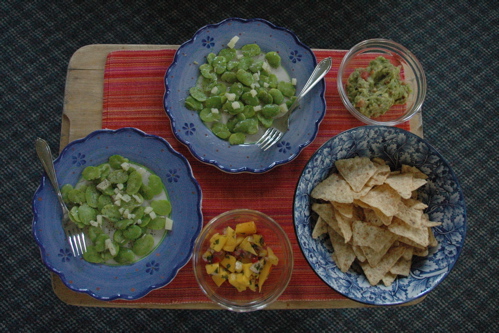
On Monday afternoon, we were hungry, and I hadn’t yet gathered the will to make dinner. To eat only a piece of cheese or an apple seemed paltry. An early-day trip to Russo’s with Julie meant that I had on hand the ingredients for some simple surprises. I prepared Marcia’s fava beans for Jimmy and me, and I put out chips, guacamole, and mango salsa for the girls. If we had beer, I would have drunk one, but we didn’t, so we had water and lime. We sat on the screened porch.

Monday afternoon snack

Monday afternoon snack

Since August 1, people have been saying, “Summer’s over.” They still say it. These leisurely snack periods are my way to put the breaks on, I think. Let’s not be in a hurry to eat lunch, to eat dinner. Let’s not wish away our time. It’s nice to sit for a while, talking and eating, and watch one part of the day segue into the next.

Also, snacks do not exhaust the cook. I love making them — they are like little gifts — and eating them. They should be quick to make and slow to eat.

Today? Popcorn (with butter) and lemonade, in the backyard. Someday soon, a snack picnic.

– Money

On Sunday, my friend Betsy and I did some consumer research, by sitting through the 4:50pm showing of Mamma Mia!, the movie version of the Broadway musical based on the ABBA repertoire.

We did this so you don’t have to. It is possibly the worst movie I have ever seen, or it may be tied for worst with Baby Geniuses.

MM is not even interestingly bad, and it’s not even worth the price of the summer afternoon treat of sitting in ice-cold air conditioning. Betsy and I frequently cringed in sympathetic embarrassment as the normally talented Meryl Streep or Pierce Brosnan belted out a song and emoted in their close-ups. (Worst: when the close-up occurred as one was singing! Pierce, how could you?)

This is a movie made by capitalist cynics (Tom Hanks and Rita Wilson, who knew?), who have pegged their audience: middle-aged, conventional, probably married people who feel that “life” (i.e., Greek island, beautiful child of uncertain paternity, slutty and artistic sidekicks) has passed them by while they were earning a living and raising their children.

As Betsy and I, both in our early 40s, grabbed each other’s elbow and winced at clunky scenes, two women in their 30s stumbled over us on their way out, halfway through the show. In the row in front of us, women over 50 sniffled and wept as Donna, the Meryl Streep character, sang “The Winner Takes It All” with her blonde hair extensions and red silky cinematic scarf swirling around her face and professionally-slim figure.

It’s a Baby Boomer fantasy, and a hetero one, too, as James reminded me, when I warned him and Doug, who know their theatre, not to see it. Indeed, my intelligence was insulted by the coy, easy-to-miss glance used by Harry, the Colin Firth character, to signal his sexuality late in the movie during a chaotic dance number in a stone church on the top of a craggy, picturesque hill. (Colin, how could you?) When the two youngsters — Sofia, Donna’s 19-year-old love child, and Skye, her fiance — decide at the altar not to get married so they can “see the world instead,” Donna and Sam, the Pierce Brosnan character, decide even more spontaneously not to “waste a good wedding,” and they link up instead.

Disappointingly, there aren’t even any good movie kisses here, between the kids or between the so obviously young at heart.

Someone — Jimmy’s mother? — asked me earlier this summer if I had noticed the rise in food prices. I hadn’t, but then I started paying attention. Wow. Between Betsy and I, we spent $16 for two tickets to a film made only to take our money.

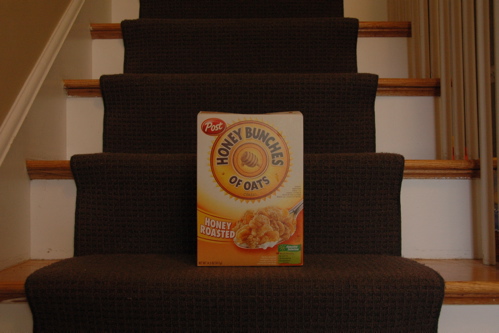
As I sat eating my breakfast today, I realized that I could buy four boxes of this cereal for the same amount, with a few pennies to spare.

Cereal box on stairs

Cereal box on stairs

At $3.99 per box and only 6g of sugar per serving, it’s less expensive and cloying than sitting through Christine Boranski, Meryl Streep, and Julie Walters singing “Waterloo,” in Elvis-like (or is it Elton-like?) get-up over the credits.