– Cabin fever

Restlessness — a lot of energy packed into a small container (you, your house) — requires an outlet. There are negative ones: complaining, watching reruns of American’s Most Smartest Model, picking at and eating dried-out candy off the gingerbread house. (Yeah, been there.) There are positive outlets, too: cleaning closets, walking around the neighborhood, making something. (Been there, too.)

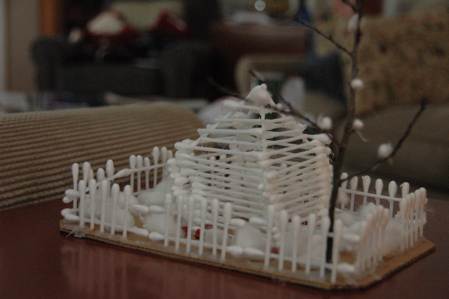
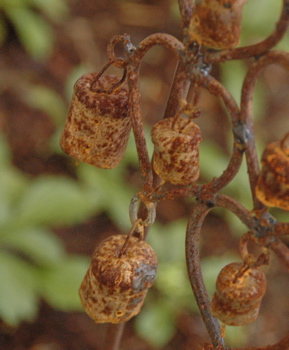
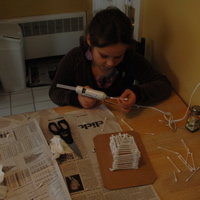
Grace with glue gunGrace channeled her cabin fever into industry today. Inspired by a spilled drum of off-brand cotton swabs, Grace started stacking them into a log-cabin-like structure, and then called for glue. I produced a lower-heat glue gun; I also handed her, unsolicited, a piece of cardboard from a discarded Amazon book box. The impulse evolved into a project, and she worked intently and inventively for a long time, even figuring out how to construct a hip roof by herself (she didn’t know she had made a hip roof until I walked back into the kitchen, saw it, and said, “Hey, a hip roof, just like on our house!”). She stripped a twig of bittersweet, in a bunch in a pitcher on the counter, of its berries and then made a tree in her little cabin’s yard. She used the red, shriveled berries as decorations around the house. I volunteered to help fashion a picket fence after she scalded herself a couple of times with hot glue.

Out of a drawer in the bathroom, Grace pulled a bag of cotton puffs, and she tore these up and put them in the little yard, for snow. “What do you call this?” I asked her. She answered, “Hmmm. Centerpiece of Winter.”

Cotton swab house

I put it on the table where the crumbling gingerbread house had been. A few of us took turns taking pictures of it. Jimmy even took a picture of Grace taking a picture. In her manner, she copied some of Eli’s photography tricks, moving both herself and her subject around, playing with angles and how she held the camera, sometimes close to her eye, sometimes an arm’s length away. I like this one — a bird’s eye view of her house, through the glass top of the living room coffee table.

House from above

And so go the days of our (winter) lives.

—-

Top picture by me; middle picture by Eli; and bottom picture, of her own creation, by Grace.

– Power tool

A few weeks ago, Eli came across instructions online for making his own messenger bag out of fused plastic bags. He e-mailed it to me and asked if we could make one. In the past few days, we did.

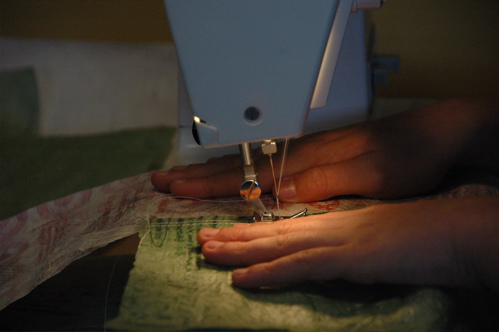
An absolute novice, he approached the sewing machine tentatively yet was open to advice and coaching. After his first few wandering seams, he got the hang of it. And eventually he got into it. From start to finish, we prepped, cut, sewed, and finished that bag together. I believe that Eli experienced the awe and sweetness of having one’s hands close to substantial mechanical power and guiding that force with purpose.

Eli guides fabric in the machine

If you know Eli and me, and you’d like to see highlights from our project, then click here for a slide show (and choose “Gallery View” for most pleasing size). If you’re a sewer, or if you enjoy reading accounts of do-it-yourself projects, then read beyond this paragraph for my description of how we adapted Bre Pettis’s directions to make Eli’s bag. At the very end, you’ll find a photo of the bag we made. Continue reading

– Hanging drop

Until I looked at Laura Splan’s watercolors in blood, I hadn’t thought of my own blood as paint or ink. Yet, it is. Many times a day I prick my finger, squeeze a drop of blood from it, and touch the drop to a test strip inserted into a glucose meter. After I’m done with the procedure, my fingertip often keeps bleeding, even though I’ve stopped being aware of it. So, as I put my hand on the mail, or a page of my glucose record log, or the Times, my blood smears and makes it mark. On paper, blood is permanent.
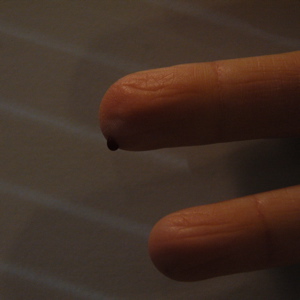
Hanging drop of my blood

Before I drive or teach — two activities during which I don’t want my glucose level to drop precipitously — I check my blood sugar. Once without my noticing it I left a smudged arc across the front page of a student’s paper. As I handed it back to her in class, she noticed it, and she visibly recoiled. “Ach, what’s this?!” Oh, shit, I thought. “I’m sorry, that’s my blood. From my finger. I’m so sorry.” I knew her as a fragile person, intensely worried about her own symptoms. Damn, why couldn’t I have smudged my blood across the paper of one of the nursing students?

Clearly, the traces of my blood on paper are not intentional or artful. Still, Laura Splan’s work put me in mind of them, and I started wondering about what I could do with all those smears. At the same time, I’ve been reading this sparkling, ruminative book, I Am a Strange Loop by Douglas Hofstadter (Brian, you would like this), which has a long section on math theorums and proofs, and I’ve been thinking about how much I loved geometry and calculus in high school and college. But, I didn’t go down the math path when I could have, and that knowledge is rusty and faded.

I’m in a predicament. I can’t draw, but I want to use my blood as ink. And I can’t, really, do math, but I want to use math in some way.

Ah ha! (When I was on staff at Simmons College, I was in a cross-disciplinary workshop on teaching writing in which the participants shared a lot of cool assignments they give to students. Donna Beers, a math professor, would sometimes get her mathematics education students to write what she called a numerical autobiography. At the time, I tried writing mine, but it quickly bored me: age, weight, street addresses, telephone numbers, age of first period, age of first kiss, number of children, favorite number, et cetera. No focus, no shape.) New, better idea — I could attempt to compose a numerical memoir piece, based on my life with diabetes, and I might get Eli, one of our in-house artists, to collaborate and contribute photographs that illustrate measurable moments! (He agreed.)

I even have the draft of a beginning, which is something I cut from another piece I wrote. Its working title, which came to me as I was driving around thinking about this, refers to the many times in a day or week I have to puncture myself. I’d like it to catch the reader’s eye.

—-

Number of Pricks

For several days in the fourth week of February, 1992, I was in the hospital. I was 26 years old and eight weeks pregnant with my first child. I had learned, the morning of the day I was admitted to Brigham & Women’s, that my blood glucose was high, around 300, and that I had diabetes.

By the end of day one I started injecting myself. The nurse offered to do it, but I said, “I might as well start.” She demonstrated on an orange; I jabbed the syringe filled with insulin into the flesh at the back of my arm and plunged. Mechanically, it is not difficult.

That night, lying awake in my hospital bed, I estimated my life expectancy – I chose 76 because it was 50 years beyond my then age and 50 is an easy integer to work with — and I multiplied four injections per day by 365 days by 50 years.

Here’s the equation. Solve for X.

4 x 365 x 50 = X

My thoughts were so scattered that I couldn’t do the simple math in my head. The next day I called my father, the math teacher, who advised against calculations: Do one thing, he said, and then do the next. Don’t count beyond today, or backwards, just take the next injection. Sometimes that trite “one day at a time” advice works; what he said helped.

More than 15 years and 20,000 injections have passed since that first day. And although I have come to take the long view when it comes to diabetes and follow a regimen that I hope will get me to old age with my feet, eyes, gums, and kidneys intact, it is what I do and don’t do during any one day — the increments of insulin dosing, carbohydrate counting, blood glucose checking, aerobic exercising, and portion measuring — that adds up to a life with Type 1 diabetes.

[end of excerpt, beginning of experiment]

—–

Picture of my November 14th fingertips by Eli Guterman
– Before and after

For anyone who is interested in the results of my propagating 100 pachysandra cuttings from my parents’ yard into mine, this post gives an update on the health of the transplants and, at the end, shows how I did it.

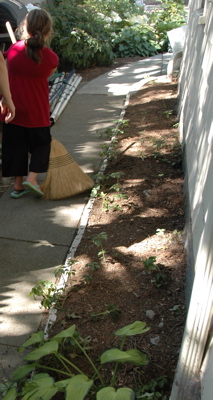
The “before” patchThis is also a before-and-after story and an occasion for me to remark on my uneasiness with sudden and dramatic transformations, which this is not. I recognize that, as a culture, we want big and positive change: the new fabulous job that will turn those daily doldrums and interpersonal irritations into personal zest and suitable comrades; the surgery or exercise that will turn my everyday outer self into a “10” (oh, yes, I’ve had those fantasies of ten-ness); the design and construction project that will help a house be all it can be (bigger, better, beautiful). This is prevalent — just type “before and after” into the Google search box and see what you come up with.

A couple of summers ago, driving to Crane’s Beach with my friend Betsy, she asked me what I would do if I won a million dollars. I asked her permission to reframe the question, setting $50,ooo as the limit, because I couldn’t wrap my mind around so much possibility — such an immensity seemed a pressure, an obligation, a weight. She laughed; she agreed; and we played the game. On my list, I put a beautiful coat, well-made shoes, a charitable gift, and a personal chef for a year. Later, I played the game with the kids, and they put items on their lists like “couch for my room,” “video game console,” and “elevator in our house.”

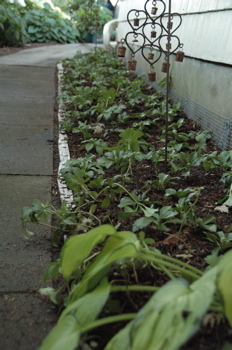
As Jimmy pointed out, as the kids and I were itemizing, any one or two or three ofThe “after” patch, with bells those wishes are ones we could actually afford now. He was right, and I realized — from Betsy’s laughter, from his comment — that the kind of changes that are either most interesting or tolerable to me are incremental ones. Indeed, I’ve become happier with my living room after getting a chair reupholstered from a busy, whimsical print to a green, textured chenille. Work is better on the day I tidy up my office and have a conversation with an eager student. My old clothes look snappier when I’m wearing a new sweater. This kind of change, which is probably most common in most of our lives, isn’t the stuff of dreams or the stuff that sells. Who would pay the initiation and monthly fees to a gym that promised only that working out would help you feel moderately better? Does anyone lie in bed at night fantasizing about updating the sleeve lengths on all their jackets and sweaters? More significantly, are any of such changes representable?

I confess: even though I am capable of ho-hum-to-fabulous fantasies, it’s the small changes in my life, wardrobe, house, hairstyle, garden, career, cafeteria that sustain me.

If you would like to follow how I made this incremental change in my side yard, as illustrated in the above Before and After images, please… Continue reading

– Passalongs: from their houses, to mine

No one is required to give credit to the source of the plants in a yard, although those sources are likely numerous: previous owner of the home, local nursery, hardware chain’s garden department, botanical society’s annual sale, mail order catalog, and other gardens.

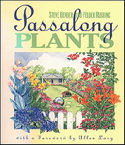
The offspring of plants from other gardens are called “passalongs.” In the purest sense, passalong describes plants that are difficult to find and purchase through the usual sources and therefore must be propagated from a piece of an existing plant in an established garden. Passalong Cover(See Bender & Rushing’s Passalong Plants for lively essays on these heirlooms.) Some gardeners use the term, simply, to describe plants divided and shared among friends and neighbors.

In my yard, I have thriving raspberry canes, clematis vines, hydrangea bush, and ajuga spreads that started from cuttings originated in other gardens. All of these plants are standards I could find at a nursery, but they’re dearer to me because as I tend them I feel, in a way, as if I’m tending my connection to their givers.

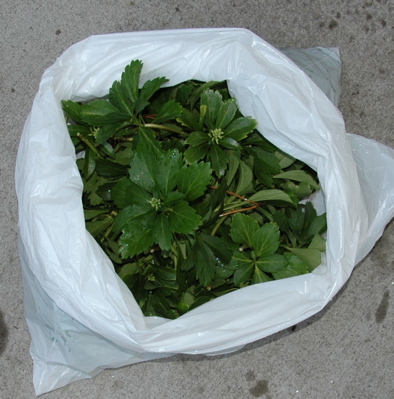
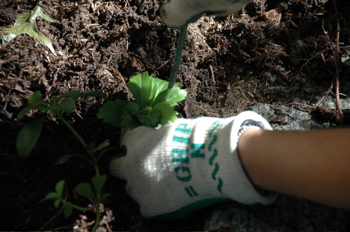
Last weekend, at my parents’ house, I deliberately harvested my own passalongs from their yard, 100 cuttings from a swath of pachysandra alongside their garage. Years ago I read, although I don’t recall where, that you can slice off the top few inches of a pachysandra stem, throw a whole bunch in a plastic bag, Pachy Greenhouseadd a cup of water, seal the bag, and then wait several days for the severed stems to root in this makeshift greenhouse. This project is motivated by a wish to transplant some growing thing from my parents’ yard to mine and also by a very blank space in an alley between my house and Bob & Mary’s fence.

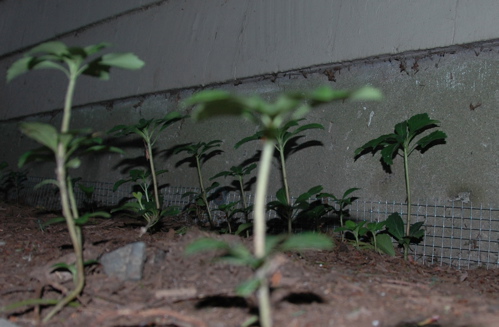
The blank space, in fact, was once filled by my own lush pachysandra patch, bought in an immense quantity in flats from Home Depot, and then planted one compact dirt-and-root cube at a time in soil enriched with dried manure and then mulched over. They lived quite nicely in their shady, neglected conditions, and probably would have ad infinitum if not for the “rodent intervention,” i.e., rat barrier, recommended and then installed by an “urban wildlife expert,” i.e., exterminator. In one afternoon, he and his partner, with a friendly Golden Lab keeping them company, dug up the pachys to get at the foundation, to which they tacked a long, foot-wide roll of wire mesh. Only a few stems Pachy Trees struggled back from leftover bits the following spring.

Will this experiment work? Will the cuttings root in their garbage bag greenhouse? Will this decimated pachysandra patch rise up and fill in? In a few weeks, I’ll know.