– Strawberry planter how to

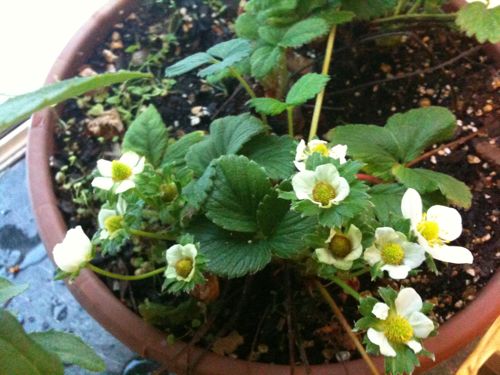
I made my mother a strawberry planter for Mother’s Day, following the directions here, with two substitutions: I used shards of a broken pot for drainage, instead of hydroponic pebbles, and I bought the strawberry plants at the nursery, instead of digging them up from an existing plot.

Putting it together was so straightforward that words are not needed. You can watch the slide show. And if you live near me and want to make one for yourself, you can get everything but the hammer at Allandale Farm.

This slideshow requires JavaScript.

—–

Thanks to Jimmy for the photography and Grace for the help. I created the slide deck in the new WordPress.com slideshow feature.

– Potato lover

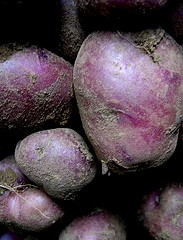
Whenever I have been asked the question, “If there was only one food you could eat for the rest of your life, what would it be?”, I have answered: “Potatoes.” And since the waning days of last summer’s sunflower folly, I have been daydreaming about filling my only sunny patch with the tubers. Today I did a little more than dream, and I went over to Wood Prairie Farm and ordered 6 pounds of organic seed potatoes (Caribe, Reddale, and Yukon Gold) and packets of carrot and beet seeds, too. There will also be a few sunflowers, to please the neighbors (and bunny) who enjoyed them last year. My plan is to plant 4 12-foot rows of potatoes, 1 12-foot row of carrots and beets, and another 12-foot row of sunflowers. That might seem modest, but come August, I hope to have an abundance.

Now, if only I had a root cellar.

—-

Image of Caribe potatoes by rovingsprout on Flickr.

– I’ll take reality.

I have always preferred reality.

I was the child who read the Little House series, Nancy Drew, Tree Grows in Brooklyn, Jane Eyre, Secret Garden, Pig Man, and Anne of Green Gables.

And like my daughter Lydia, I have always liked facts. One spring, when I was about 16 years old, I took a stack of books out of the library’s nonfiction section on farming, gardening, and vegetables. (That summer I also attempted a 10 x 15′ garden on a clayey waste plot in my family’s back yard. What I recall is that lettuce grows quickly, and slugs like to make a home among lettuce leaves, which a person finds out when she holds that salad lettuce up to her mouth and sees a baby crawler on a leaf.) Another time I took out a less goal-oriented selection of books on the human body — a bunch of owner’s manuals. (I remember a set of photographs from a dermatology book on effects of aging, and how an older person could pinch skin on the back of her hand and it would stay in a little teepee shape for a second or two. I tried this on my own hand then and could not imagine a little skin teepee as a possibility.)

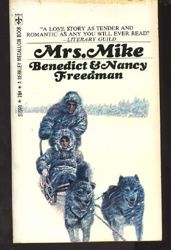
In my fiction reading, as much as I followed plot I liked learning how people did things with their hands: laundry in big tubs, food over an open fire, sleeping 3 or 4 to a bed, toys from sticks and rags, and treatments from poultices (ah, Kaiser Pease’s onion bath in Where the Lilies Bloom). When I picked up Mrs. Mike again, at least 30 years after I first read it, it was to find the description of an emergency amputation that has stayed with me:

I filled a kettle. I lifted it to the stove. The cries drew me back. His nails dug long furrows in the wood of the table. His dark eyes rolled back under his lids, leaving white, unseeing holes. The smooth muscles moved in Sarah’s arms. Back and forth, back and forth. The trap bumped and clanged against the table. Sarah’s strong man’s hand pressed the saw’s teeth deeper into the wound. It quivered, it quivered like jelly. A strange laughter stirred me. Mother and child, I thought. Mother and child. Then Sarah begin hacking. The bone chipped and splintered. I looked at her face, at the clamped lips! I looked at her hands. I thought, how can she do it! I looked again at her face, relentless and calm… His body lay under her hands, twisting, screaming, while she hacked at him calmly with a saw. I stared at a flap of hanging flesh.

Continue reading

– Indoor strawberries

My officemates and I are turning our huge window and its sill into a greenhouse. In addition to some cactii, which are meant only as houseplants in New England, we brought in some of the spent container plants from our home porches back in October: fuchsia, geranium, sweet potato vine, and strawberries. All are thriving, and there are strawberry buds. Will we soon have red berries in Room 12-111? Stay tuned.

– States of mind

Every time I hear on the radio the new Alicia Keyes/Jay-Z song, “Empire State of Mind,” I (mis)hear Keyes’s lines as her voice enters the song. To me, it sounds like:

In New York…
I’ve become a wintry tomato
There’s nothing you can’t do…

Play the video, and listen for the line starting at 0:56. Do you hear what I hear?

In the car today I asked Lydia, “What is she actually singing there?”

Lydia replied, “Something about dreams.”

“Dreams?” I queried. “Dreams?! Where do you hear that?” I sang to Lydia my tomato line.

Lydia smiled. “I think I prefer yours, Mom.”

For the record, this is what Keyes sings. Lydia is right.

In New York…
Concrete jungle where dreams are made of
There’s nothing you can’t do…

You pick what you like: wintry tomatoes, or concrete jungle dreams. I’ll stick with what grows on the vine.

– Bulbs and boxes

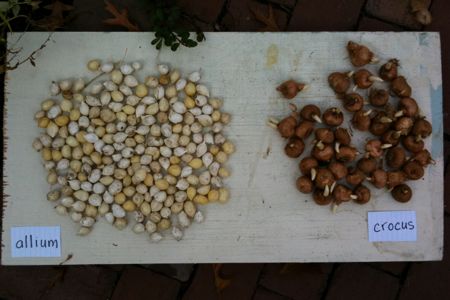
What I like about bulbs, which I planted on Sunday, is their utter forgetability. I dig a hole, drop them in, leave their spot unmarked, and forget. The cold and short days of winter will pass — some sparkling days swiftly, most days grindingly — and then one day I’ll be walking up to the house, with my head down and hands in my bag searching for keys, and I’ll see them. The cocked, belled heads of the crocii will be first.

We moved into this house in the summer of 1999, not sure what was planted but for the big, gumdrop shaped old shrubs. Much of the planted parts of the yard seemed taken over by leaf mold or invasive ground vines. That first summer, the most we did was cut back the overgrown parts and mow the neglected grass. In late February 2000, though, stomping through the yard with Eli and Lydia who were still small and close to the ground themselves, we spotted tell-tale little blue heads poking up just inches from patches of cold, bare ground still circled by snow. Planted by someone else before us, they were like a gift from the past to the future. And there we were.

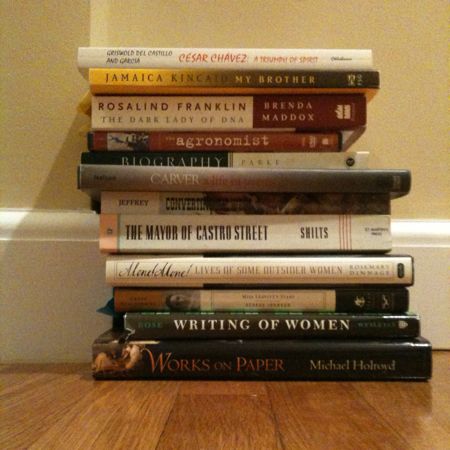
I had a feeling like that recently when I went up into the attic to rummage through my boxes of books and papers I had packed up in June 2006, when my job at Simmons College ended due to budget cuts. (That was a sad, sad time.) I’m currently getting ready to teach a course next semester on expository writing at the Harvard Extension School, and I’m basing it on the first year writing course I taught at Simmons, in which we read and wrote about biographical texts of my choosing. (At MIT, I don’t choose the texts for the WAC courses I’m involved in; the lead professor does.) I opened box after box and found treasure after treasure: books, DVDs, notes, and handouts I had forgotten. If I were in a movie, I would have had to toss those papers into the air to communicate my glee. Instead, I leafed intently through them, my interest in my dearest interests rekindling; I made a pile of keepers. While I did not speak aloud to the empty attic, I felt like whooping, “Yippee!”
Sometimes pieces of ourselves get shut up and put away, underground or in attic boxes. The putting away can seem as though an interment: Oh, that part of myself, or my talents? It is dead to me. Never again. And then, months or years later, the boxes get reopened, the green leaves and colorful heads push up from the ground, and we realize that the book, the bulbs, those little packets of life, have only been waiting for us, keeping themselves alive, shut away in darkness.