– At long last: grackles

At long last — weeks after I had given up the hope that I would see them this year — they returned.

As I stood at the kitchen sink, drank from a cup, and stared absent-mindedly into the backyard, I faintly heard a chorus of chattering. I heard it before I recognized it.

My attention tracked the origin of the noise. I went to the door, opened it quietly, and peered up at the old trees. Ah, they were dotted and filled with the purplish, black birds. Hundreds of them chucked like pigeons and squeaked like rusted gates. Hundreds. From the trees in the front of the house to the trees in the back, a crowd of them swooped, and the swooping felt like a huge quiet breath inhaled by the sky over my shoulder: a pause, a contraction, a gathering of force.

Usually, their arrival coincides with Columbus Day. This year, I waited and waited and waited, yet they seemed to have passed by without stopping for me, or perhaps they had not passed by at all, which made me wonder: what is going on in our climate?

The grackles are very late this year. Still, they have arrived and will probably stay for a day or two. While their gang sound is chilling and seems to bring a portent, I am relieved by their visit.

—-

P.S. This video was taken by me, on the morning of November 16, 2009, as I stood on our back steps and looked up at the trees in our yard and beyond to my neighbor’s red roof. As you watch, turn up the volume on your machine to appreciate the effect of a sky filled with grackle sound.
– Store bought manure

In the first episode of season six of The Office (watch it here, on Hulu), Michael spread false rumors about several employees in order to cloak his having leaked the secret about Stanley’s affair. He figured if he spread a LOT of gossip, no one would know what was true and what was not. Classic Michael logic.

About Dwight — weird, weird, weird paper salesman from a family of farmers — Michael insinuated he used store bought manure. Dwight was livid.

Manure

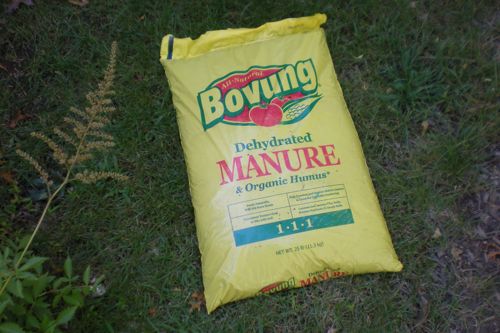
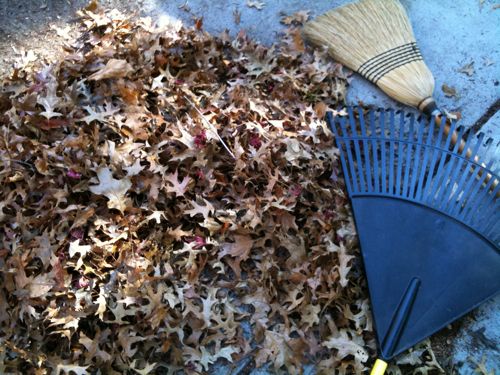
We’re not as proud here on Puddingstone Road, and we don’t have access to a herd. Over the weekend, we bought eight bags of dried cow shit and raked it into our future potato patch.

—-

P.S. Word lovers, what do you think of the product name? 🙂

– Harvest

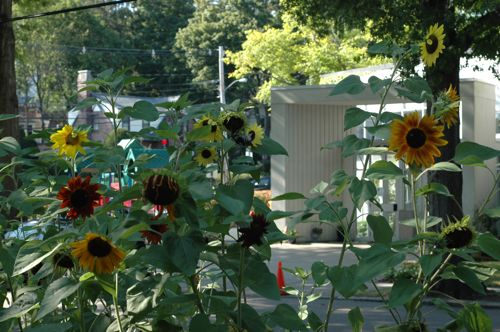
Rich, my neighbor — husband of Julie, father of Georgie, and looker-alike of this guy — walked by and asked me if the sunflowers were ready to be harvested for seed.

Yes.

Harvest_profusion2

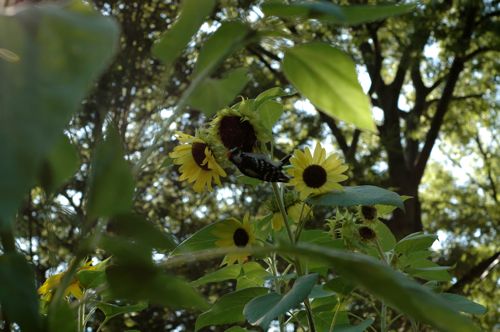
However… “I decided not to harvest them,” I replied to Rich, “and that I’d leave them for the wildlife.” I told him about a Downy Woodpecker and other birds that were feeding obsessively on the seed heads.

Harvest_ sunflower gymnast

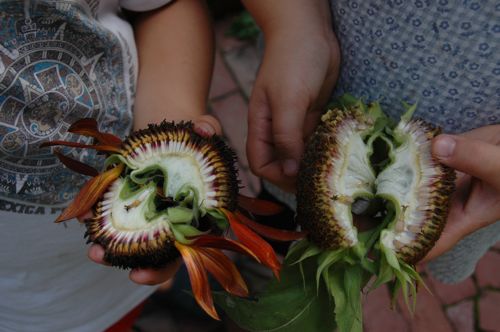
It also seemed that there was other local wildlife interested in harvesting those seeds: Grace and Georgie. Later, as I poked around in the yard, they asked me if they could cut some down and get the seeds. I said, “yeah, but you can’t eat them.” Their countenances suggested I had offended their intelligence: “We know.”

The two of them went to work, cutting down mostly spent sunflowers and cracking open the seed heads.

Harvest_heads in hand

Then they strafed them. Continue reading

– In the pines, in the pines

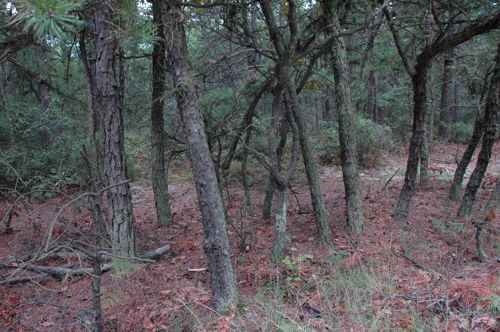
Pines2“What did you find out?” That was the question I was asked when Jimmy and I returned from our one-day field trip to the Pine Barrens of New Jersey, to find Elizabeth White’s house, Suningive, and explore Historic Whitesbog Village, a state trust which preserves a turn-of-the-century company town built around cranberry and blueberry farming.
The question, innocent enough, made me bristle. It seemed to beg for information, and the purpose of the trip had really been about sense. Having spent a good part of the summer reading about agriculture, fruits, the Pine Barrens, and Elizabeth White and her family, I wanted to test my sincerity. Am I really interested in this subject? Is my curiosity powerful enough to bring me back here, to keep taking the next steps?

There’s something about the beginning of an idea that’s so fragile: just a few cells, stuck together, with a heart barely beating. One must hold onto it, without exposing it. That’s how I feel. The beginning should be conducted in the darkened room of privacy.

So the question — wow! That felt like an intrusion. Inside, I felt my will kind of clamp down around what I could say or reveal, wanting to keep it for myself.

Still, the question-asker is a kind of audience, and I had said enough about my impulse to write a biography of Elizabeth White that the audience deserved a response, an early communication. Continue reading

– Habitat

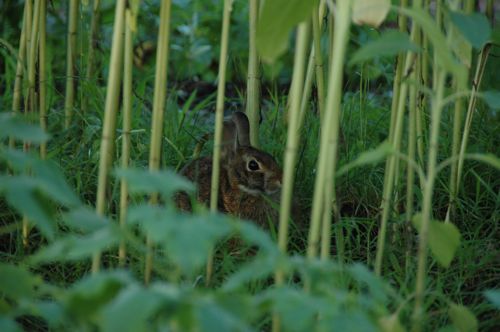
I planted the sunflowers for me, and also for passers-by, but it seems that the creature most enjoying them is a wild rabbit. It’s there in the morning for a couple of hours and then later in the afternoon, resting in the shade.

Rabbit

It seems to have its own spot: a bare patch of dirt among the stalks and leftover lawn. I’ve seen the rabbit stretch its length and roll a bit on its bed, so I guess it has created that bare patch, worn it down in the same way we humans wear down a path: thoughtlessly.

The rabbit no longer seems paralyzed and wary when it sees us watching it. Sometimes, the rabbit turns and looks at us. Other times, it stretches and rolls on the dirt. The children stand quietly and look. Jimmy waits to run the mower until mid-afternoon, when the rabbit is out. I showed the rabbit to an older couple who go often to services at the temple across the street; she always wears green as her signature, and he always drives their car. They stood with me on the sidewalk and looked in, delighted. We spoke in low voices, as though a new baby was sleeping there under the sunflowers.

I had hoped my sunflowers would attract hummingbirds and butterflies. So far, there have been many bees and one butterfly. The rabbit is the most frequent visitor.

Scratch that. The rabbit may be its resident, splitting its time between the sunflower patch and a nest or burrow somewhere else in the yard or neighborhood. Continue reading

– Convalescence

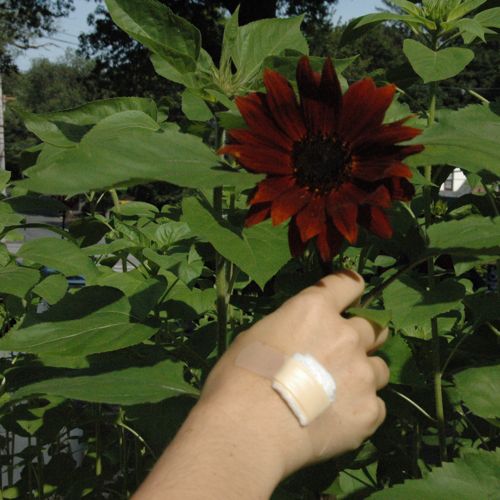
Dark sunLydia came into the bedroom at 7pm last night and said, “Mom, I can tell you kept yourself busy this morning.”

“You can?” It was so sweet of her to know how I operate.

“Yeah,” she replied. “You never fold my clothes.”

She was right. Yesterday morning I busily and methodically went through the house, making beds, folding dropped clean clothes and putting them away, hanging up jackets and shirts, sponging the kitchen table, and straightening books and papers on the coffee table. That’s my modus operandi: to deal with percolating fear, I keep busy.

By the time Jimmy and I left, yesterday morning, for the hospital at 11am, the house was as neat as if we were expecting company. My hair looked great and perfectly straight, because I had blown it bone dry, which I rarely do in the summer. My finger and toe nails were trim and clean — don’t anesthesiologists examine the nail beds for oxygen flow? I think I learned that on Quincy, M.E., years ago, when the clue that pointed to murder was the dead woman’s painted fingernails. She had died during surgery, and her nails were still beautifully manicured. Quincy had overlooked that detail at first: Don’t women often have painted nails? Ah ha!, though, not if they’re having surgery; the surgical team needs those nails bare. Quincy removed the polish and found the cause of death: a lethal injection to the nail bed.

Not only do my hands tend to unnecessary tasks when nervous, my mind does, too. Continue reading

– First sunflower

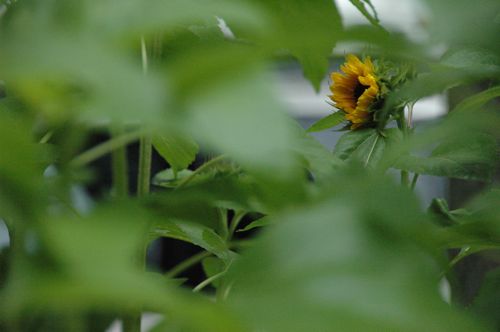
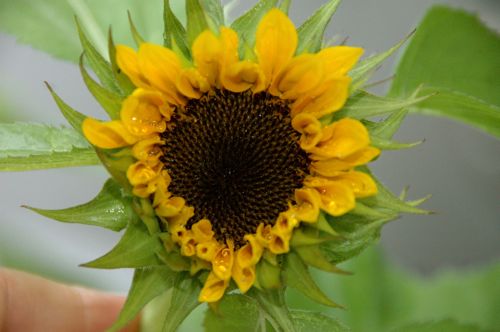
Seventy-two days after I planted the seeds, the first sunflower in my folly has shown its face.

First sunflower 2

Like someone who has been waiting and waiting for a long expected guest, I want to run into the house and yell: “She’s here! She’s here! Everyone come outside — she’s here!”

Sunflower face

—-

Photographs by Eli Guterman.

– Blueberries on my mind

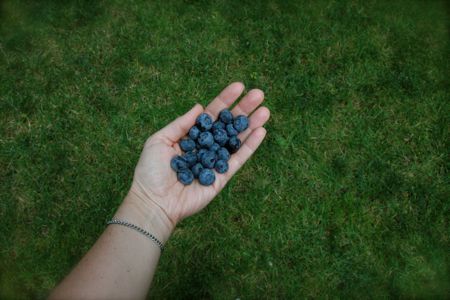
Blueberries in handWhile I do not know what form this will take, I am embarking on a biographical research project. The subject is Elizabeth Coleman White (d. 1954), an amateur botanist and serious farmer who brought the cultivated blueberry to New Jersey in the 1920s.

Why do we do the things we do? Why do we make the choices we make?

I’ve been thinking about those questions in the last month or two, after I made the commitment to myself to work on this and then started going public by testing the idea in conversations with friends as well as strangers.

No one assigned me to this subject. There is no writing contest of which I’m aware that has to do with blueberries or women farmers. I like blueberries, but I don’t grow them or even live near a patch of them.

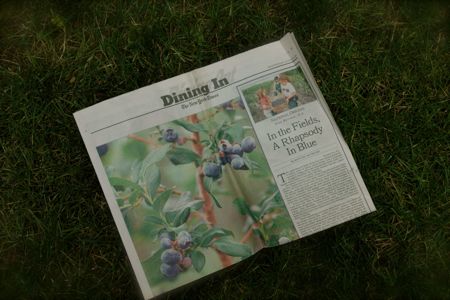
I first got the idea to research Elizabeth White back in the summer of 2000, when I read a long article in the New York Times on New Jersey and its blueberries. In a 26-paragraph, three-recipe story, Elizabeth White appeared in a mere three sentences. Still, her story interested me enough that I saved that section of the newspaper. I dug it out several weeks ago, when I was sorting through some boxed clutter.

Article on blueberries

At the time, I was thinking that this might make a good subject for a children’s book, like Jacqueline Briggs Martin and Mary Azarian’s Snowflake Bentley. I even imagined a drawing of a woman, walking through fields in a white summer work dress that is stained indigo in places from squashed blueberries. In fact, I imagined that drawing so much that it started to seem like fact to me: a woman, rows and rows of blueberry bushes, hot sun, white dress, stains. Continue reading