A daughter reads Eclipse on her Kindle on the front lawn at 7:30pm at the end of a cool June day.

A daughter reads Eclipse on her Kindle on the front lawn at 7:30pm at the end of a cool June day.
I didn’t win the race; I won my race.
Lydia and I ran the B.A.A. 5K along with 6,000+ other runners, our second race this year and my second race ever. On the train ride back to our car at 9:30am, having done what we each set out to do — Lydia improved her time and I ran the whole route without walking — Jimmy asked me if this race felt different than the first.
Yes, it did.
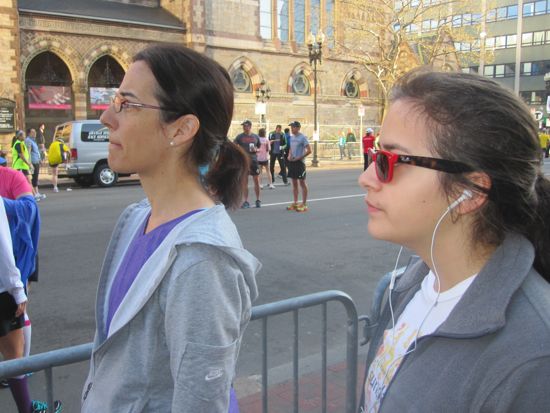
Before the race, Jane and Lydia contemplate the finish line.
I enjoyed this race more. There was only one hilly patch (near the State House), and my mental resources therefore were not focused on the stamina and positive self-talk needed to get up yet another one of the several hills in the South Boston 5K. My mind was free to think other thoughts.
After the start and as we were trotting up Boylston Street, I noticed a lot of women running past me in lululemon tanks with the ruffle down the back and several sporting lululemon running skirts. What, by the way, is up with skirts on runners? Do they hide something? Does wearing one communicate a dichotomy in identity? I’m pretty; I’m strong. What’s wrong with simply I’m strong?

Lineup gathers on Boylston Street in front of the Boston Public Library.
Speaking of sartorial runners, before Lydia surged ahead I pointed her attention to another mother-and-daughter pair near us who were in full makeup, foundation included, with hair carefully blown dry.
All those overt beauties ran past me along with many other runners who were fast starters. My ego felt vulnerable in the first few blocks. I was determined to pace myself, and yet it’s a little disheartening to be passed by just about everyone. I had a talk with myself and bolstered the self-esteem. Continue reading
Eli was home from college for a week. Even when he was quiet he made his presence felt by the traces he left here and there: a skateboard in the mudroom, canvas shoes near the door, and water glasses near the couch and his bed.
This morning I grabbed the last banana to caramelize for the waffles, and I saw that Eli may have picked up my tendency (and taken it to the next level) to see writeable surfaces in every scrap.
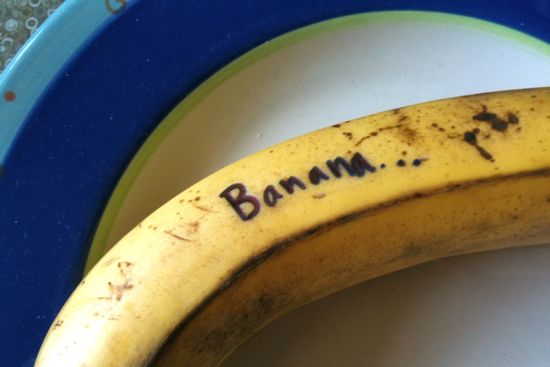
How do I know he wrote “Banana…” on the banana? That’s his handwriting and his sense of humor.
We’re having friends over for dinner tonight. Because I’m working until 5pm today, I cooked the main dish (the filling for Korean beef tacos) overnight in the crockpot. This morning I shredded the meat, strained the broth, and packed the meat and liquid into the refrigerator. Eli is home from school for a week, and I can imagine him rummaging through the fridge in my absence, finding cooked shredded beef, and sampling. And there would go dinner.
He’s still asleep. Soon I’m off for the day, so I’m left him a communiqué, taped to the Pyrex measure containing the broth to be boiled down later.
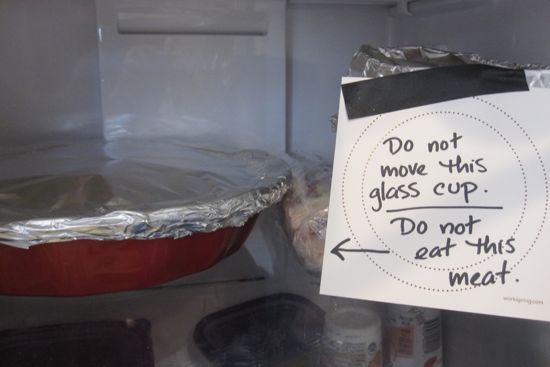
About me Lydia once said to Jimmy, “It’s so cute how mom leaves these little scrap notes everywhere.” Any paper bag, junk mail envelope, promotional note pad, newspaper or magazine page margin, notice from school, a stray and linty post-it note, or an old greeting or business card: these are writable surfaces and a good place for me to leave a list, note to self, or note to you.
This is the line that goes through my head every time I enter a Registry of Motor Vehicles, as I did yesterday with Lydia to get her learner’s permit.
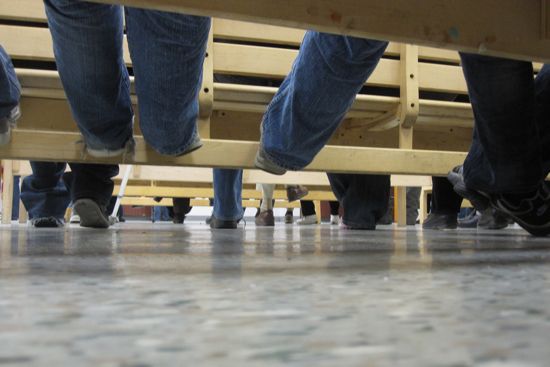
view from the floor, Watertown RMV waiting room, Feb 27 @ 4:23pm
While I don’t think my parents ever embarrassed me*, I do cross that line occasionally with my children. Usually they let me know and stop me from whatever I’m doing.
At the Registry, Lydia wasn’t too happy with me taking pictures of people in the waiting room. (Who knows when I’ll need a portrait of human abjection?) So I moved the camera to the floor.
Missions accomplished: learner’s permit gotten and pictures taken.
Yesterday, Eli was treated to some new pants on sale at the Gap and J. Crew. I predict that new pants are also in Lydia and Grace’s near future. If one gets, they all want.
This morning, 20 minutes before he had to leave for work, Eli presented me with a post-retail frustration: the security tag still attached to the seam of his Gap jeans.
Why drive back to the store when you can remove these tags yourself? I’ve done it before. I got a flat head screwdriver, hammer, and hacksaw from the toolbox, although in the end I only needed the screwdriver and saw and a few minutes.
It is just so typically me to come up with a moderately hard way to do something and only later find the simpler way. Go here and here to see how to do this in seconds with two sets of pliers. The second video even shows the mechanism inside these hard tags and why the two-pliers method works.
—–
Credit for images 4, 5, 6, and 7 goes to Eli Guterman.
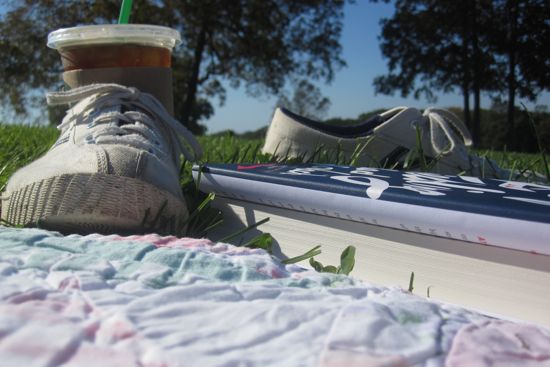
This afternoon at Larz Anderson, up on the hill. Lydia next to me, memorizing something Shakespeare for homework. Grace nearby in the shade, reading a murder mystery. I, like a cat in the sun, with the new book love of my life: The Art of Fielding. And of course the coffee.
 At some point, Lydia turning to me, “Happy October!”
 I stood at the reserves desk in the library where I could check out the assigned reading. This was in the fall of 1985; I was a junior in college; and this was before the age when text could be digitized and placed on the web. When professors assigned readings, students had to buy or borrow a physical copy of the text to read it.
Kathleen M., a senior who was passing through, saw me and walked over. She was funny, and I liked her. “What are you doing?” she asked me.
“Obviously, I am getting ready to do my reserve reading.”
“No one does the reserve reading,” she remarked. She smiled.
“What?” Wait a minute, I was thinking. She’s a brilliant student. (Kathleen went on to a top-tier law school.) Don’t all good students do all the reading? I did all the reading. It was killing me.
“Only read what you need to, is what I mean,” she said.
To me, reading meant starting at the cover, turning to the first page, reading the first word, and reading every word until I got to the last page — all the while taking notes — and doing this for every item on the professor’s list. Kathleen explained that I should look at the syllabus, see what was coming up next in class or exams or papers, and skim what seemed most relevant to what the professor was covering. “You can kinda tell from the syllabus,” she added.
The librarian returned, and I took the folders full of photocopied book chapters back to my table. I got out the syllabus and looked at lecture topics and exam and paper descriptions. Indeed, it was all right there, a set of clues as to what to read (and what to skim or even skip) embedded in the class schedule.
I didn’t read all the assigned reading word-for-word, that night or ever again. I figured out how to read what I needed to. This was a paradigm shift for someone who (a) loved (and still loves) to read and (b) took some pride in her academic duties.
Interestingly, I became a better student at that moment because it prompted me to start managing my work, as opposed to simply doing it, and I also believe I learned more. I also started talking more in class, which helped me learn more and become more visible.
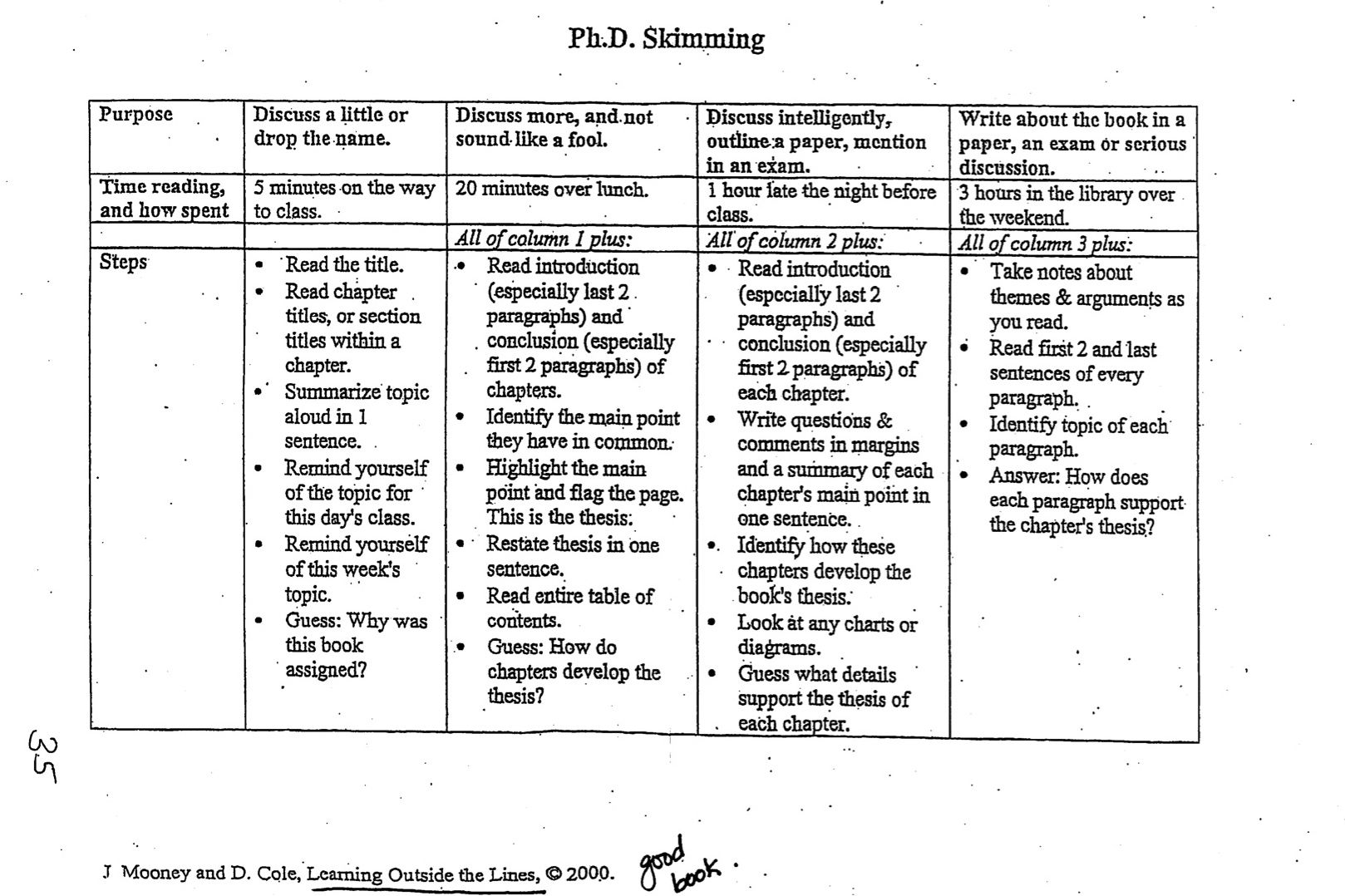
What would my professors have thought, if they knew I was suddenly reading less and sometimes skipping reading assignments altogether? As a college teacher now, I know that my colleagues and I put together our syllabi with great care and think and talk about what readings are fundamental to the course. When I taught at Simmons College, I recall one long lunch date with a political science prof during which she spoke agonizingly about her students’ failure to do the reading. “You’re a writing teacher. You must have them read stuff,” she said. “How do I get my students to read?” Continue reading
Many readers or watchers of The English Patient (I preferred the novel) were swept away by the romantic story line: the Count and Katharine, their illicit liaisons, the plane crash, desert cave, fire. And I? In both the film and the book, I was drawn to the nurse’s story: Hana, her makeshift hospital, and her care of the burned and disfigured English patient.
Real love, in my view, is seldom epic. It’s steady and practical, and it accumulates in small gestures.
 One of the to-do items on a long list of preparations and purchases for Eli’s move to college was mending. Months ago he left three pairs of jeans on the window seat in my room and asked me to make them wearable again. I don’t feel like mending during the school term — I’m too busy mending drafts, I guess — so I put off the task. Last week, a few days before my first child’s departure, I set up the sewing machine, looked at the pants with their three sets of problems, and sat down with scissors and sewing box.
Only one pair was ripped on a seam line, an easy problem to solve, although a rivet through three layers of denim created an obstacle for my non-industrial machine. Solution: remove the rivet, using a hammer and small chisel, and sew along the existing seam lines. Done.
Two pairs weren’t ripped so much as tattered. Eli, through use, had worn the fabric down in the seat and around his wallet pocket. “Couldn’t I just buy you two new pairs of jeans?” I asked him. “I love these,” he said. “Couldn’t you just try to sew them?” Then he flattered me: “Mom, you can do it.”
Anticipating that more fabric would be needed, Eli had given me an unloved pair of denim shorts to cannibalize. I cut patches from these shorts and pinned them to the tattered places. I tacked them in place using a zigzag stitch.
Then I dialed the stitch setting on the machine back to the straight stitch, and I randomly and repeatedly sewed back and forth across the patches. This was true patching, building up a new fabric, in a way.
I kept my foot on the power pedal, periodically pressed the directional switch to reverse (the “back” of the back and forth stitching), and watched the stitches gather and blur into each other. I switched thread color, from gray to light blue for the denim ones and khaki to stone for the corduroys, to increase the blurring effect.
I thought about leaving my signature somehow, writing a word in stitches that would be like a secret message — one so secret only I would know about it — for the mended pants to carry around as Eli wore them. Mom, Jane, love all seemed too corny. (Plus, how twisted would that be, to write your own name in your son’s pants?) I considered hieroglyphs, which would fit invisibly into the random stitching, or tattoos or Japanese characters.
No symbolic language, in the end, made it into the mended pants. After I finished sewing, I snipped all the loose threads and admired my own work. We threw them into the wash, and Eli folded and packed them into his suitcase* for college. The pants and Eli live in Vermont now.
*Wait, there’s more! In trying to lift Eli’s overstuffed suitcase into the back of the car, I hurt my toe. Of course, I had to find a way to write about that. I called it “Toe Story” and posted it on my other blog. Link. There were sequels: “Toe Story 2” and “Toe Story 3.” Link 2 and Link 3.
The neck of my 18-year-old son was bent over the bathroom sink, and I took this as a good moment to bring up the subject of recreational drug use. Eli was heading to Gathering of the Vibes, and he had spent the morning packing the car and communicating with the two buddies he was traveling with. Time ran out, and, instead of going to the barber shop, he enlisted me to cut his hair and shave his neck.
 “Eli, I know there can be a lot of fun and debauchery at these music festivals.”
Silence from the young man.
I pressed on. “On Sunday I read an article in the newspaper about this new drug – “
Eli interrupted me. “Yeah I read that. Bath salts.”
“Right, bath salts. Anyway, so a lot of times at these big public festivals, people are having a good time – and I totally get that – and sometimes doing impulsive things. Like saying yes when someone offers them a new drug. They think, oh, what the heck.”
Eli was shirtless, and my hand was on his naked shoulder. He sat on a desk chair I had pulled from a bedroom into the bathroom and faced the sink, not me. “Mom, everyone knows you should never buy anything from someone you don’t know.”
“I’m not sure you are getting my point. Eli, people are getting pretty fucked up from this drug. The damage lasts for months.” [Note: This is the first time ever I addressed Eli directly with the F-word. It was the best word in the situation.]
“Mom, I am not stupid.”
“I don’t think you are. But I do think people let down their guard when they’re having a good time and – “
“Mom, I am not interested in bath salts.”
“Well, I just wanted to bring this up so you could think about it ahead of time. I don’t want you to make a foolish decision and end up in the emergency room.”
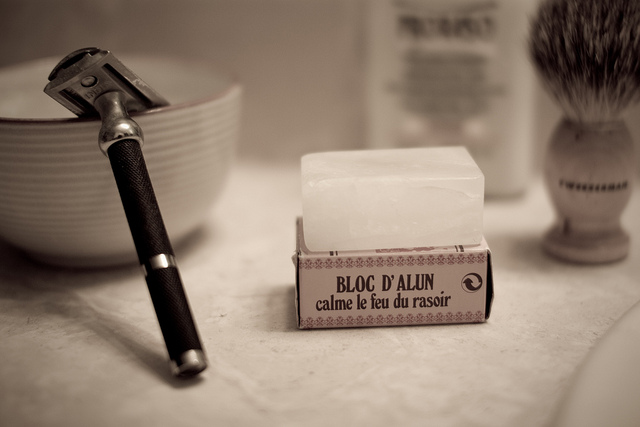
The wet shaving with a razor hadn’t been going so well, so I wiped the white Noxema foam off his neck and tried the electric shaver. Not as close a shave, but an easier go for me.
“Mom, did you ever think that article is exactly in line with the anti-marijuana propaganda of the thirties?”
“What?” I asked him. I felt disoriented, and I wondered if I had spaced out during some point of our conversation and lost the logic trail.
“So that article in the New York Times could be propaganda, attempting to frighten people just like how propaganda in the 1930s tried to get people to fear marijuana. Notice how the reporter didn’t include any information from people who were not hurt by using it.”
Whoa. He changed the terms of the argument. I never know what to do when this happens – when a smart and quick-witted person throws me a conversational curveball. Often, I end up mute, an argument loser.
“Eli!” I was scrambling. All I could think of was his name and my tone of voice: serious, plaintive.
“Hey, Mom. Be cool. I’m just playing devil’s advocate with you. Can’t you tell?”
His neck was as smooth as I could get it with my amateur hands and tools. I wanted to abort the conversation right there. There was no way I could win, persuade him, get him to the point where he would say, Mom, thank you so much for bringing this to my attention. Obviously, you care a lot about me and want me to be safe. I am going to heed your words. If only. Continue reading
 _____
_____ leaf stitch word