– Travelers’ advisory: Canada

Although I have often said that travel with children is more a change of scenery than an actual vacation, we managed to see new sights and experience rest and recreation during our recent trip to Montreal and Ottawa with four children: our own, plus John Tyler, Eli’s 17 year old best friend. It turns out we had much of our fun off the beaten path, which is often how things go.

Montreal

Vieux-Montreal (or the old city) spreads out along the seaway. It’s great for walkers, bikers, tram riders, and Segways, which Jimmy and the three older kids tried on our last day in town. The food there was not great on the low end, as my sister Em had warned; I can vouch for that. French fries and ice cream abound.

We did *not* go to La Ronde, the massive amusement park that is across the seaway and impressively visible from the boardwalk. No one in our clan likes roller coasters and other rides (which also explains why we, as a family, have never been to Disney World).

Of the touristy things we did in the “new” city — Biodôme, Insectarium, Jardin botanique, and Parc olympique — what we enjoyed the most was the Olympic swimming pool, which seems to attract more Québécois than visitors. For $3, a person can swim all day. We did that one day, and we liked it so much we went back again the next. As I sat on the side and watched the kids swim, an athlete (heading to the Beijing Olympics?) was practicing her dives off the highest platform and a team of synchronized swimmers, all wearing white caps emblazoned with the red maple leaf, practiced their routine on deck.
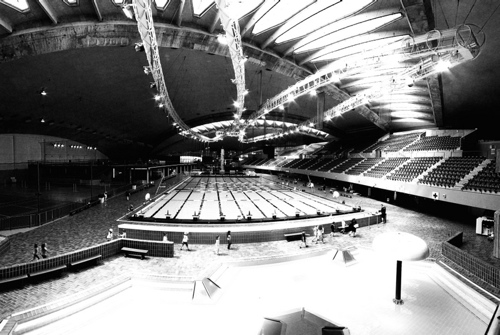
Pool, Parc olympique in Montreal

Pool, Parc olympique, Montreal

Because we were with kids, two of whom are vegetarians, we ate in a lot of pasta restaurants in Centre-Ville, where our hotel was. Groan. The food was forgettable at best. On our last night we drove north on Avenue du Parc on a hunt for Fairmount Bagel, billed as a Montreal institution. I pictured a sit-down deli, sandwiches, Dr. Brown’s cream soda. It was a storefront that sold good bagels indeed, but was not a deli. It was almost 8 o’clock and we had to eat somewhere. We parked. We walked around. Finally we found Le Petite Ardoise on Laurier Ouest. It was a delight. We sat on the terrace out back; the waiter spoke mostly French but was very kind and willing to try some English to translate the menu; the crêpes were just right for an outdoor nighttime meal. Later I apologized to everyone for dragging us out for bagels. Lydia said, “That’s okay. If we hadn’t come here, we wouldn’t have found the little French café.”
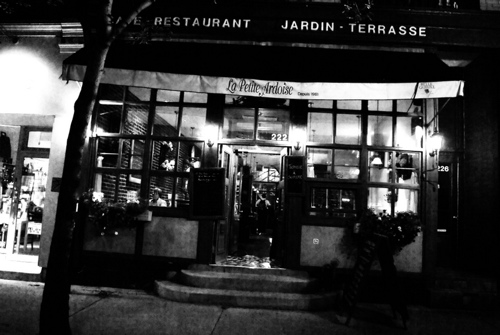
Le Petite Ardoise, Montreal

Le Petite Ardoise, Montreal

We had one why-are-we-doing-this? moment, at Oratoire Saint-Joseph, which is a pilgrimage site and the largest dome in the world after Saint-Peter’s in Rome. It was really late, and we had already been to a lookout at the top of Le mont Royal. At the cathedral John, Eli, and Lydia bounded up the granite steps, and Jimmy and I goaded Grace to keep going, up and up, 100 steps or more. She fell and banged her knee cap, hard, on a granite step, and then she fell apart, crying. Gently I tried to soothe her, and then get her start climbing again. (What was I thinking?) She sniffled, stopped, climbed, sniffled, stopped, climbed, and so on. I tried to distract her by telling her about this healer — Father Ralph DiOrio — who for a long time had an office in my hometown when I was growing up, and the stories of how he healed the sick and injured were dramatic and fascinating. Grace kept crying; I kept talking. Meanwhile, other visitors are walking up the stairs or down the stairs, passing us. We finally made it to the deck, to look out as the boys took their pictures, and then had to persuade the still weeping Grace to walk down. Really, it was an act of persuasion, not force, but still: What was I thinking?! The next day, Jimmy told me that another visitor, a woman, happened by us on the steps, just as I was telling the story about Father Ralph. She looked at Grace and then us, as if to say, “What are you thinking?!” Good question.
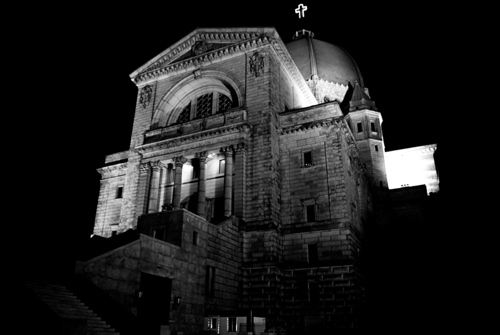
Oratoire Saint-Joseph, at night

Oratoire Saint-Joseph, at night

The next morning I told my roommates — Jimmy, Lydia, and Grace — about a dream I had in the night, in which I went to a religious retreat at a huge campground. Many of the people there were members of families that we used to socialize with as children (the Newcomers, the Fisets), and many were strangers. We were all waiting for the healer, who was taking his time coming. People were crying as they waited. I tried to comfort them. I kept saying the same phrase to them, over and over, and embraced each one. Grace wrote it down in her notebook, and today I came across the page, which she must have ripped out of hers and tucked into mine. This was that dream phrase:

You’re a stranger to me, but I love you, and I want you to know everything will be fine.

And so went my only vacation-time dream.

In Montreal I was not only a monster to Grace. On the last day, just hours before we were set to head to Ottawa, she and I went skating for a few hours on the indoor ice rink at Atrium Le 1000, a huge office tower at 1000 de la Gauchetiere Ouest, which was only one door away from our hotel, a Marriott. Why it took us until the last day to discover this, well, that’s the nature of vacation. As we whirled around the ice, with a assortment of skaters, I had that feeling of perfect rightness: This is where I want to be, now. Grace did, too. Usually a timid skater, she ordered me a couple of times to stand still at the side while she skated solo once or twice around the ice. Then, she ordered me to take a solo turn while she waited and watched.

Ottawa

I have less to say about Ottawa, and yet we enjoyed it more. It was our first visit. My mother recommended it as a destination, and yet when I told this friend or that about our plans to travel there, eyes would either narrow or open wide with skepticism. “Oh…. really? How… nice. Are you sure?”

It rocked. Canada’s capital, it’s lovely, walkable, outdoorsy, English, artsy, interesting. You can walk right up to government buildings — Parliament, for example — and not have a machine-gunned guard try to inspect your bags or keep you out. Hmm, how unlike another country I know well.
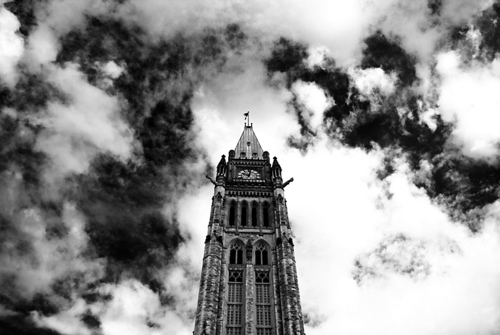
Parliament, Ottawa

Parliament, Ottawa

We had the same bad luck with food that we did in Montreal, but that’s not because there were no good restaurants; there are plenty. It’s just that our kids don’t want to eat in any of them. We did walk 18 blocks one night to Pancho Villa, at 361 Elgin, and we all loved the freshly-made Mexican food and the cheery waitress.

Our hotel was on the corner of Sparks Street, home to the city’s pedestrian mall, and the annual Buskerfest was going on while we were there. We saw more fire-eating acrobats in three days than any of us had in our lifetimes. And still, we kept going back for more…

Every night in the summer around 10 o’clock there’s a weird, yet affecting sound and light show at Parliament. Actually, it’s projected *on* Parliament. Lydia and I went. It’s very patriotic, and I tried to imagine myself as a Canadian. I felt proud.

During the day, we walked through Byward Market and passed by restaurants, food stalls, souvenir vendors, flower and vegetable farmers, and coffee and ice cream shops. Kind of like Fanueil Hall in Boston, times 10.

Jimmy and my favorite spot was also the place we had the least time in: the National Gallery. This may be the most beautiful museum I’ve ever been in. The way it uses its site and honors the art inside enlarges a person’s experience of a building. I can’t describe it. I wondered, as I walked through, if what I felt was akin to what people walking through those ancient, massive Greek temples felt, in their times. The art, especially 20th century Canadian, was something, too.

We hoped to visit, but did not, the War Museum, which we drove past on our bus tour. The guide told us that its building is the only one in Canada that is not visible from the air, because of how it is designed, like a bunker, with sloped sides and planted on its roof with grass.

Now that I’m home, I keep meaning to check this on Google Satellite.

—–

Pictures by Eli Guterman.
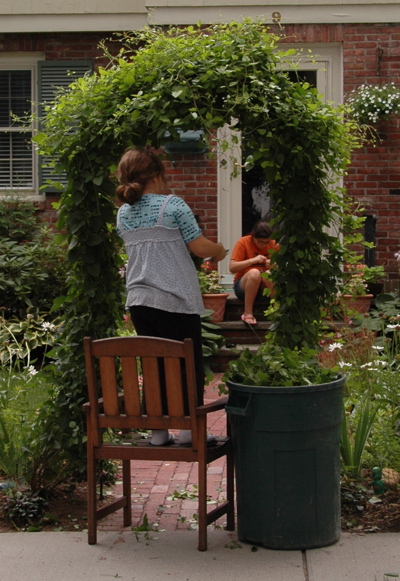
– After vacation: chores

It’s good to have a helper.

Grace, the little gardener, prunes the clematis arbor.

Grace, the little gardener, prunes the clematis arbor.

My other helper sits in the background, where only moments ago she checked my hair for lice, which has descended again on our house. To the back of my head Lydia said, “Dammit. White hair and white nits. I can’t find anything.”

Upstairs, staff photographer Eli is hard at work at the desk, editing and archiving photos, a few of which I hope to publish.

Someone has to wash the kitchen floor, and I think it will be me.

– During idle minutes

Like Jimmy, Lydia likes to be extra on time, or early. So, at her urging, we took our seats 15 minutes before departure time on La Balade, a open tram that scoots its passengers along the waterfront in Vieux-Montréal.

We were sitting in the back row, Lydia’s choice, for the best view. I agreed, “Yeah, we have the future in front of us, and the past behind us.” I spread my hands as if introducing a prize on a game show.

Lydia: “Not really. It’s more like the present is in front of us. We can see it.”

Jane: “Okay, yes. I guess it wouldn’t be the future…”

Lydia: “… if we can see it.”

We sit there quietly for a while and watch people who are not in the tram go by us in bikes and on foot. It’s breezy and sunny.

Lydia: “Well, actually, the present only lasts this long.” She holds her thumb and index finger together so that there’s space between them for only a raisin, maybe. “I mean, once I even say the word present…”

Jane: “… it’s gone?”

Lydia: “Yeah.”

The tour starts and we are wheeled up to the locks (west). The narration is on a tape that alternates between French and English. I like tours, but I lose track of the voice on tape.

The driver turns the tram around, and we head east. He stops at the clock tower and gives us 10 minutes to explore. Jimmy and I stand near the river and remark on how swiftly it flows, how huge it is. We go back to our seats in the tram, where the girls still sit.

Grace has turned around, and has rested her arms on back of the seat and perched her chin on them. The girls, therefore, are facing in opposite directions: Lydia, forward, Grace, back. We wait again for other passengers to return.

Grace: “I love the past. I like looking at it.”

Jane: “Maybe you’ll be a biographer.”

Lydia (sighing and rolling her eyes): “I hate the past.”

The tram eventually starts again. This was Sunday.

– Out of nowhere

Lying on the couch in that early morning daze, Grace just asked me,

Mama, can people marry objects?

I had to stop and think.

I don’t think so.

Grace asked a child’s inevitable follow up question,

Why not?

Of course, not being a legal scholar, I had no answer. Her logic for the impulse that sparked the question, however, is irrefutable:

People should be able to marry something, if they love it.

I thought about describing marriage as a socially-constructed institution that preserves a status quo and testing her notion against that theory, but then thought, She’s only eight, so I’ll wait.

– Arts camp

Today is Festival Day at Creative Arts at Park. Parents walk around, watch performances, meet teachers, and see their children’s pictures, objects, and sculpture.

I’m in the air conditioned room where the juvenile writers work. I can’t resist checking my e-mail and pretending that I’m a young writer at camp; I put words in a file because it’s my turn. It’s fast and freeing. It’s my 20-minute, unrevised blurt:

*

13 Ways of Looking at a Guterman

*

1. You see the hair: head, brow, lash. Circulation, blood: that interior river sprung.
*
2. Each finds their own place. Friends are places to hide. Friends set you free.
*
3. Sound frees, freaks, frets. Guitar has frets. Lydia frets. Grace freaks. Eli, “Free us.”
*
4. Strings attach you. Blood ties and sometimes it leaks. They bleed they cry.
*
5. In bed, dreaming. Limbs stir and breath is slow. They submerge themselves in worlds not known.
*
6. Rhyme, they don’t. Different, they insist and take and beg and bargain. No five-year-old Jesus comforts them. No sparrows.
*
7. Food in cupboards, stashed. Cooked, they don’t eat. Hidden, they gorge themselves. We starve them; there will never be enough.
*
8. For us, too much sometimes. Three pairs of legs, arms, nostrils, those eyes. Three times ten toes. Digit after digit after digit.
*
9. Pixelated beauties, freeze. Stop time. Blow smoke in their faces. Breathe in.
*
10. Ions and electrons, slow down. No slouching towards Bethlehem, you rush.
*
11. Heads together, they share ideas and parasites and propagate both widely. I pick and pick and those damn notions and lice return.
*
12. Return they won’t. Gone, gone, gone – every new day, an old one gone.
*
13. Old clothes and battered shoes. Papers and artifacts. What they sound like. These we hold fast to. What they smell like? Atoms dispersed. Join the air.
*
*

Eli looks over my shoulder and says, “Mom, let me read it.”

He reads it. “Uh, I don’t really get it.”

Jane: “It’s not literal.”

Eli: “Okay.”

*

At 12:15pm we have three children in three separate performances in three different spaces. There are only two of us. Fractions.

*

– Midnight costumer

An eight-year-old child comes home from her arts camp on the second-to-last day and says to her mother, “Peggy says I need to wear jeans tomorrow.”

The mother, who knows that (a) the girl has no jeans and (b) the girl doesn’t like jeans, asks, “Why?”

The girl says, “Because I need them for my costume.”

Ah, yes, the last day of camp is filled with the performances and art shows the children have been preparing in the intense five-week session.

The mother offers to alter her own jeans skirt.

The girl refuses it. “Mama, my character is a man. So I can’t wear a skirt.”

The jeans make sense; now the mother remembers that the girl plays Frank, whoever he is, in Annie Get Your Gun.

So, mother and daughter head to the fabric store and buy stretchy, denim-like fabric (that’s not denim!), a “quick sew” pattern, and notions. We come home, eat dinner, and get through the evening activities, including girl’s bedtime.

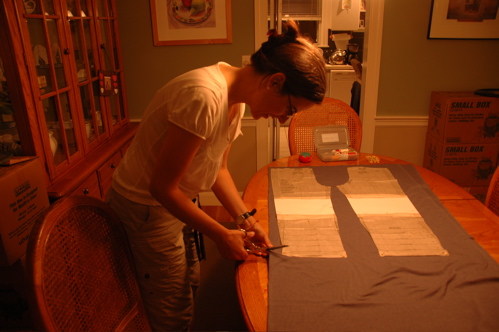
And here’s a picture of the mother, at 10:30pm, about 12 hours before the curtain goes up.

Jane cutting fabric for Grace's faux jeans

Costume Department

Photograph is by girl’s father.

– Nuggets

We overcame family inertia and went to Halibut Point State Park for the holiday. Even though it’s not open for swimming, we thought that the kids would find the quarry fascinating.

In the van on the ride up to Cape Ann, one of them introduced the topic of wills. “Hey, what happens to us if you guys die?” was the opening question. We all discussed this at length, and Jimmy and I outlined our so-called “estate plan” (who gets them and our life insurance money). The three of them called for a revision, and they had some good ideas. Eli offered to become guardian of the girls if he’s 18 when we die: “I would take good care of them.”

Grace eventually called for an end to the conversation. She also doubted the likelihood of such a catastrophic family event, saying, “Mama can’t die.” Eli answered, “That’s right. She’s a machine.”

I asked them all about words they disliked. (This is a game my sister Sally came up with years ago.) We had fun with this. Lydia answered so quickly, it was almost as if she were waiting for a chance to say them.

Lydia: I hate the word girdle. And jiggle. Oh, and jelly. But I like the word jam. And I don’t like the word gravy. Or regurgitate.

Eli: When I was younger, I didn’t like the word vat. And now I don’t like when people swear in a way that doesn’t sound good. Like when they’re trying too hard. It sounds good in a movie, in dialogue, but not when people talk.

Grace: I hate the word empathy! It sounds like one of those pencils that don’t have an eraser and scrape my ears! (She mimed putting her hands over her ears.)

Jane: Here’s a word I dislike that students use all the time, once they discover it: plethora. I also dislike moist. Yet I like wet. And I hate the word vinaigrette.

Jimmy: veggie.

Words they liked? Simultaneous (Eli). Pathetic (Grace). Linoleum (Lydia).

Someone’s iPod and speakers made the rounds among the backseats, and the three of them took turns playing DJ. Eli played “Upside Down” by Jack Johnson and said that his camp’s folk band is doing a version of it. (That should be an improvement.) Grace picked “Soulja Boy” by Soulja Boy (good thing she can’t decipher the lyrics). Lydia, who has an ear for singers and loves a song that’s a real song, treated us to “Mercy” by Duffy. Watch this (there’s fire), and listen:

Before we headed to the quarry, we went into town to get some lunch. Lydia, who has been to Rockport the most recently of all of us, with a friend and her mother, blurted, “I know a good place to eat! It’s like a fish house, but it has grilled cheese.” We looked for such a place; we found one.

At the quarry, finally, the kids, who are all excellent swimmers, wondered why there was no swimming allowed. “Someone could drown,” I speculated. They wondered how deep it is. I guessed 100 feet and then discovered later that it’s 60. We found some gravel and threw it in. They pried up egg-sized stones, stood at the top of 40-foot ledges, and tossed them in. Plop. Grace and Eli found a few rocks the size of, oh, lunch boxes. Only Eli was strong enough to heave them in, which he did. Humongous splash. By that time, he had an audience of two elderly people and their grown daughter, who misread a caution sign and kept calling the park “Danger Quarry.”

None of us fell in, but Jimmy experienced many times that parent gut-clutch, when kids get too close to the side, which they did, many times, because they’re kids.

Of course, everything fell apart on the ride home. I drove. There was teasing, “monkey bites” (a kind of pinching), and parental irritation. Many times Jimmy told Eli (future guardian of the girls?) to keep his hands to himself. Grace cried. Lydia giggled. I said to Jimmy that I wished there were a way to call ahead and have a pot of coffee waiting when I walked in the door.

We made it.

– Opinions

As dinner ended, Lydia, Eli, and I discussed our summer trip. (Grace had wandered off to the television; Jimmy is at a dinner meeting.) Eli is impatient for us to nail down the date and destination. The children have opinions, which enrich but complicate the process.

Lydia (suddenly): I know! Let’s rent one of those coach buses for a few days. What do you think it would cost? It would be, like, a great family vacation. All the Kokernaks could go to New York for the weekend.

Eli (loudly): Lydia! That’s like communism — it sounds like a good idea, but it isn’t.

Back to the drawing board.

– Number one fear?

For weeks, Grace has been preparing for her animal research project, which is the culmination of the second grade curriculum. Out in the garage, with the door open, she constructed over many days a diorama that featured the elephant seals’ habitat. In the basement, on the kids’ computer, she searched Google for “elephant seals” to find what she called “quick facts.” (They are carnivores and eat skates, small sharks, and other fish, by the way.) She talked about an upcoming “oral presentation,” yet the design and rehearsal of that happened entirely at school.

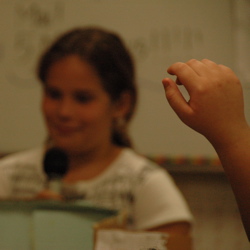
Raised handOn Friday, we went to school, sat in the back of the classroom, and watched Grace and her classmates, one by one, give their presentations. The room was arranged like an auditorium, with a table as podium at the front and the desk chairs arranged in rows. There was a microphone, into which each child spoke as s/he read aloud her prepared remarks. After the formal presentation, each speaker asked, “Any questions or comments?,” and then called on raised hands. Remarkably, what happened during the Q&A is what happens during the Q&A of presentations made by many adults: The speaker relaxed, smiled, and seemed more natural and engaged.

Children have less polish and guile than we do, so there’s something very raw about the behavioral “data” they present for our scrutiny. In this instance, the eight-year-old presenters gave me an opportunity to wonder this: Why does even a practiced, rehearsed professional speaker seem stiffer, less natural, than the same person during the Q&A?

I have always been skeptical of that claim that Americans fear public speaking more than any other fear, even fear of death. This source points to a 1973 survey by the Sunday Times of London that initiated that now wildly-held belief. Of 3,000 respondents, 41% listed public speaking as their number one fear. Hmm. About 1,200 Americans — many of whom might be dead by now — have got a lock on our fears. I, for one, do not fear public speaking over fear of death, or the death of anyone I love, or my fear of woodchippers. Let’s put this survey, and its outdated data, aside and actually examine this fear. Whether it ranks first or tenth, it’s still real. Continue reading

– Hazards of reading

This is an approximation of a conversation I had with Grace recently. While I did not invent her remarks, I did cut out some of the repetition. There also were a lot of thoughtful pauses I have eliminated.

Grace: How old do you think you’ll be when you die?

Jane: Old, I hope.

Grace: Who do you think will die first, me or you?

Jane: Me.

Grace: Who do you think will die first out of me and Eli and Lydia?

Jane: I don’t think about that. You all will live a long, long time.

Grace: Why do people have to die?

Jane: Because their cells wear out and they can’t last forever.

Grace: Why can’t we live always?

Jane: I’m so sorry. I know. I promise, though, you will live a long, long time and life will feel long enough.

Grace: How long?

Jane: Grace! Could we talk about something else? How about… what are we going to do tomorrow?

Grace: I can’t help it. I just keep thinking about this.

Jane: Why do you think that is?

Grace: Because I’ve been reading biographies.

Jane: Oh?

Grace: Yeah. And I’ve noticed — people are always dying in them.