Link.
word
That’s not me, or is it?
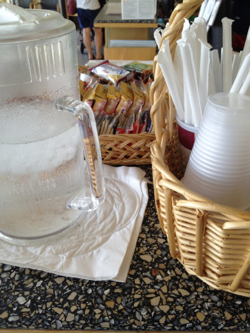
clinic comfort station
For several years, I have periodically visited a hospital clinic to see a specialist about my anemia. The clinic — Hematology/Oncology — mainly treats very sick people. As I have waited in the waiting room, mentally I have set myself apart. “That’s not me,” I have thought with willed conviction, seeing a person in a wheel chair across from me or hearing another person’s muffled crying in the alcove where they take our vital signs. (An essay I wrote on a moment in this waiting room, where I witnessed a doctor ask his patient to dance, is published here: link.)
I was there again in this clinic a few weeks ago, on a Wednesday after lunch. Typically, the mood is subdued. It’s a very serious place. This time, though, the emotional container seemed to have burst. As I stood at the check-in desk, a woman ran into the waiting room from the adjacent treatment area, sobbing and calling for a doctor by name. Couples came in holding hands tenderly. I saw a woman, about my age and very thin, shuffle in. As she leaned on the check-in desk to state her name, her white tshirt clung to her trunk and I could see that her abdomen was the site of large tumors. She and her husband sat near me. They murmured together, about the tumors. He was a very good helper: he listened, he placed his hand on her back for a little while and then removed it (so as not to tire her out being helped, I thought), and he did not take over.
I tried, as usual, to stay detached, to think of myself as not that sick and therefore not of them. But I couldn’t hold the pose. What was it about this day? The chemistry of it, perhaps. My thoughts went in a different direction than usual, more stark. I ruminated on sickness and health not as a binary but as a continuum. We are all on it, and our position on the continuum changes as we go through life. And maybe we can find ourselves occupying two points at a time on this continuum. For example, although I have diabetes as a diagnosis (and it is a disease), I take care of myself and identify myself as a healthy person.
Maybe it would be better to give in, I sometimes wonder. On this day, I did for some reason feel vulnerable as I sat in chairs, waiting. “We are all sick, or will be someday,” I mused. It turns out, although I could not have predicted it, that my body is not quite as I thought: link. I do belong, not to the cancer club, but to the human one.
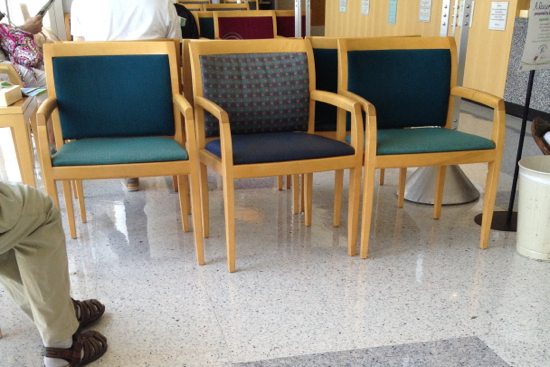
waiting for patients
Hovering over a lake of words
We gave ourselves an assignment: write every day for a week, minimum two minutes each time with an ideal goal of 30 or more. This was in response to our constant wailing, in our weekly chats, about how work and life get in the way of writing.
James will have to report on his own results, but mine showed that, even though I write for work many hours every day, I don’t write for the creative projects I claim to be longing to do. Words are all around me — they are the stuff of how I make my living — but I am not immersed right now in any creative project even though I often feel as though I am on the verge of one. Ironically, instead of using this self-imposed writing week to dive into a creative project, I felt compelled to interrogate myself daily with the question that could be boiled down to this: With all the writing I do, why am I not ‘writing’?
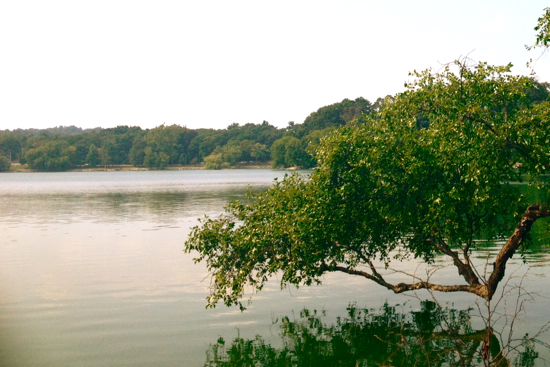
tree branch, Jamaica Pond, August 27 2013, photo by Lydia and editing by Grace
Below the jump I have published an excerpt from each of those seven days. Even though these reflections and rants are not necessarily essay-worthy, I did enjoy seeing how my unpolished, unstudied writing could yield some straightforward insights in unfussy language. Too often I feel my prose is the product of too much crafting. My free writing is free of my cool pose, and I like that in places.
Next assignment? If we are to continue with the daily writing, James and I will put aside the fretting about not writing and, instead, do the writing. My topic this week is anger. My hope is to jump start an essay I started and put aside a couple of years ago.
Alone time and its treats
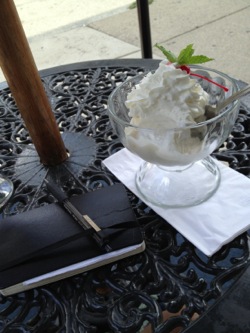 Today’s post, in lieu of an essay, is a set of notes I took during a two-hour lunch break last Saturday in the middle of the Children’s Literature Summer Institute (blog post here). It was sunny, after days of clouds and rain, and I wandered over to Jersey Street for Thai food, wine, dessert, and the solitude that happens on city streets and in restaurants. I sat alone at one of the three tables with umbrellas on the sidewalk out front, and the waiter did not rush me. I wrote — about the conference and what was going on around me. It looks like I made some thought or section breaks as I wrote, by inserting horizontal lines; I kept them in this transcript:
—–
Everyone [speaking at the conference] seems fully to make their living from art — only Yee even used words having to do with money + employment.
I surmise though that speaking at these conferences helps writers/illustrators connect with school librarians who hire them to speak at their schools. In fact, the school librarians I met mentioned specifically that they were hoping to bring some of their artists to their schools. There seems esp. to be budgets for this in K-8.
For me, this kind of environment is really inspiring — gets me wanting to do this, to value it as important.
The YA novelists talk about themes in their novels that were themes in their teen years. They keep trying to work them out. How did I stop my YA novel so easily, worrying about neurosis? This is the territory — maybe writing is not the way of mental health. Continue reading
Hands down, the best literature conference anywhere
This past weekend, I attended the Children’s Literature Summer Institute 2013 at Simmons College, my graduate school alma mater. Among academic conferences, it is one of the best, managing to be smart and profound but not stuffy. As Lois Lowry, the keynote speaker, conveyed in her talk: We are all in this world of children’s literature together.
About 150 people – teachers, writers, illustrators, grad students, librarians, editors, scholars, and fans – attended. Strangers were instantly affectionate. The featured authors and illustrators were approachable. I made a conference friend, a school librarian who is also a Simmons alum, and I really enjoyed having one person with whom I could continuously share impressions and enthusiasm. I also loved being at Simmons again and remembering my professors, my friends, and my years of learning.
I gathered much good insight and advice from the many author and illustrator talks, which were all prepared and differently framed around the Institute’s theme for this year: Love Letters. I took notes. I hope it will all stay with me, motivating me to return to some projects I have set aside in doubt and helping me stick with them.
From my notebook: a list of the speakers, in order of their appearance, and ideas and inspiration I wrote down as they spoke. There are 13 of them, a baker’s dozen. Keep reading after the jump.
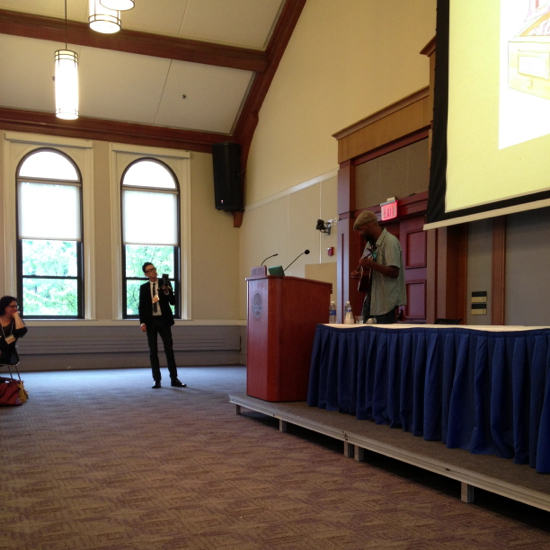
Shane plays; Jack records.
1. Shane Evans, illustrator and writer: website
He gives himself an assignment to journal on the same topic for 41 days. The topic might be truth or love or some other big idea. He does this “because I’m lazy.” Once, for 41 days, he asked a different person every day the same question and photographed him/her and then put it all on his website.
Interesting metaphor: mountain top vs. valley. “Nothing grows on top of a mountain; it can’t breathe. We have to go down to the valley; it’s where nurturing happens… We talk about highs and lows – what’s wrong with the lows?!”
He showed a slide of works from 10 visual artists who are his inspirations. I wonder: who would be my 10 inspirations? What would it be like to take a work from each of them and hang it over my desk?
Shane is also a musician – went to college with Taye Diggs – and got us to sing along with him… TWICE.
2. Deborah Freedman, illustrator and writer: website
She is a former architect. Looks at books (physical ones) as “a spatial problem.” She said, “a picture book creates a space.” She believes an iPad won’t do that, or can’t do that yet. (I wondered, “Why not?”) She likes things she can touch; she likes things that exist in space: “I like the book.”
Talked about balancing “intuition and rationality.” She does that in her sketchbook; she starts a new one for each project. Once she has an idea, the first thing she does is to “go to the library and look at every book about that idea.”
In picture-book making, pacing is very important. She works this out in a storyboard, and she’s constantly “pacing and re-pacing.” (I noticed that pacing is a quality of stories and books that several of the writers or illustrators mentioned in their talks.)
Tight limitations are a gift, she said, using those words exactly. I liked her.
Gardening is revising
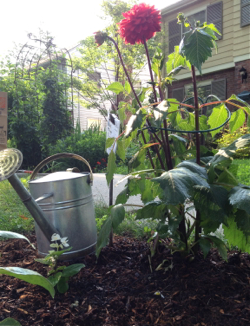 I hadn’t really planned to garden on Saturday — I have been fantasizing about a day of decadent rest with books and a lightly spiked drink — but after Jimmy and I dropped Lydia off at 6:30am in the South End for the first leg of her trip to Vietnam and Cambodia with Boston Children’s Chorus, I had a hankering for both dirt and improvement.
“How would you feel about a quick trip to Home Depot? I believe it opens at seven.”
“Sure,” said Jimmy, the driver.
By 7:30am, we had pots of sunflowers, flats of ground ivy, and one red dahlia, which I had to buy because, as I told Jimmy, “It’s alone, and it needs me.” It was the last dahlia in sight.
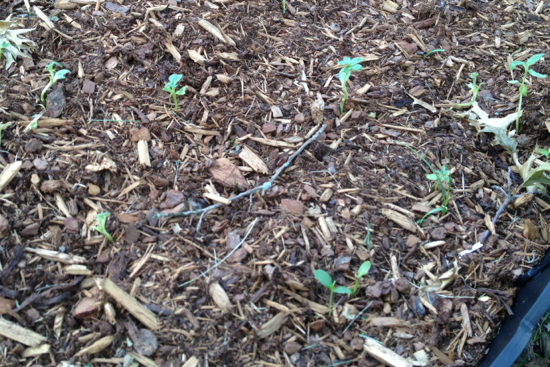
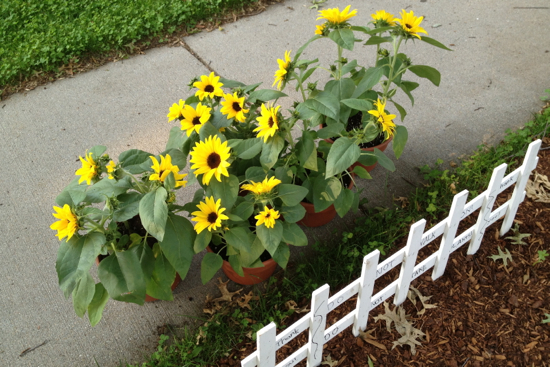 The sunflowers that Lydia and I planted a few weeks ago never really took off. I blame the black landscaper’s cloth; I should have used the white cloth I used for my first folly. A few seedlings came up here and there but not enough to insure a burst of yellow in August. Instead of giving up and throwing down grass seed, I thought I’d help nature along and augment our few babies with some adolescent plants from the nursery.
 By 8:30am, they were planted in the two narrow rectangles in front of the house between the road and the town sidewalk. The dahlia doesn’t really fit, but she needs sun too, so I nestled her in with the sunflowers.
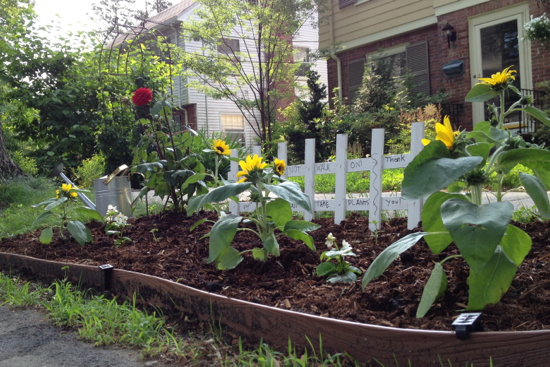 After we had a coffee-and-dog break, Jimmy went back to Home Depot for some rolled sod, which was scheduled to arrive in the store at 11am. Meanwhile, I started digging up the area around my path to nowhere. The heavy rains mid-June had pounded away a lot of the grass seed, and the water also revealed some stones that had been too deeply set. They were enough below ground level that a huge puddle formed, about two inches deep and three feet in diameter. The birds were happy, but I didn’t make the path for it to become an occasional birdbath.
 As I dug, I thought about writing and especially about revising. It can be very exciting when you jump into a new project full of energy and vision. The satisfaction of finishing a first draft — whether it’s a poem or a new flower bed — reflects a glow onto the work itself. For a while, the draft can shimmer in beauty simply by virtue of being done and having an existence outside the maker’s head. But then some time passes, whether days or weeks, and shimmer fades and the reality of the draft reveals itself. There are awkward phrases; there are gaps; and there are puddles that make only birds happy.
Jimmy returned with the sod, and he dug too. We got dirty, and the closer we got to getting done, the messier this revision became. I tossed rocks to the side as I came across them. We pulled up stray roots. I wondered of course why I was re-making a path to nowhere. The world doesn’t need it.
At one point Jimmy, noting my tight-lipped fatigue, suggested that we put the tools aside and get back to it next Sunday. I looked him in the eye and said, “We have to finish it today.”
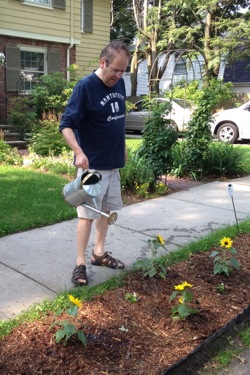 In the middle of revision, even though I enjoy having something to work with and puzzling over problems, it often starts to look worse before I can make it better. In such moments, it is tempting to put the hard work aside and fall in love with a new project. People say the blank page is scary, and it can be, but it’s also full of possibility: a screen I can project my hopes onto. In the middle of a revision, it’s easy to lose heart, because I can start to see what my poem or essay or sunflower folly or wandering path will not become.
And yet only by finishing it will it become something. So we dig, shovel, smooth. We finish, as well as we can.
Teacher as learner, learner as teacher
Friday I went to the studio of my MIT friend/colleague Juhan, for a critique meeting for Health Axioms, a project for which I’m doing (freelance) editorial work. On my way in, one of his colleagues, whom I’ve met a few times, said to me, “Jane, I read your article on teaching MIT students. Very nice.”
If you haven’t read my reflection published in Technology Review on teacher as learner — and, by extension, students as teachers of their own work — here it is: link.
Paddle out, paddle out
At some point, the ideas become too many, and the pressure to write them becomes too great. The documentation of real life has its limits. Fiction seems roomier, or at least different.
So I begin. I start in a place I know, the setting for the story I have imagined. I writer, stop, write. The story starts traveling far away from the point I imagined the protagonist would travel to. I don’t know where she is heading anymore.
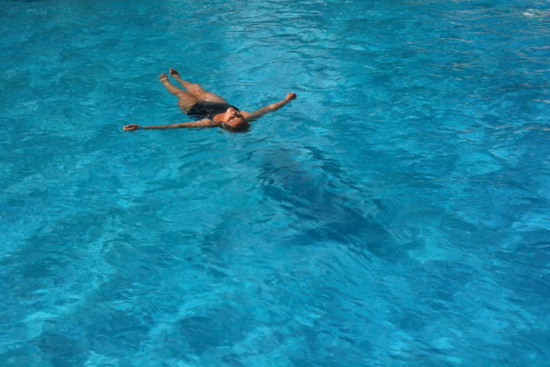
summer 2012, south boston swimming pool
I tell James, during our weekly hangout, “It’s like I’m swimming out, past the lifeguard buoys, and I keep going.” I wonder if I should turn back — to try forcefully to get back to the place the story began for me. But it’s going somewhere else.
James says, “It’s okay if you keep swimming out. That’s the good thing about metaphors.”
It’s true. I won’t drown.
What may be happening, he explains, is that in fiction we are writing a bunch of things at once, and wanting to deal with them all at the same time. “All these things come into the mind all at once” — and this is motivating, it keeps us going — but we have to deal with them separately, one or two at a time to give them the depth that the story wants.
And this going out, farther and farther, this might change the story.
Paddle out.
“Anxiety is based on the assumption that there is this perfect version of the story waiting to be unveiled,” he adds. “But there is not only one way; there’s a bunch of ways.”
Paddle out.
“Because it’s writing, you can stay out for weeks at a time. You’re not going to starve. You’re not gonna die of dehydration.” He pauses and laughs at his own joke in advance: “And maybe you’re a whale.”
I laugh, too, picturing myself.
That means I can dive under deep.
“But all the possibility is out there, so why would we tether ourselves to the land?”
I do not know where the story will go. I write, the narrative meanders, and I have to adjust my vision of it. And then I go farther, the story changes, and the vision is adjusted again. The story feels as though it is a few inches in front of my understanding, and I take a stroke, float closer, and it floats a few inches away again.
So I paddle towards it. I wonder if finishing will feel like getting back to shore, or reaching an island.
Blurt out, babble out the first draft (says John McPhee)
My favorite part of John McPhee’s recent essay in The New Yorker on first drafts and revision is the text of a letter he wrote to his daughter Jenny McPhee (now 51 and a novelist), when she was a senior at Princeton High School and frustrated by her inability to get things right the first time.
Dear Jenny:
The way to do a piece of writing is three or four times over, never once. For me, the hardest part comes first, getting something — anything — out in front of me. Sometimes in a nervous frenzy I just fling words as if I were flinging mud at a wall. Blurt out, heave out, babble out something — anything — as a first draft. With that, you have achieved a sort of nucleus. Then, as you work it over and alter it, you begin to shape sentences that score higher with the ear and eye. Edit it again — top to bottom. The chances are that about now you’ll be seeing something that you are sort of eager for others to see. And all that takes time.
What I have left out is the interstitial time. You finish that first awful blurting, and then you put the thing aside. You get in your car and drive home. On the way, your mind is still knitting at the words. You think of a better way to say something, a good phrase to correct a certain problem. Without the drafted version — if it did not exist — you obviously would not be thinking of things that would improve it. In short, you may be actually writing only two or three hours a day, but your mind, in one way or another, is working on it twenty-four hours a day — yes, while you sleep — but only if some sort of draft or earlier version already exists. Until it exists, writing has not really begun.
Entirely by John McPhee. A writer could go a long way on his advice and reassurance.
All the dead and ruined young lives
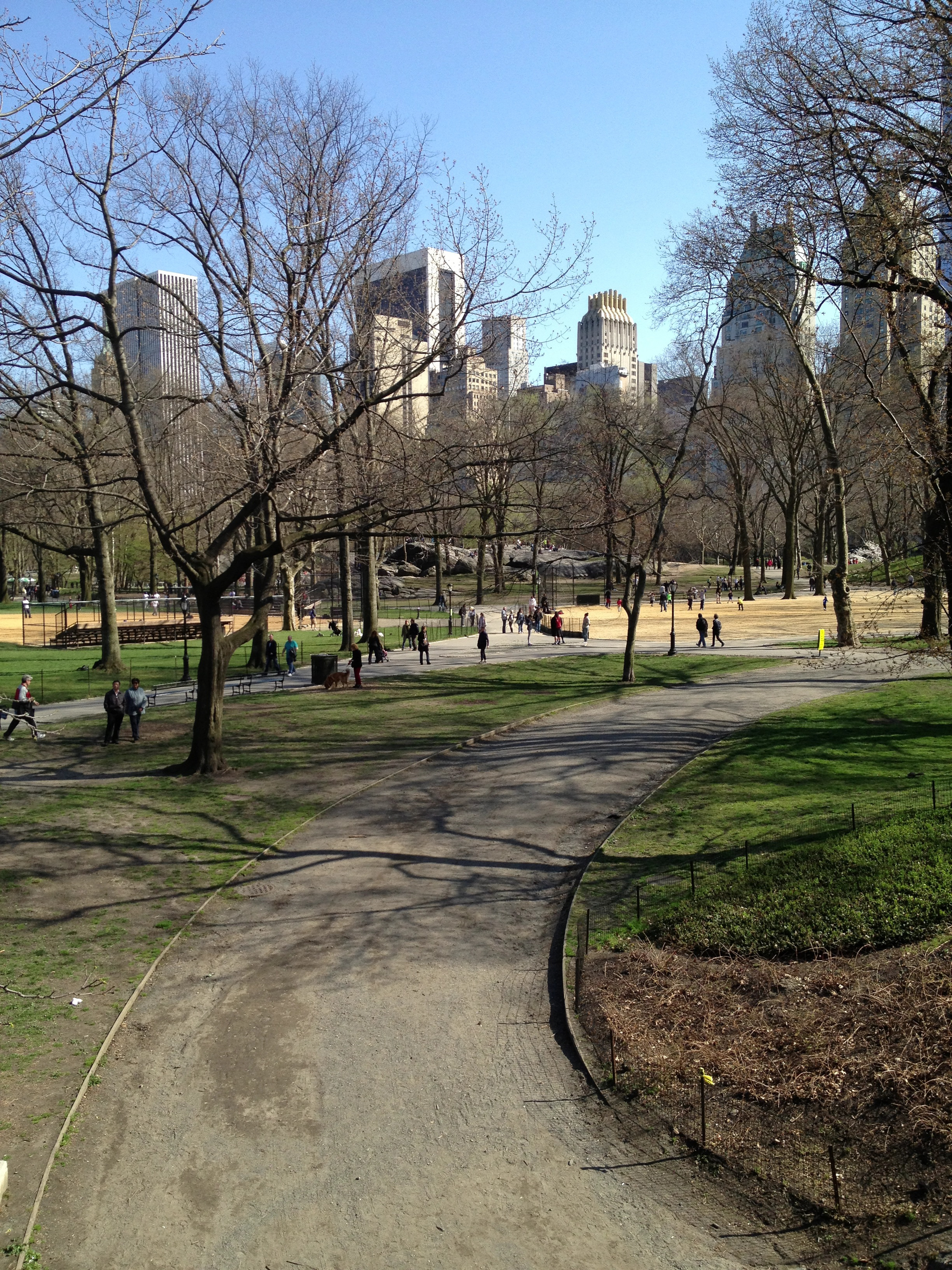
Central Park Running Path, 4.15.2013
On Monday, April 15th in the afternoon, Lydia and I were walking through Central Park from the Guggenheim down to Columbus Circle. It was the end of a two-day trip to the city to see a college that Lydia is interested in applying to.
I kept looking at my phone because the walking paths curved here and there, and we followed them and yet still wanted to be headed generally in a diagonal across the park, so I needed the Google map. In the Ramble, I got a text from Jimmy:
There appear to have been explosions at the finish line of the marathon. We are at the arboretum, far away.
I did not know enough to worry, and I ignored the text. Maybe “explosion” meant firecrackers launched by naughty kids.
Lydia got a message from a friend about the explosions, and she followed up. Perhaps she is more easily alarmed than me, by personality or age. “Mom!” she said something like this, urgently, and conveyed the seriousness of what had happened.
Our walk to Columbus Circle — to go to Whole Foods to get something to eat on the train before we headed to my sister Emily’s office and then Penn Station — lost its power. The beautiful spring day seemed to be happening to other people. Lydia even remarked, as we passed New Yorkers, that they probably didn’t know yet.
I did stop to take this photo (above) on a bridge that looked over a playing field and what is called Central Park Running Path, according to the geographic locator in Instagram. Lydia discouraged me from taking more, claiming that our moment for picture-taking was gone.
I didn’t know what I felt: distracted, there-but-not-there, worried about our travel plans.
When we got to my sister’s office near Penn Station, we heard more. We watched videos on our phones and my laptop. We discussed. The word “amputations,” more than any other detail, provoked whatever it is I felt, and those feelings I could not name.
 leaf stitch word