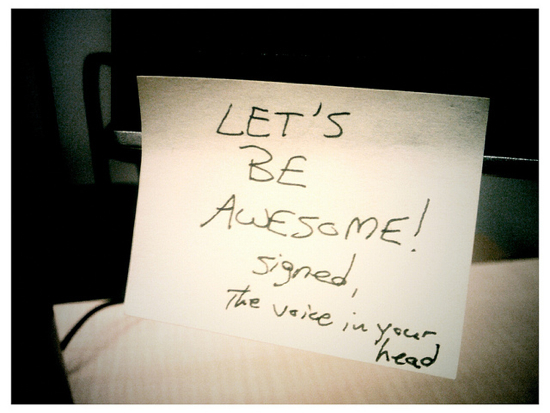
Imagine a point in the future when you will look back at this moment

be awesome

There is this notion of “anticipatory regret” that is supposed to make you avoid doing something bad by anticipating or imagining the negative consequences of the action. You know, you won’t lie if you imagine untangling yourself from the inevitable web of lies spun out of the first one.

Years ago, I read the novel Therapy by David Lodge. For a long time, I attributed to that novel a different, more positive take on anticipatory regret: that it can help you do something good and desired that you imagine feeling future sadness about if you don’t do it. As I remembered the plot, I recalled that the middle-aged Tubby, who was invited to go on a pilgrimage with his former sweetheart, goes with her because he imagines that someday he could deeply regret not going.

I recently re-read Therapy — which sadly does not hold up well, though I remember it as a shining moment in my history of reading pretty much all of Lodge’s novels up to a point — and, although Kierkegaard’s arguments about regret are part of Tubby’s inner calculus, I found nothing about anticipatory regret.

Perhaps the different take was and is my own.

—–

In the spring, for one of my classes I got into the habit of holding open office hours in a classroom, so students could drop in and talk to me about the assignment and, if they wished, sit for a while and write together. One time, 10 students showed up and stayed! Another time, only one did, but he stayed for two hours to work on his report. He would write, ask me a question, write again, say something out loud, write again, and so on. “What do you write?” he asked me at one point. This was an unexpected question, it being a computer science (writing) class and me so clearly not a computer scientist. Why would he, or any CS student, care?

I hemmed. I hawed. “I have written some essays… tried my hand at poetry… last summer wrote a story.”

“What about a book?”

“Well, a while ago I started working on a novel, but then I stopped because I thought it might not be so good for my mental health.”

“What do you mean?” He was still looking at his own screen, writing.

“Like, the story was too close to home. I wondered if I should be getting my thinking in order instead of projecting it all on a novel.” As I was saying this, it sounded stupid to my own ears.

“THAT IS MESSED UP!” he exclaimed, kind of laughing. “That does not make any sense.”

I, sheepishly, “Well, it did to me, at the time. But, yeah.”

—–

You know, when you say something out loud, or you write it down, then you have to think about it.

—–
Continue reading

Money for artists (and that includes writers)

If you are an artist, there are several reasons why you should be seeking grant and fellowship support for your work:

  • money to make art, learn more, and develop career;
  • support for the scope and completion of specific art works;
  • recognition and encouragement;
  • credentials in the artistic community; and
  • because you’re a worker, and workers get paid.

If you are an artist, there are reasons why you think you don’t need money in support of your art work:

  • I make art; I don’t seek money.
  • My work stands for itself; I don’t want to talk about/explain my work.
  • I have a day job that pays me enough to live. I don’t need money.
  • I haven’t developed enough as an artist to ask for support.
  • Fundraising is salesy, and I don’t want to do it.

People, my eyes were opened to both of these sets of reasons when, in April, I gave a guest lecture/workshop to students at the School of the Museum of Fine Arts, Boston (SMFA), at the invitation of an artist who teaches a class there on “Creative Futures,” which helps undergraduate and graduate students plan for the career part of being an artist.

Because I worked in development for many years before becoming a writing teacher in 2003, and because I’ve had significant experience doing freelance grant-writing more recently, I was invited.

But… I have never applied for grant support myself (for writing projects) nor have I helped any individuals seek grant or fellowship support.

I turned, therefore, to my artist and writer friends for their insights into and advice on the world of grants and fellowships.

Continue reading

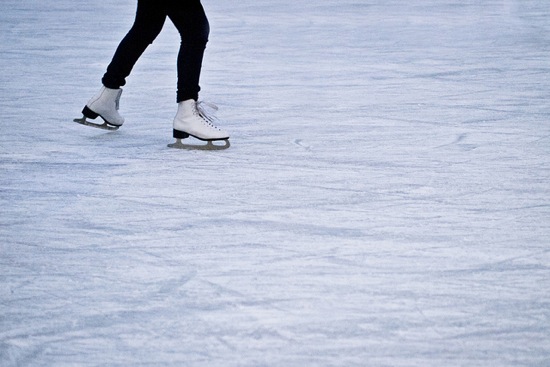
Skating, not skating, and learning to jump

Many times over the winter I almost quit figure skating.

I would go to a lesson and not practice.

I would practice and then push back an upcoming lesson.

I barely went to the rink hours for the MIT Figure Skating Club, of which I was an enthusiastic member last year and the year before.

skates

In my head, I practiced quitting, crafting the excuse, and finding something new and safer to do, like tennis, which I played in high school.

I didn’t quit, although it seemed many times — when a week or even two weeks went by without skating — that I paused.

This was after a long year of being tired. Work seemed too hard, and it was tiring. I was always pushing myself to get it done in the time expected to meet important deadlines and not to let anything drop. I had pushed myself skating, taking the test and failing it. I joined the group fitness challenge at work, and for 12 weeks in a row I met the incrementally increasing time goals. The first week it was 150 minutes. By the end of 12 weeks, we were expected to be exercising and logging 300 minutes a week. A few of those weeks, I went beyond, and exercised almost 500 minutes.

I was proud. I was tired. I felt as if I stopped I would lose ground.

During my summer vacation from teaching last year I worked as a grant writer for a nonprofit organization. I really liked the work and was successful at it. However, my life had little free time. I longed to sit on the couch and do nothing. I longed for an absence. My friend Jessie looks at this as a presence and calls it “rest.” I couldn’t. (I mean, I dreamed of rest, but the list of stuff to do called more loudly than the couch did.)

Last summer, I also took weekly skating lessons, but there was not enough time to practice in between. Yeah, I felt bad. Bad student. Not doing enough homework. But I kept going, half keeping skating alive.

I made no progress. It was like a review, remedial, over and over and over. The teacher was very nice and smart, yet I felt discouraged. I had hit the brick wall of my own ability. There is the reckoning that comes when you realize, and only adults over 40 can realize this, that it is not all onward and upward. There are limits. There may be back falls. There are ends. Continue reading

Art and method of the interview

Maura

Maura Flanagan

Recently, I published a two-part interview on ASweetLife with Maura Flanagan, a college classmate who radically changed her health habits and lost 100 pounds after a diagnosis with Type 2 diabetes. Read part one here and part two here.

These are my favorite kinds of stories to do. Interviews are akin to making one’s self a student of the subject. I ask in order to learn, and not to pruriently find out.

It takes both preparation and improvisation to conduct a good interview. As a teacher/scholar, when I’ve conducted studies on a teaching or learning question of interest, I usually incorporate an interview part. I really enjoy these kinds of engagements with people. And, whether the interview is for an online magazine or a research study, my method is similar. I describe it below, for other writers to consider as they develop their own practice as interviewers. At the end, as evidence that the method works, I quote Maura as to her experience.

Continue reading

The David Sedaris method

3882941631_b1929e63a6_mI recently read the 2013 collection of essays by David Sedaris, Let’s Explore Diabetes with Owls. It made me laugh; it made me think; and it made me write a review: link.

One of my favorite essays, which unlike many of the other essays has not been previously published in a magazine or journal, is “Day In, Day Out.” He describes his faithful practice as a diary keeper, beginning September 5, 1977 when he and his friend Ronnie were hitchhiking along the West Coast. He was mailing letters and postcards home to friends, but had no fixed address and so they could not write back to him. “And so I began writing to myself,” he reports. For a few months, he used paper place mats that he picked up at the diners they ate at. Eventually he switched to sketchbooks and “began gluing things around [the] entries: rent receipts, ticket stubs–ephemera that ultimately tell [him] much more than the writing does.” In 1979 he started typing his entries and recording details of his daily life, “writing down things that seemed worth remembering.”

Then came drug addiction (crystal meth, he says), and six diaries in a row amounted “to one jittery run-on sentence, a fever dream as humorless as it is self-important.” Re-reading the diary entries by his former drug-addicted self, he “wanted to deny him,” but couldn’t.

That’s the terrible power of a diary: it not only calls for the person you used to be but rubs your nose in him, reminding you that not all change is evolutionary. More often than not, you didn’t learn from your mistakes. You didn’t get wiser but simply older.

Since the first day of daily diary writing in 1977, he has been “consumed” by the habit. He has skipped, “on average, maybe one or two days a year.” The diary is tied to his practice as an essayist. He spends the day recording observations (e.g., “a T-shirt slogan”), overheard conversations, and thoughts (e.g., about an argument with Hugh) in a notebook, and the next morning he tries to do something with them. “Over a given six-month period,” Sedaris writes, “there may be fifty bits worth noting, and six that, with a little work, I might consider reading out loud.”

4372725422_461681d55dIn more than 35 years, he has filled more than 136 diaries, which he keeps in a locked cabinet. He has also indexed the volumes, and the index itself is 280 pages. He worries that: “I’m so busy recording life, I don’t have time to really live it.” Once, after his laptop is stolen, including eight weeks of his diary that he hadn’t backed up, he exclaims, “Two months of my life, erased!”  Hugh reminds him that he “had actually lived those two months.” It wasn’t his time that had been stolen, Hugh asserts, just the record of it. After years of diary-keeping, this was “a distinction” that Sedaris “was no longer able to recognize.”

—–
Image of notebook stack by See-ming Lee on Flickr via a creative commons license
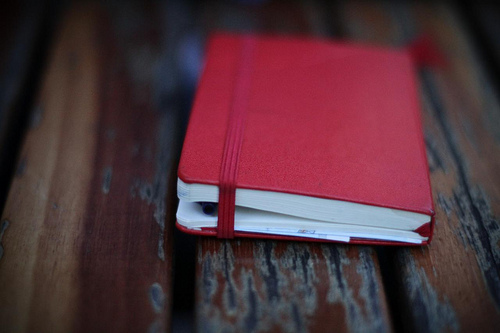
Image of red notebook by Jean-Jacques Halans on Flickr via a creative commons license


Self-directed exploration of education as a topic

On December 12, 2013, I posted this on Facebook.

Dear learners and educators,

Please think about one book you have read about education that has greatly influenced your thinking or practice or learning, and post the title of it in a comment. I’m trying to make myself a deliberate reading list. Thanks!

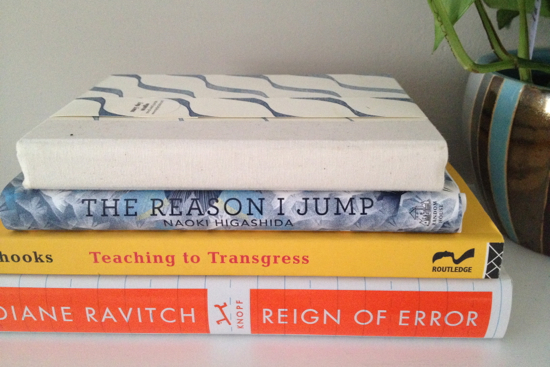
My friends, relatives, and colleagues — all of whom work in or care about education — suggested the following. Two of the titles were actually Christmas gifts to me from my daughters, Lydia and Grace, who probably saw the post on Facebook but did not at the time respond.

This is a lot of reading. I put the list below as a reminder to myself and also as a resource for others. Also for Christmas I received a handmade notebook from my son Eli. I am reserving it for making notes and reflections on this course of reading.

a few books related to education and one blank one

a few books related to education and one blank one

I begin with bell hooks and Teaching to Transgress because (a) I already own the book but have never read it and (b) new projects should begin with radical inspiration.  Here is the first paragraph from her first chapter, “Engaged Pedagogy”:

To education as the practice of freedom is a way of teaching that anyone can learn. That learning process comes easiest to those of us who teach who also believe that there is an aspect of our vocation that is sacred; who believe that our work is not merely to share information but to share in the intellectual and spiritual growth of our students. To teach in a manner that respects and cares for the souls of our students is essential if we are to provide the necessary conditions where learning can most deeply and intimately begin.

And here we go. Most of these books do not directly apply to my work as a teacher of scientific and technical communication and college students in a private research university, but it is my belief that any books on writing, education, or human development are relevant to my thinking and practice. There are 17 listed and linked. Please add your suggestion(s) in a comment.

Change-Prompting Books on Education

A Surge of Language: Teaching Poetry Day by Day, by David Capella and Baron Wormser (recommended by Meghan Cadwallader, a poet and director of admissions)

Teaching to Transgress: Education as the Practice of Freedom, by bell hooks (recommended by Sally Kokernak Millwood, trained as a social worker)

Hunger of Memory: The Education of Richard Rodriguez, by Richard Rodriguez (recommended by Karen Baloo, a pseudonym for a psychology professor)

Writing/Teaching: Essays Toward a Rhetoric of Pedagogy, by Paul Kameen (recommended by Anne Geller, a writing program director, who says she thinks all the time about Kameen’s thinking on “the difference between performing being and performing becoming” and indicates that the book is also online: link for the download)

Student Writing: Access, Regulation, Desire, by Theresa Lillis (also recommended by Anne Geller) Continue reading

Paper, thread, fabric, and glue: be still my heart

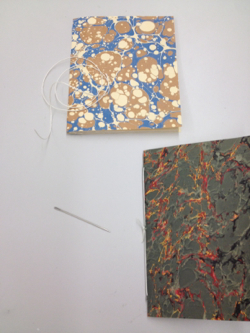
sewn pamphlets

sewn pamphlets

It’s winter break, and the MIT community offers weeks of workshops during its Independent Activities Period, or IAP. Some are brief, some occur over days, some help participants build work or academic knowledge, and many are just for fun.

This week, I went to the MIT Libraries’ introduction to bookbinding workshop. To get to the location, I followed a series of signs that began buildings away. In the library, the signs took us into the basement, through the rolling book stacks (‘wait, there’s something behind here?’), into a far corner, and finally into a room which opened into clinical brightness: the Curation and Preservation Services Lab. It was like the secret room in a secret-room dream.

The lab is a model of both warmth and order. The space is about the size of two undergraduate teaching laboratories (or, maybe equivalent to three medium classrooms hooked together). Walls are white. There are several workstations, a few bench height. There is a GIANT paper cutter, and I wish I had a photo of that — the lever was raised, and no doubt you could butcher a chicken with its guillotine blade. Over the sink, the staff had arranged its kitchen implements (e.g. a tea strainer) on the kind of peg board you’d use in a workshop. Everything I saw was in its place and clean. Pinch me.

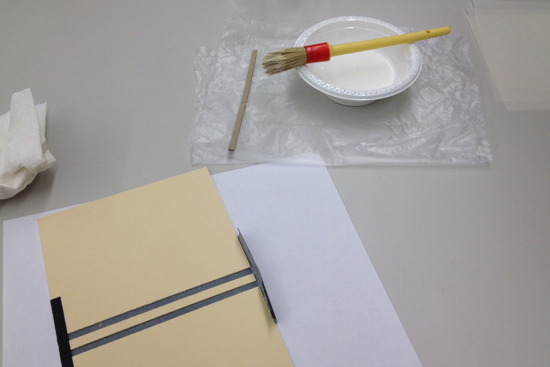
One the largest workbench was an arrangement of small rectangles of decorated papers and others of solid fabric, spools of linen thread and hanks of colored embroidery thread, and a few tools. On other workbenches were compositions of workshop supplies, one setup for each participant: paint brush, white glue, a cloth paper weight (like a bean bag), a linen wrapped brick, paper to protect the work surface, and paper to sew into a pamphlet.

first steps at making case

first steps at making the case

Some people might get excited walking into a bakery or shoe store. The array of paper and the just-so placement of supplies made this heart beat faster. I also had one of those moments of thinking: It’s so awesome to work at a university. Everything good happens here.

One librarian introduced the workshop and described the purpose of the lab. It’s a “hospital” for the library, and they do both prevention and treatment. The staff also advises on disaster preparedness and disaster response. Honestly, I instantly felt that I was ready to change my occupation. ER for books, people! Continue reading

Tidings of comfort

porch from the outside, january 3, 2014

porch from the outside, january 3, 2014

Today we put booties on the dog, bundled ourselves up, and ran around the neighborhood for 10 minutes. Every time the dog lifted his left and I saw his little penis, my crotch, which was well clothed, experienced a sympathetic chill. “Winston, you’re killing me!” I’d say when I could see he didn’t even have to go.  The cold air and wind were mostly exhilarating. It doesn’t bite when you are confident you’ll be home soon.

On cold days I wonder if the Ingalls family were ever warm in the winter, in the way that we are daily.

Once I read an article about people who live for a time at the research station in Antarctica. It’s regularly -30° F there, and even indoors they are never warm.

This morning on the phone my mother told me about a time she and my father, after we all had moved out, had lost power in a storm for about four days. They did everything they could to stay warm — putting on layers and a winter coat and getting under the covers was one method. She guessed the house had been about 50 degrees. One day they took the Sunday paper to my Aunt Elsie’s apartment in the city to stretch out the day. My cousin Joyce, who lived across the street from my parents and lost her power too, invited them over to enjoy the wood-burning stove in her family room. They had plans to sleep there when the power came back on one night around 10pm, and they went home.

The cold days remind us we’re lucky we have central heating, even though it is a commonality among everyone I know. Everyone.

Also today I’ve been reading The Invention of Comfort: Sensibilities & Design in Early Modern Britain & Early America, by John E. Crowley (Johns Hopkins UP: 2001). I picked it up while browsing in the used book area of Brookline Booksmith before Christmas. Before 18th century material comfort was in full swing, “comfort was primarily a moral term indicating personal support.” The 18th century “consumer revolution” in Britain and America “developed a culture of comfort that synthesized comfort’s new physical meaning with traditional ones of moral support.” Most notably, “satisfaction with a comfortable home became one of the most convincing ways to give meaning to consumption patterns.” Continue reading

Early winter thoughts

On the shelf over my desk at work there is a picture of me at around age 11 sitting on my parents’ bed and practicing my flute. My mother gave me this snapshot in a small lucite frame, along with some other childhood artifacts, when I turned 40.

Sometimes I look at that photograph to remind myself, “That’s me.”  My hair is long. I smile. No doubt I had the room to myself, so I could practice. This was before my father built an addition on our house, so solitude was at a premium in our small house with seven people living there.

More and more, this seems important: to look back on the self before it became adult and look for some pure thing. Even 10 years ago, I would have disparaged (in my mind) others doing this. I believed — and rationally I still know this is true — that the self is mutable and changes every day that we are alive. Today marks the day that I am who I am.

Adult life is both full of and fragmented by responsibility to others. This is especially true as a parent and amplified by being a teacher on top of it. The nurturing of the potential of others feels like where a lot of my energy and mental overhead go.

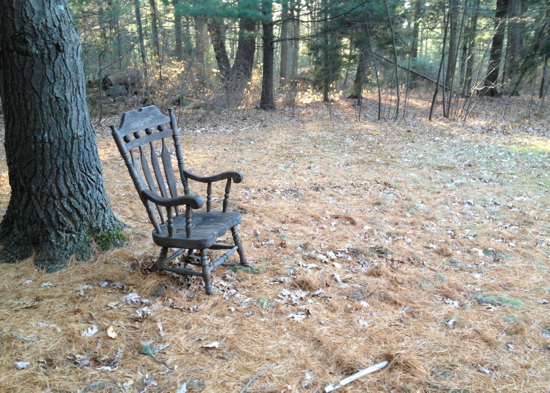
Solitary chair, Cunningham Park, Milton, 11.29.2013

Solitary chair, Cunningham Park, Milton, 11.29.2013

Not all of it goes there. In the past few or several years, my egotistical thoughts and fantasies have become more important to me, as if they are getting unburied with the pressure of time. This is probably some adult developmental stage, and if I knew more about classical psychology or if I were in therapy, I could describe myself to me in a framework.

In my own thoughts, I am like an adolescent: who I am? what will I become? what can I accomplish that is significant?

But I am an adult too, and I remind myself that my life is well underway. The horizon doesn’t shimmer so much with promise as it does with the quiet light of certainty.

Roaring self resists. I document the accepting side of my thoughts, and a lioness stirs and says, “No. It cannot all have been written yet or done.” Promise is not only for Eli, Lydia, and Grace. Promise is not only for the college students I know for a semester or two.

These thoughts have been vividly alive in the last few months because I seem to have reached some limits. Certainly, limits can be overcome or gotten around, but to some degree I am trying to talk myself into learning to live with them and thereby retreating from the challenges they present.

If I don’t run, I won’t ever feel like an inadequate runner. If I cease my skating lessons, I can satisfy myself as a recreational skater. If I content myself with being a satisfactory writing teacher, I will quiet the desire for more authority, more prominence, greater effect. If I write only for myself and my students, I may marvel at how the written word can connect one person to another.

A smaller space might be enough. I could ease into a respectable old age.

I wonder therefore if my reflections on myself as child and adolescent are a way to carve out a space for myself alone, or a self before so many responsibilities grew in my life. “What did you want, Jane?” I can ask her, and only she can answer. The thing is, did she know?

Or, did she know, but she feared to say or do it?

It’s so coy to end on a question. If a student ended an essay or a major section of a paper with a question, I would call him/her out on it. “A reader wants to know what *you* think.”

The child in me is all desire: I want everything that I have ever wanted. The adult in me, all reason: prioritize, defer, and accept limitations (your own and others’).

Continue reading

NaNoWriMo: Progress Report 2

The experiment ended, and it continues. I creep along.

4348270425_8e76a67d96In November, I wrote prose poems on 25 out of the 30 days. These are drafts, and, among them, maybe 5 are ones to work on. Whether you count 25 experiments or 5 potential poems, those are significantly more than I would have written without the special event.

My favorite writing days were when I had no more than an image to go on. Something caught my eye, I wrote it down with no anticipation of a poem I would generate, and I followed one sentence with the next. For example, one day online I saw the tagline for a crochet book: “figure-flattering crochet fashions.” It was absurd, and it stayed with me. Later that night I followed the line and wrote a character-driven prose poem.

Crocheted Sweater Vest

She dressed in figure-flattering crochet fashions of her own making. The looped stitches
were turned into squares, and squares into clothing. She imagined her vests and hats as
having an intrinsic duality: curves and edges. She was mocked at the office. Other women,
lavish in their mimicry of concern, critiqued the craftiness of crochet. It’s just not sexy.
When had sweaters become erotic objects? To Phoebe, named after the bird by her mother who had died young, a sweater was akin to grass growing on a hill or a beard
on a chin. A light coating, spongy, something that could be trampled on or gripped. It did
not ask to be taken off. But Phoebe left her sweater — rose wool, with some acrylic —
on her swivel chair overnight. She had dared herself. In the morning, it was there, the
victim of no mischief. So she balled it into the metal file drawer, locked it, and left.

[end]

Toward the end of the month, I realized that, although I preferred ending a poem on an image or action, a poem might need to go further into a question or idea. Therefore, some of the later ones (not published here) did that. I now wonder how the poem above could get beyond sweaters and self insulation. How would I change it? What  line or two would I add at the end?

I liked the daily pause and productivity so much that I will keep going but change the rules. In December, I will continue to write daily, but with no required form. The topic will be this: ANGER. I will take a crack at it — in prose, poetry, or reflection — every day.

—–
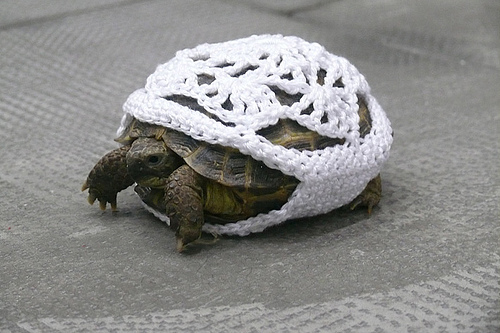
Image credit: Tortuga con jersey de ganchillo (2010), by Alícia Roselló Gené on Flickr via a Creative Commons license.