Origins of my $8 table

I like order. While I am no perfectionist, and I recognize that we live in a chaotic universe, I feel more at peace when t-shirts are folded and put away neatly and tasks are on lists.

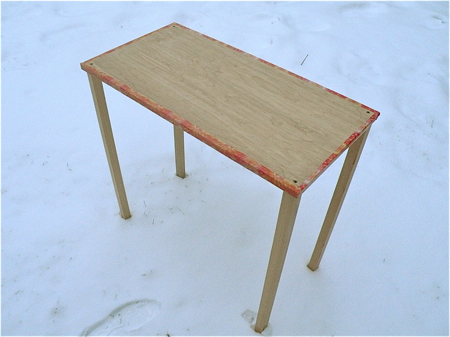
my January laundry table

Where there is no order, I enjoy imposing it. I see a mess, and my imagination starts selecting, categorizing, and straightening. When I am in a colleague’s unruly office, I must resist the temptation to say, “I could help you with this.” (What a time suck that would be.)

I like the revision part of writing as much as I like the generation part. The mental activity is not unlike cleaning out a closet. Creativity is not all right brain. Could anything ever get made without the desire to bring coherence to a wash of ideas, experience, sensations, stuff? The left brain brings shape to raw material and finds what my friend Jan calls the spine of a piece.

I often think about one creative activity when doing another: writing when gardening, for example.  Recently, I organized the laundry corner of the basement, quickly made a rudimentary table, and thought about teaching while doing both. And I didn’t just think about teaching while my hands were busy; I thought about my wonderful junior high shop teacher, Richard Bayrouty, who died in December, and the benefits of real hands-on learning.

In 1977, when I entered 7th grade, there was a policy shift in my hometown’s school system that girls could take industrial arts, or “shop,” as an elective. If I remember correctly, before 1977 all girls took home economics (cooking, sewing, laundry) and all boys took shop. That year, the policy loosened, and suddenly there was cross-registration. Boys who wanted to make and eat cookies took “home ec” with Ms. T. Girls who knew how to sew, cook, wash, and iron, as I did, took shop. My friend Lynn-Marie, who recently wrote to me that she never “caught on to home ec” and “never really liked to cook,” and I were the only two girls that year in Mr. Bayrouty’s class.

He had the best classroom. Continue reading

The continuum

Sunday night, I couldn’t sleep. I stayed up late to work, one in a long string of staying-up-late nights, and then I couldn’t let go. For two hours I lay in bed and ruminated over the papers I had stayed up to review. Not wanting to fret about insomnia (which only exacerbates insomnia), I occasionally said to myself, “It’s okay. At least I’m resting my body.”

At 3am, I moved to the couch. I noticed the many ways the lights from the street made their way into the room. I bunched a feather pillow under my head and replayed a couple of weeks of work in my head. And then I thought about the weeks ahead. In no way was I worried or panicking. It was simply as though my brain continued to develop and work on problems even as my body lay there immobile.

At 4:30am, with the same loop of images still playing in my head, I thought to myself: “I am mentally ill.” No, really.  It occurred to me that this is what people mean by obsessive thoughts. Leave it to me to have them about drafts, and colleagues, and presentations, and this student and that one, and even that pile of folders on my desk that I keep meaning to put in the shredder bin.

“Ah, no. Not mentally ill,” I thought. “Just fucked up.” I did have enough awareness to step outside myself a bit, look at my thoughts, and recognize how unproductive they are. I wasn’t able to quiet them, but I could reality-test them.

Years ago, my friend Betsy told me and our small circle of friends about the mentally ill/fucked up continuum. This is not unlike the sexuality continuum, although M.I. and F.U. have nothing to do with a person’s sexual identity. Essentially, we are each of us M.I. or F.U., and there are gradations between. Continue reading

The case for coffee

In 1992, during a hospital stay after my diagnosis with diabetes, I was faced for the first time with a meal that, at that time, was institutionally considered nutritious: undressed turkey, steamed vegetables, a boiled potato, diet Jello. No salt, no butter, no sweets. Worst of all: no caffeine in the coffee.

Feeling all hope bleed out of me, I implored the dietician, “Could I just have one cup of real coffee? One?” (Insulin, I could deal with. But a life with no coffee?)

“Honey, have as much coffee as you like,” she said, to my great relief. “Everyone needs a vice, and this is not such a bad one.”

That’s become almost a mantra for me, and I’ve embraced coffee like a maniac. Turns out, though, it may be less a vice than a health virtue*:

  • People who drink 1-2 cups of coffee a day had an elasticity of major blood vessels around 25% higher than those who drink little or no coffee
  • Compared to not drinking coffee, at least 2 cups daily can translate to a 25% reduced risk of colon cancer, an 80% drop in liver cirrhosis risk, and nearly half the risk of gallstones
  • At least six studies indicate that people who drink coffee on a regular basis are up to 80% less likely to develop Parkinson’s disease
  • A study published in the journal Circulation looked at data on more than 83,000 women older than 24. It showed that those who drank 2 to 3 cups of coffee/day had a 19% lower risk of stroke than those who drank almost none. A Finnish study found similar results for men
*Data are from GeekStats (search term: coffee).

So now I might be looking for a new vice, one that tastes as good.

—–
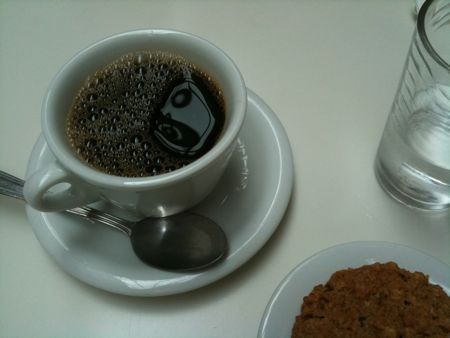
Picture-perfect coffee drunk by me at b espresso, Toronto, in August 2010.

Plunge into illness

My short essay, “Diabetes Diagnosis, Before and After,” appears today in ASweetLife. Link.

Excerpt:

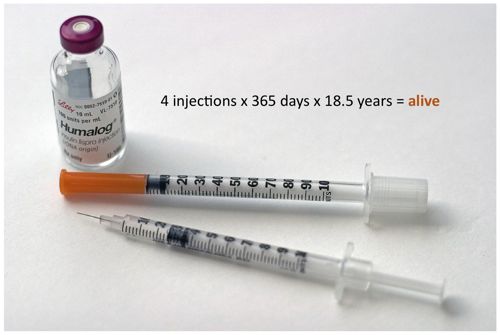
More than 18 years have passed since my diagnosis day; in that time, I’ve injected or bolused insulin at least 26,280 times, and never mind how many units. I’ve pricked my finger and tested my blood almost 40,000 times and counted and eaten more than 900,000 grams of carbohydrates. There have been many moments when the immensity of my task has been so overwhelming that I have stood at my kitchen counter with a syringe or insertion set poised in my uncooperative hand and said to myself, “Jane, just do this one.”

—–

Image of syringes & insulin by DeathByBokeh at Flickr via Creative Commons.

Scourge of the season

We are well into summer, so it must be time for a head lice outbreak. More and more people searching for “head lice” and “lice treatments” and “nitpicker” and so on have found their way to my blog recently because I have commented on this topic before. And WBUR recently did a story on the parasites.

While lice, at first, are appalling, they are not so disgusting after you get used to them. I describe my fascination with head lice, and the physical closeness they prompted between me and Eli, Lydia, and Grace, in my researched essay “Little Creatures,” which was originally published in P•M•S poemmemoirstory 9. Here’s a taste:

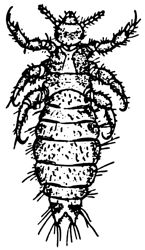
I dip the fine-toothed louse comb into a container of burning hot water and swirl. Captured ones float for a few moments before sinking. The lice are dark enough in the container of water that I can count them. Occasionally the count seems not to add up so I hold the comb up near my eyes to look for bodies trapped like seeds in human teeth and find them there, suspended sideways between the plastic teeth. Their lash-like legs, scurrying in air, seem always to move in this workmanlike way, regardless of footing, unable to take me in as a threat, not afraid of me as a predator in the way that mice are afraid. I make my thumb and forefinger into pliers and close over the head and tail of each and drag it down the space between tines. I feel the substance, like nut meat, and I imagine eating them. I do this enough times so I think always of eating them when they are pinched in my fingers like this. It would be so easy to eat them that I feel drawn to doing it in the way I feel drawn to letting my body go over the barrier at the edge of the falls or on the upper level of an open air parking garage. It’s that close.

I do not eat them. It’s not something that I would do.

—–

Image credit: wikimedia commons.

– What I am thinking about this week

Lee did not ask me or anyone to follow him in writing, but I read his post, and what can I do but be prompted?

Thoughts, especially written-down ones, propagate thoughts. That is one thing I am thinking about right now.

Today in the grocery store I stood in line near an old, yet very well groomed woman. She was tiny and precise: short, thin all over, ironed black shorts and ironed white summer blouse, black framed sunglasses proportioned for her face, short hairdo the color of dried grass with a little pink to it. She paid by check. “I don’t do bank cards,” she said to the clerk. It’s a family-owned grocery store, and they accomodate habits like these. In her cart she had two of many things: two boneless chicken breasts, two russet potatoes, two yogurts. I looked at her left hand, which was bony and veined of course, and she wore two or three bands on the ring finger, one heavy with stones. Her hand seemed to droop, perhaps simply from that fatigue that strikes us all at 4:30pm, but the view of those rings and all the food twins in her cart put this phrase in my head: heavily married.

Revision is an open wound. As long as a piece or project is underway and unfinished, it is susceptible to every influence that comes near it. That’s good, but also hard to experience, and manage. On this, I will have more to say in the future. Continue reading

– Validation

It takes more strength to go slowly.

Said today by yoga teacher Portia. The remark had something to do with the lowering and raising of our legs, but it seemed personally applicable. Like, it’s okay that I can be a slowpoke (in writing, thinking, cooking, reacting, painting, responding, folding, driving, etc.). And that slowness might come from strength, and not a deficit.

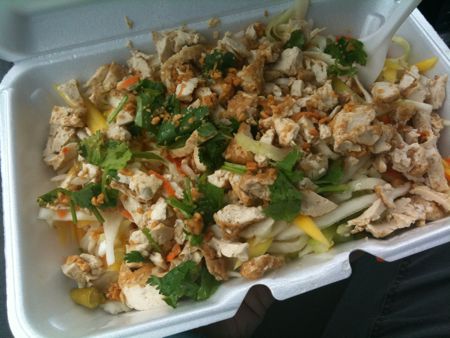
After yoga, there was no Clover Food Truck to get my usual, so I stood in line at Goosebeary’s Food Truck instead. I ate the Mango Salad with Tofu, not quickly. Vegetarian food can be heavenly too, you know.

– Little bursts

During one sustained yoga pose (downward dog), I looked at my hands, fingers splayed on the mat. Wow, I thought. Look at you. I acknowledged them for 45 years of work. No appliance could do what they’ve done and still be so capable.

Later, lying on my back, with my legs straight and feet in the air, I looked at my bare knees and calves, and I liked them. Marvels.

My regular habit, after Wednesday yoga, is to go to the Clover Food Truck on Carleton Street and get a soy BLT, my discovery of the spring. At $5, it’s a perfect food.
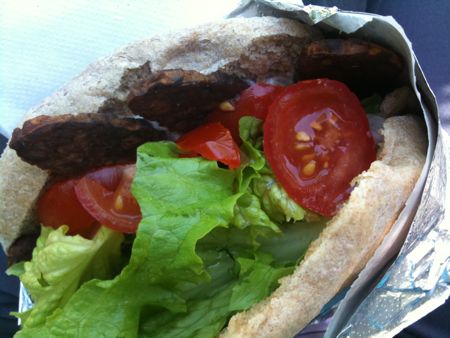
Today I sat on a bench next to the parking lot, half in the sun and half out, and ate it. On the bench perpendicular to mine, a young woman and man talked about happiness, and all the pressures in the way of it. She said to him: “There are too many choices. And having to choose work you love, or a person you love, is overwhelming. I read that people are less happy when they know there is other work, or someone else out there.” He said to her: “I said to my therapist that, among all my options, the least disagreeable to me is dentistry.”

One pigeon walked on the cement pavers near my feet. Of course, pigeons do not fear us. It came closer and seemed to stand there, turning and waiting. I looked at its three-clawed feet and stick legs. Do you know they’re pink? A dark rose. The feathers are less gray than a dusky purple, with shimmers of green around the neck.

In Olive Kitteridge by Elizabeth Strout, on the occasion of her son’s wedding Olive thinks about what she knows of loneliness and ruminates, too, on its antidote:

Olive’s private view is that life depends on what she thinks of as “big bursts” and “little bursts.” Big bursts are things like marriage or children, intimacies that keep you afloat, but these big bursts hold dangerous, unseen currents. Which is why you need the little bursts as well: a friendly clerk at Bradlee’s, let’s say, or the waitress at Dunkin’ Donuts who knows how you like your coffee.

Or a sandwich from a truck.

On the way home, I stopped the car for a few seconds where Ames Street joins Memorial Drive. A few pedestrians passed in front of me, which made me turn my head to follow them. I saw a woman holding a toddler, still awake but slumped in her arms, the child’s head lolling on the mother’s shoulder. I remembered the slack weight of a baby against my chest: that closeness, that power. The child held out her own hand and looked at it, turning it palm down, then palm up. She closed her fingers into a little fist and looked at that, too. There was no haste in her movements. She could stare at that hand and turn it over and over, forever.
– Bleach kills bacteria.

“bleach kills bacteria”: that’s what I Googled before taking Boston.com’s advice on sanitizing our clean dishes during the MWRA/Boston area water emergency that began Saturday, May 1 at 6:40pm. I found out that, indeed, bleach kills bacteria quite reliably. And seeing that we’re bathing and washing our dishes too in pond water right now (from back up supplied by the Chesnut Hill Reservoir, a kind of local goose haven), it’s possible there are some robust organisms hanging around the kitchen sink that wouldn’t mind finding a human host.

Here I am, demonstrating the dish sanitizing procedure. Take that, E. coli. You’re not welcome here no more.

Will the bleach solution also clobber the water-born parasite Giardia? I hope so, yet I am not as sure. <gulp>

—-

Update (May 3 afternoon): Since making and posting this video, I have discovered, or been pointed to, various advice for sanitizing dishes after washing them. I’ll summarize:

  • Boston.com recommends using 1/8 t. per gallon H2O and specifies no length of time for the dishes’ submersion in the bleach solution.
  • The MWRA “Consumer Fact Sheet” recommends using 1 t. bleach per gallon H2O and specifies 1 min. for the dishes’ submersion in the bleach solution.
  • Interestingly, earlier on the Massachusetts Department of Environmental Protection site, there was a recommendation to use 1 t. bleach per gallon H2O and a 5 min. submersion time, as a reader (Jeremy) alerted me to. I found that link again, and discovered that information has been changed, to be consistent with the MWRA’s advice. That’s good: a unified message from the government bodies safeguarding our health!

The winning method, therefore, for sanitizing clean dishes, during the boil order, is: 1 t. bleach per 1 gallon lukewarm water for 1 min. submersion.

—-

P.S. Thanks to Jimmy Guterman for videography, and for remembering the boiling point of water: 100° C or 212° F.