– Grades beep, rattle, and hum.

But grades don’t speak.

It’s report card week in Brookline, and as usual we got a heads-up e-mail from the high school headmaster, prodding us to ask our sons and daughters to hand over their quarterly assessment. “The report card is an important school communication,” he concluded.

One thing every parent of a high schooler knows is how little communication there is between home and school, especially compared to the mountain of notices, bulletins, and newsletters that come our way during the K – 8 years, not to mention the PTO breakfasts and principal’s coffees and “special” events. (For the record: I do like parent/teacher conferences.) Eli is a junior in high school, and I met his teachers once at an open house event. Yes, I had a nice and helpful conversation with a few of them. However, that and a few visits Jimmy made to similar open houses constitute the extent of home/school communication in the last three years. I’m generally okay with that, but I am not okay with grades standing in for communication.

Grades might be aggregated data, and they might even be signals, but, because they lack (a) teachers’ interpretation and (b) opportunity for direct feedback, they cannot be communication. Continue reading
– Fragile, dear, and broken

Sometimes, in one of my little fantasy conversations, I imagine saying to the phantom I’m talking to, “I am not a person who breaks things.” I imagine saying this not as a boast but as a deeply held commitment, a promise to myself: I will take care, I will not break. And when I say “things,” I mean everything that can be broken, like dishes, and promises and hearts, too.

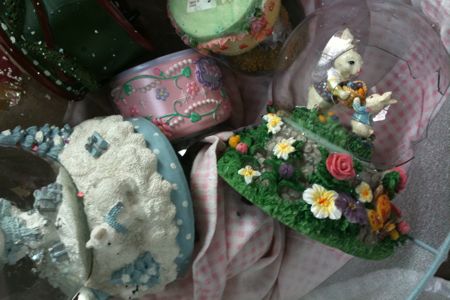
But, of course, I am occasionally a clumsy animal, and I break things. Two hours ago, for example, I broke two snow globes.  This made my daughter cry.

We were on our way to school. Lydia was riding shotgun, and Grace was in the back seat with her backpack, music bag, and a mysterious bundle wrapped in a fleece baby blanket. After I stopped the car in the drop-off line of other cars in front of the school, I reached into the back seat and tried to push this swaddled bundle closer to Grace, who was outside the car now and trying to figure out how to carry everything.

The bundle slipped off the seat onto the floor. I heard a little grind. Grace burst into tears. “You broke them, you broke them, you broke them!” Continue reading

– Girls around Jamaica Pond

Grace and I dropped Lydia off downtown at her rehearsal and then drove back through Roxbury and Jamaica Plain, the sun in my eyes the whole time.

On Perkins Street, as we approached Jamaica Pond, Grace said, “Let’s stop here and walk around.”

I, thinking selfishly of afternoon coffee, tried to reason her out of this impulse: “We don’t have hats. Our heads will get cold.”

Grace was undeterred. “Look at all this hair. Our heads will be warm enough.”

Try again. “I have gloves, but you don’t.”

“Mom, look at all the gloves on the floor back here. And a scarf.”

I parked the car; we tiptoed down the snowy slope to the path. It was 4:30 in the afternoon and already the snow was taking on the blue of the air, and the trees were as dark as espresso against the sky and frozen pond. I persuaded Grace to stand near the shore and get her picture taken. As I posed her this way and that way, I spotted in my peripheral vision some walkers coming down the path to my left, and I heard a woman’s voice chirp, “Taking a picture!”

There must have been something in her voice that invited me, because, without stopping to think or ask permission, I turned and said, “And now I’m taking a picture of you!” I snapped the woman and her companions.

Linked up, Jamaica Pond, 1.7.2010

The three of them looked over my shoulder as Miranda, the woman with the scarf and sunglasses, dictated her e-mail address to me. Whoosh, I sent the photo to this stranger. Continue reading

– Pucker up, baby

Grace and I are sitting at my parents’ dining room table, eating cheese and crackers. Grace is also, as usual, writing on a notepad.

“Mom, I have a question,” she says.

“What?” I reply hesitantly, expecting the unanswerable.

“What do you do when life gives you lemons?”

Oh, that old one? I think. I say, instead, “Make lemonade.”

“Nope.” Grace rolls her eyes at my obvious answer. “You pucker.”

And, indeed, you do.

– Explicit lessons

Eli, at the dinner table, asked us if there were any “explicit lessons” we had taught him. He couldn’t think of any.

“Uh, what do you mean?” I asked.

He gave an example: “My friend’s parents taught him you should always walk a girl to the door.”

Hmm. Well, that is not anything I or Jimmy had ever thought to make explicit. I do recall, from my own youth, that my parents thought this was a good thing: boys should make sure girls get home safely — and that means to the front door, and into it. (And who makes sure that boys get home safely?) Yet, I have failed to pass this along.

“What about a message like ‘Be kind’?” I suggested.

Apparently, that doesn’t count.

“Turn off the lights when you leave a room?”

Nope.

“Brush your teeth? Get a good night’s sleep?”

No and no.

Eli did not seem to mind that we couldn’t come up with anything. “Basically, I think I know a lot of stuff and you didn’t have to teach it to me.” He said something like this, in so many words, and added that he was able to think through, on his own, a lot of situations and dilemmas he encountered.

Wonderful, his mind is at ease. However, mine has not been. I’ve been mentally backtracking through Eli’s 17 years on the planet (and Lydia’s 13 and Grace’s 9), looking for moments when I have communicated an explicit lesson or made a parental speech.

I have thought of only four items for what must be a rather skimpy guide to life. Here they are. Continue reading

– Chaperone

No adults allowed

Sign at playground, Golden Gate Park, San Francisco, 10.11.2009

Haight Street in San Francisco is just one long strip of shops and cafés. In America, we seem to put more energy into commercial diversity than we do into the human kind.

Along the strip, Lydia and Grace pulled me into store after store. They did not need to use physical force, like the hand yank or the extreme whine. I had already capitulated to an hour or two of shopping. If you know me, you know that’s a generous act: I dislike shopping, especially shopping without aim.

The clothing in the stores skewed to the young, or the “young at heart.” I’m neither young nor old at heart, yet in years and body I am smack between the two poles.

In one store, called X-Generation, while I waited for the girls to hunt and try on, I  wended my way through spaces between circular racks and looked at hats, scarves, and purses. The little dresses and tshirts were too skimpy for me, but hats — those are ageless, right? I tried one on, then another. I liked them, and even more importantly, they fit. I have a big Kokernak head bone, and it’s hard to find a woman’s hat sized for my head.

I turned to Grace, to Lydia, and asked, “Do you like my hat?” Both answered wordlessly, with lifted eyebrows or rolled eyeballs. I put the hat back on its hook, chastened. Continue reading

– Cupcakes and life

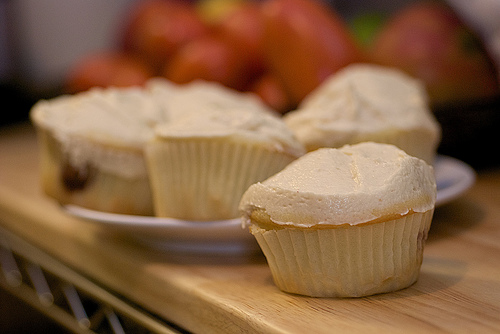
CupcakesAt 9:40pm, Jimmy is folding laundry and playing dj. It’s Prince: “I Would Die 4 U,” “Raspberry Beret,” and “When Doves Cry.” Eli is out. I am putting away my sorted clothes, and Lydia and Grace are hanging out with us. As usual, the children introduce conversational threads out of nowhere.

Lydia:  When we go to New York, can we go to Magnolia Bakery?

Jane:  Why?

Lydia: Because they mention it in “Lazy Sunday,” and Andy Samberg loves their cupcakes.

Jane: Lydia, it’s only a cupcake.

Lydia: Mom, life is short —

Grace: — in a long way.

*

—–

Cupcakes image is from B Tal’s photostream on Flickr. I worked with B Tal, that is, Brian Talbot, at Simmons College, and I once had the opportunity to have one of his peanut butter and jelly cupcakes. They were so great I had to get the recipe, and I have made them for the kids, who have dubbed these THE BEST CUPCAKES EVER. (Who cares about Magnolia?) You can make them, too, by following the recipe that appears under the photo on his Flickr page. Two tips from me — use only 1/3 or so cup of milk in the frosting recipe, and either make a double batch of the cupcakes or a half batch of the frosting, because the frosting recipe, as is, makes too much for the 12 cupcakes indicated. And refrigerate them: like a lot of cake and frosting combos, they are delicious cold.

– Incomprehensible

EconomistJune13CoverThe June 13th issue of The Economist is on the kitchen table, and Grace, who loves magazine covers, is examining it. I’m puttering around the kitchen. She asks, finally, “What does it mean?” So I lean over her shoulder and take a stab at explaining the visual metaphor: “Right now, the world is experiencing huge financial problems, created by people who are adults now. However, the problems are so huge that it may take 30 or so years to solve them, and the people who will be most burdened by these money problems are babies now.”

Grace responds, “I still don’t get it.”

Jimmy has entered the kitchen and offers a more concise explanation than mine: “The world is in debt right now, and the people who caused the debt are Mom and my generation and the Baby Boomers’ generation. However, the people who are going to pay for this debt are babies and children right now, like you.”

Grace looks again at the cover. “I still don’t understand.”

Honey, you shouldn’t have to, I want to say, but there is nothing more to say, because she is only nine years old.

– Mother/daughter moments

1.

Our upstairs bathroom, early in the day. Jane leans over sink, face close to mirror. Lydia stands nearby.

Lydia: Since when did you wear mascara?

Jane: Since Adam’s Bar Mitzvah.

Lydia rolls her eyes as a first response. Jane keeps doing what she’s doing.

Lydia: Um, why?

Jane: So I look more alert.

Lydia widens her eyes, narrows them, and breathes out loudly. She exits.

2.

Two chairs in a waiting room, late afternoon. Jane and Lydia leaf through old copies of People and Prevention.

Jane: Aren’t you glad your mother doesn’t dye her hair in three shades? She points at a picture on a magazine cover.

Lydia: Who’s that?

Jane: Wynonna Judd.

Lydia (looks at Jane, looks at picture, looks at Jane): Oh, yeah.

– More or less functional

bicycleMany years ago, some Kokernak family conversation was being had, and this exchange between my father and my sister Emily occurred:

Dad: Do you think our family is dysfunctional?

Emily: Well… it’s more or less functional.

I don’t remember which function was the topic of concern (perhaps all the times my father threatened, when we were misbehaving in the car, to pull over and make us run alongside?) or if that’s exactly what Emily said (perhaps she said, “Like most families, we’re more or less functional.”) or even if I was there (perhaps I was only told of this exchange, and my imagination promptly filmed it and added it to the memory storehouse). However, I have long considered Em’s comment brilliant.

And two days ago her comment returned to me, when I realized suddenly how it applies to my family, the one I live with. Continue reading